Part 1 of my trip to Sabah in March 2026, and the start of the “Festival of Ian”
In case you were wondering what became of me when it all kicked off in the Middle East, no, I was not in Abu Dhabi. I happened to be in the Bornean jungle on a birding trip with Steve Young, Jon Porter and Duncan Orr-Ewing. I had been to Borneo twice before, on both occasions shortish trips (to Kinabatangan and Sepilok) that yielded some excellent birding and wildlife. I wrote a report of my first trip in 2014 here, and then blogged about my trip with Erica in 2019 here (and here). Although those trips were fantastic tasters, I had missed many desirable species, and when JP and Steve agreed to go on a trip for nearly 4 weeks to grip back those sightings and otherwise “clean up”, I knew I would regret it, and be gripped off forever, if I did not accept their invitation to join. This was therefore a primarily defensive operation on my part 😜. But the fact that in 2026 I have a birthday ending in zero (as does Steve) added to the justification and made the permissions easier.
Unfortunately I could not afford the full amount of leave needed for the entire trip that they had planned through BirdTour Asia, which would start with a week in Sarawak. The targets there looked less inviting, so I arranged with BTA and the team to arrive once they returned to Sabah, meeting the team at Trusmadi, the sight of a very well equipped hide, and likely sightings of a few special birds.
After a flight to KL from Abu Dhabi, and a connection from KL to Kota Kinabalu, I was met by a pre-arranged driver who whisked me up the steep roads into the mountains behind KK where we would spend the next 6 nights.
Within an hour of me arriving and settling into my basic but pleasant room in the village of Tambunan, a minibus arrived bearing the hulking frames and smiling unshaven faces of Steve and JP, along with our guide, Azmil Pilantong. At first, when I found out that our guide would not be one oft the better-known BTA guides I was disappointed, but it did not take long before this was dispelled by admiration and respect for Azmil and gratitude to BTA for their choice of guide. Azmil proved to be one of the best local guides I have ever had the pleasure of birding with, and a thoroughly nice chap to boot. He was even able to sustain a solid pace and concentration despite observing Ramadan very strictly, not even drinking water during the day despite the heat and humid conditions of much of our birding. Chapeau, Azmil!!

Steve and JP (and of course Azmil and our driver Ray) had spent most of the day on rough roads, winding their way slowly through Sarawak and into Sabah over more than 7 hours. They had wisely acquired a slab of Carlsberg en route to the hotel, and, as night fell, we got the restaurant to set up an impromptu table outside and place a few beers in the icebox. No indoor drinking, and and no fridges here! As the beers chilled, they proceeded to grip me off with tales and pictures of Hose’s Broadbill, Dulit Frogmouth, Blue-banded Pitta, and Crested Jayshrike — top targets for me, and apart from the frogmouth, not ones that I had realised would be more readily available in Sarawak. Reflecting on my decision to join late, I remained comfortable in the knowledge that at least the latter two of these were almost nailed on certainties later in Sabah (or so I thought). For Jon and Steve, it had been tough hiking and camping conditions, but they had been rewarded for their efforts, and got the toughest part of the tour done and dusted. Like our trip together in West Papua 6 years ago, the level of accommodation would steadily improve throughout.
18 Feb
Our first full day was spent almost entirely in the main Trusmadi Hide. This is a super-professional setup, designed for visiting birder and photographers, with a “sympathetically” cleared area into which various iconic species are attracted by grain and mealworms laid out by the owners each day. Tea and coffee making facilities, a stove, and CCTV are in the hide and there is even a small prayer room that Azmil was able to use when the time was right. The team brought us coffee, breakfast and even lunch at suitable quiet moments. If they had just provided a potty as well we could have avoided moving all day. Instead my near-60-year old bladder required prizing myself from the windows to use the flushing toilet just up the path, hoping that nothing good turned up while I was gone.


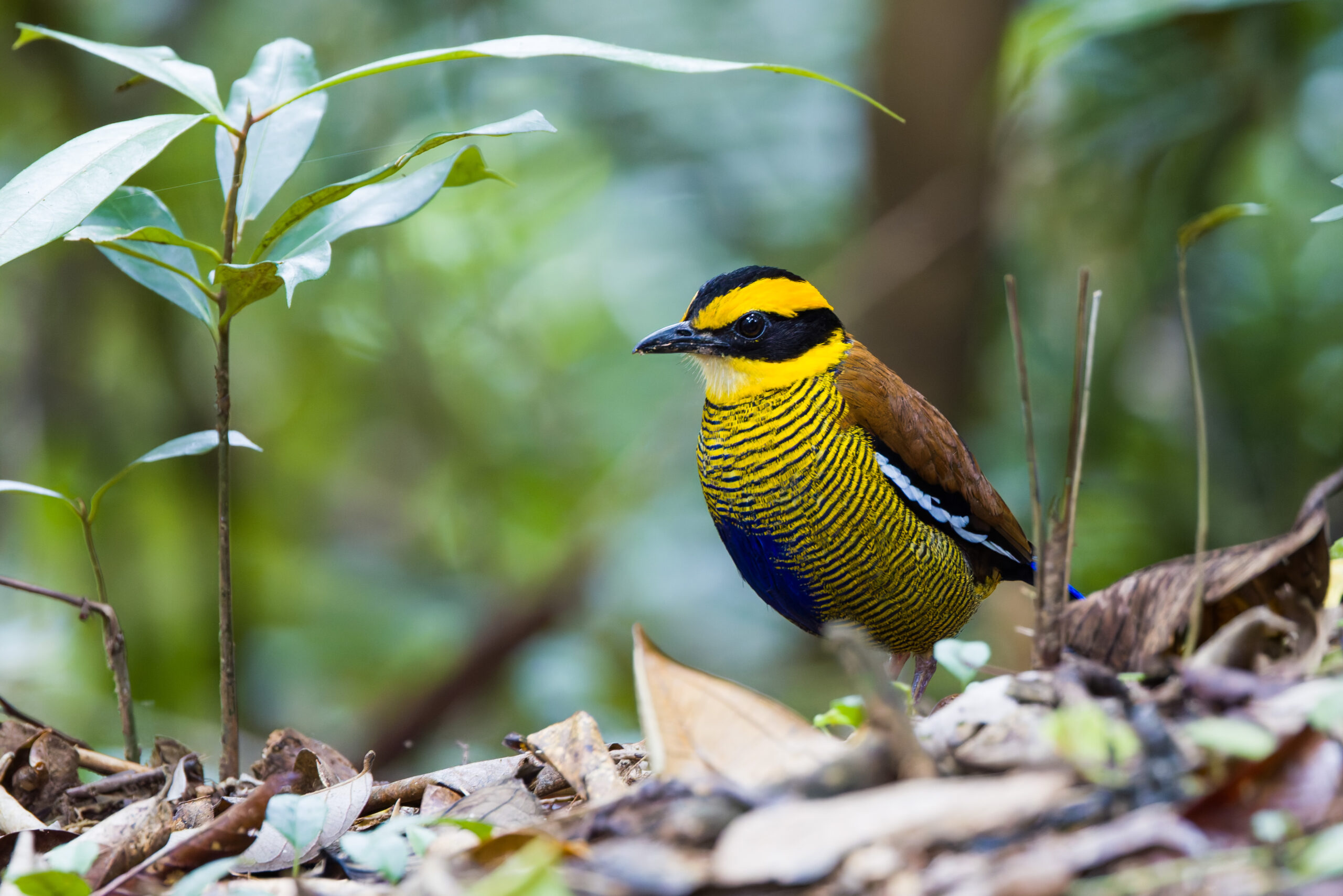
A board on the roadside proudly proclaims “Over 20 species” which doesn’t seem that great until you see which species. Throughout the morning we had visits from most of these, including my bird-of-the-day and one of my very top targets for the entire trip, endemic Bornean Banded Pitta. At least one male bird made multiple visits to the hide.


Other amazing quality included Orange-headed Thrush, Rufous-chested Flycatcher, Crested and Red-breasted Partridge, Siberian Blue Robin, Chestnut-hooded Laughingthrush. The latter two birds were non-lifers: my first (and only previous) encounter with SBR was in Thailand, while the Laughingthrush, a Bornean endemic, I had photographed from the window of the lodge in which Erica and I stayed the night before climbing Mt Kinabalu in 2019. It was the only bird I noted on the mountain back then, as I walked light (no optics) and concentrated on the path in front and, occasionally, the incredible views.


White-crowned Shama, endangered because their beautiful song makes them a target for the caged-bird trade, were also regular visitors. Any time it was quiet one or two would lob up and, grab tasty treat (mealworm!) from a log and sing a few bars. I also had my first encounters for the trip with some of the commoner birds that Steve and JP already had UTB, such as Bornean Whistler, White-throated Fantail, and Dyak Blue Flycatcher (a family of 4 visited throughout the day). Bulbuls are generally not the most interesting family. We had two: Yellow Bellied and Penan. The latter is a Bornean endemic, a lifer for me, and quite funky with a loud, intrusive (but not untuneful) song, red eye, wispy crest and a glowing white beard.
Grey-hooded and Temmick’s Babblers, often hard to see as they skulk in trackside vegetation, were out in the open on the logs, pecking away at mealworms in crevices. Same with Asian Emerald Dove. A Sunda Scimitar-babbler put in an early appearance when it was still too dark for photography, and unlike almost every other species, did not return later. Mid morning a drawn-out single note might have been either Blue-banded Pitta or Rail-babbler, species which sound very similar apart from a difference of less than half an octave in frequency. We double-checked and realised this was a Rail-babbler, another superb bird, but one which Steve and JP had had as their bird-of-the-trip so far in Sarawak, and which I had seen a couple of times in Panti Forest in Peninsula Malaysia (see report).


Sitting in the hide with a very stable platform allowed great photo opportunities. When I first started using the R5 mark ii, after using the R6 (mark i) for several years, I was a little disappointed with the low light performance, However here, with time to experiment, I realised that my best settings for the conditions were not low ISO, low shutter-speed, as my instinct and previous experience suggested, but high ISO (6400 or even 12800). Even at these levels I could get acceptable noise by setting my shutter-speed at 1/500s or 1/640s, then cranking up the ISO until I was exposing to the right. This resulted in a lot more keepers — maybe even too many keepers — than on the low ISO, low SS setting, for which any bird motion causes a loss of sharpness.
The afternoon was inevitably a bit slower, but there was still a steady trickle of visitors and we persisted because one key species — for many (incuding us) the potential star of the show and the reason to come to Trusmadi — had yet to make an appearance. Sadly we waited all day for Bulwer’s Pheasant without luck. The only new bird added in the afternoon was the somewhat drab White-bellied Erpornis.
Back at the hotel Azmil told us that a Bulwer’s had been seen at the second Trusmadi hide at 9am. We were deliberately staying in the area two nights for just this eventuality and we would go there as a priority tomorrow morning, fingers crossed!
19 Feb
Naturally our first port of call this morning was Trusmadi Hide #2 (on ebird, referred to as the CP Song hide), just up the road, and on the opposite side to Hide #1. The setup here was much more basic, and the “stage” area in front of it more open and less sympathetically designed. From 6am we sat and watched. Azmil drew our attention to Bare-headed Laughingthrushes calling invisibly over our heads, but we daren’t move from our stations (apart from the inevitable piss-break to relieve aching, ageing bladders).
There were a birds to keep us amused, but fewer and lower diversity than yesterday: a pair of Crested Partridge emerged very early to get first dibs on the grain that had been distributed by torch-light; Temmick’s Babbler; Dayak Blue Flycatcher; Penan Bulbul; female Rufous-chested Flycatcher; a scruffy young male Siberian Blue Robin. The only new bird was a cracking Black-capped Babbler, that JP found picking its way along the back of the “stage”.


As it usually does on these stake-outs, especially when you are in last-roll-of-the-dice territory, the tension rose over the next hour. Not long after Steve and I had returned from our comfort break, Azmil whispered across the line: “it’s coming”. He pointed high up the slope to our right, and sure enough we were able to notice the slow movement, occasional glimpses of white as our quarry picked its way down through the steep jungle. When the Bulwer’s Pheasant finally did emerge it was magnificent. A bright blue wattled covers it face, its body is burgundy on the breast blending to deep blue, speckled with stardust on the wings and upper body. And an incredible, pure white tail. JP went with “preposterous”! And Steve was even more thesaural with “audacious” — having such a bold advertisement, a massive white flag dangling from its arse, in an environment where camouflage is de-rigeur. Despite its gaudy appearance, until the Trusmadi hides were able to attract them, this was an almost mythical creature, very rarely seen by anyone, let alone visiting birders.


It hung about in the open for about 15 minutes, eating grain seemingly unperturbed by being completely exposed in the clearing. But then it slunk back into the undergrowth just before a group from Hide #1 arrived, having had the news relayed to them by locals. It was probably the minor commotion of their arrival that alerted it. As it hovered nervously, mostly out of view, JP tried valiantly to help them get on it, but they rudely ignored his help, much to his disgust! After what seemed an age it moved back into view and the late punters were now able to enjoy the kind of view we had had earlier. We quietly left them with the bird and retreated to the car for breakfast.
As we munched away at our packed meals we noted the following: Mountain Imperial Pigeon; Banded Woodpecker; Black-and-Crimson Oriole; Ashy Drongo; Bornean Treepie; Chestnut-crested Yuhina; but unfortunately the Bare-headed Laughingthrushes had not hung around. We carried on up the road to Mount Trusmadi into the Trusmadi Forest Reserve beyond the Kupu-kupu Gate. We explored a side trail on foot, then spent some time hanging around the gate.


The birding was slow, but we added a few new species, though nothing special: more Chestnut-hooded Laughingthrush, our first Sunda Laughingthrush (though no BHLT), Little Cuckoo-dove, Pale-faced Bulbul, Bornean Barbet, Mountain Barbet, Bornean Leafbird.


Hide #2 list; Trusmadi Forest Reserve list 1; Trusmadi Forest Reserve list 2 ; Kupu-kupu Gate
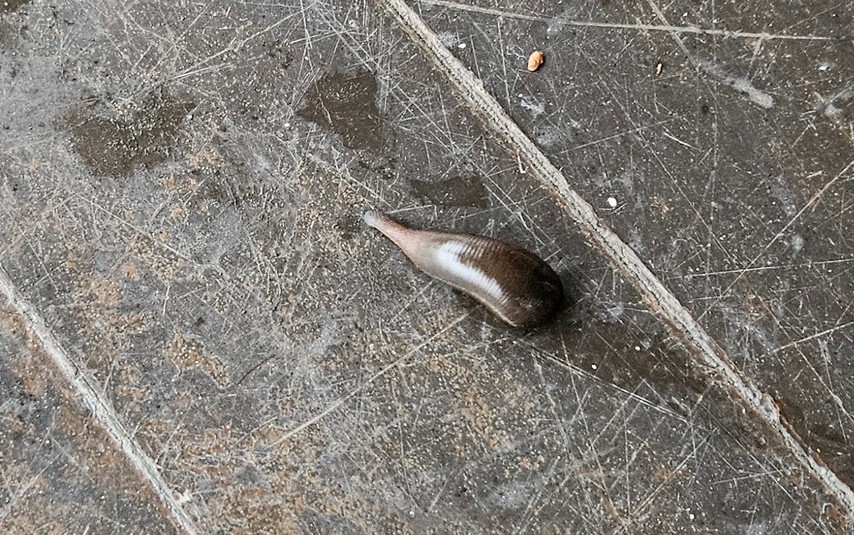
En route to Mt Kinabalu through the winding mountain roads, we called in at Gunung Alab Restaurant & Motel area. We would not have much time at all to explore the area (there seems to be a hide here, even) — this was just a brief diversion up into a forested area to a spot that clearly Azmil knew well. We pulled up near a culvert and Azmil placed some mealworms on a mossy rock. Within seconds a Snowy-browed Flycatcher had appeared, then an Eyebrowed Jungle-flycatcher. We hoped for Bornean Shortwing but it was not to be, and we would have to wait for a few days. Two hours later we rocked up to Kinabalu Pines Resort, where the laconic smile and banter of Duncan Orr-Ewing was there to greet us, having arrived a few hours earlier. Given the hour, there might have been time for some birding before dark, but it had started to rain during the last 30min of our drive and there was little point in heading out into the damp and gloom. We gathered om the decks of our basic but comfortable rooms (Steve and I sharing one, Duncs and JP the other) to start the banter and unwind. As I pulled my trousers off a lump dropped to the ground and I realised I had been feeding our first leech of the campaign.
We adjourned soon after to the bar and restaurant where beers and a cracking Chinese/Malay meal beckoned.
