The final leg of my Borneo/Sabah birding trip was to the very plush and very famous Borneo Rainforest Lodge in the heart of Danum Valley. Danum Valley Conservation Area is one of SE Asia’s best ancient rainforests, a protected area of around 400 sqkm, 130M years old. Like many of the other places we had visited, it is a biodiversity hotspot, with over 340 birds species and 120 mammal species recorded. Right in the middle of the forest lives the BRL, a 5-star hotel in the heart of the jungle, and just about the only place one can stay. A gallery of the glitterati who have stayed here over the years adorns the entrance to the fabulous dining room.


In the previous episode of this blog we had departed Utan lodge. After the dull drive back to Lahad Datu, we disembarked from our Utan transfer, noted Nankeen and Black-crowned Night-heron at their roost 100m up the road, refreshed with cool towels and cup of tea in the BRL headquarters, then boarded a BRL transfer vehicle for the 2-hour journey into the jungle.
After the Blue-banded dip, our success at Utan had rejuvenated the mood considerably. With just a few key targets left, and 4 whole days living in great comfort to get them, we were all pretty relaxed and optimistic. Number one target for all of us was Bristlehead, a Bornean endemic and so unusual in its taxonomy that it is in its own family. This, and the ground-cuckoo, were ear-marked pre-trip as my top two targets. There were also a few Wren-babblers we still needed, maybe another crack at Blue Banded Pitta, various padders, and for me, I also wanted Crested Jay-shrike — not an endemic but, like Bristlehead, a monotypic family, so needed for my world family list.
1 March
Unlike the drive to Utan, through endless palm plantations, the drive to Danum enters secondary rainforest — now protected — barely 25km out of Lahad Datu, after which the road snakes its way through the forest towards the central, virgin area, never logged. We would stop occasionally along the road to bird, especially at spots where Azmil had previously observed Bristlehead. We were optimistic to get the key target under the belt before we had even arrived.
It was not to be. Roadside birding yielded a meagre list: Whiskered Treeswift, white-morph Changeable Hawk-eagle, Buff-necked Woodpecker, Plain Sunbird, Dusky Munia, a heard-only Black-crowned Pitta. The closest we came was about 10km from BRL when we found a vocal and active flock of Dusky Broadbills. Azmil explained that the Duskies and Bristlehead are “friends”, often going around together. But this encounter with several friends was to be the closest we got to our target.


By the time we arrived at BRL itself, the day had almost drawn to a close and there would be no time for birding before we lost the light. On arrival we met, for the first time, the very sweet, diminutive Deb. We discovered that she would be there each and every time time we came back to the lodge, waiting with a lemon-grass scented refreshing flannels — so I christened her “the towel angel”. During a briefing in the lounge about the hotel and the rainforest we met our in-house guide Emmanuel (Manu), who would accompany us throughout. A guide for every guest group is one of the things that marks this place out as special, but also adds to the cost. And for us it was not entirely necessary. Azmil cut his teeth right here at BRL, where he had been one of the in-house guides for 10 years. Before leaving to set up his own birding company and do contract work for BirdtourAsia and others, he had graduated to be the key bird guide, the one that all the bird groups requested. So for Azmil, arriving to BRL was like a homecoming and he embraced many of the staff as old friends. For Manu, sweet, but green and not specialised in birds, it was a privilege for him to spend so much time watching and learning from the master.
Fortunately the briefing was indeed brief, and we could freshen up in our excellent digs, grab beers all round, and settle in for dinner at the outstanding buffet, dining while looking out over the Danum River to the primary forest beyond.
After dinner we set off in a 4WD along the entrance/exit road on our first night drive. Of course we hoped for Clouded Leopard but in 15 years Azmil has only seen one on three occasions, and tonight would not add to that score. Azmil’s DV2, and the sharp eyes Manu and the driver, did help us find a cute Slow Loris and an even cuter “yoda”, Western (or Horsfield’s) Tarsier. The latter didn’t hang around long enough for photos. We had brilliant views in the torchlight as it clung to a thin vertical trunk, unfeasibly large wide eyes staring back at us. But with one jump, it instantly disappeared into the night before we could wield cameras. Further along the road Azmil located a superb Blyth’s Frogmouth, yet another species that without the DV2 we have struggle to find.


2 March
The following morning we assembled for early breakfast in the restaurant and dining area. Mist clung to the escarpment on the far bank of the river, and the songs of gibbons and grunts of hornbills punctuated the liquid birdsong of the forest waking. I finally managed to satisfy my desire for a “proper” Malaysian breakfast at the superb laksa station. Outstanding local food and luxury in the middle of a 130M year-old rainforest. I was in heaven!
By 6.30 we had hit the road, and then a loop trail through the forest under the canopy walkway. Diversity was high, and in five hours walking we managed more than 30 species (this may not sound much, but in tropical rainforest where you often have to work hard for even one or two species, this is good going), though the photo opportunities were limited. Our high hopes for an early score of the biggy were dashed though. Not a sniff of Bristlehead :-(. The compensation was a magnificent encounter with a bird I had not expected to be on the menu. Read on (but not before you admire a gallery of forest photos)…


We began along the road. In the trees and flowers just outside the lodge a Bornean Spiderhunter was flitting about busily. We noted similarly busy relatives Yellow-breasted Flowerpecker, Yellow-rumped Flowerpecker, Crimson Sunbird, and Yellow-eared Spiderhunter in the roadside trees and flowers. Skulking in the scrub and vines were various babblers: Fluffy-backed Tit-babbler with its rufous cap and bare blue skin around its eye looks remarkably like an antbird from South America. This was a lifer, as was Rufous-crowned Babbler. Higher up in the canopy, and lifer babbler was Moustached Babbler, and at the other extreme very smart (and endemic) Bornean Black-capped Babbler walked along the ground in the undergrowth (we had seen this at Trusmadi).
Blue-crowned Hanging-parrots kept bombing over like tiny missiles, alerting us with their squeaking high-pitched call. Finally one landed in view and a I got decent scope views. We craned necks for a superb Red-bearded Bee-eater and lifer Golden-Whiskered Barbet. Spotted Fantail was also a lifer, though clearly not one that made much impression of me, since I neither took a photo, nor can I recall any detail of our encounter, or even an amusing anecdote to accompany. Other non-lifers, but new birds for the trip, included Orange-backed Woodpecker and Lesser Cuckooshrike. A couple of Black-crowned Pittas called, but we didn’t bother to chase them after our score at Utan. Rhinocerous and Bushy-crested Hornbills were obvious in the tall fruiting trees — we saw the Bushy-crested in the same area each day, perhaps indicative that they are breeding there.


Leaving the road for a forest trail, almost immediately we lucked onto a Green Broadbill. It was active in the mid-storey, and I found it impossible to get my lens on it. I made do with mediocre binocular views, which took the edge off finding one of my pre-trip (secondary) targets. Manu then led us deeper into the forest. I had not realised that Great Argus might be a possibility prior to the trip, but now found myself in a hide where they visit regularly! As we arrived, so did a rather tame Hooded Pitta, presumably accustomed to the arrival of humans being accompanied by mealworms. Although we heard the Argus, it was some distance away and did not seem minded to come any closer.


After a short conflab between Manu and Azmil (who had been hanging behind the hide), they led us back out onto the trail. It almost always pays to go with the local gen so we followed not really knowing exactly what the plan was — perhaps we were heading to a different display area they had mentioned. Then 200m along the trail, they arrested our progress: there was an incredible male Great Argus in the undergrowth just a few metres away! For such an enormous bird, with unfeasibly long tail and feathers and secondaries, even just a few metres into the dense forest it was difficult to see at all, let alone view the full bird. It was shy, but not overly so, and we were able to stay with it as it moved slowly through the forest feeding and resting. I could see bits of the bird through gaps in the leaves and one could start to get an appreciation for how outrageous it is. Its head would appear, then the body would slide through the narrow window, and keep going and going, as if it would never end. Although the non-photographers JP and Duncs were now satisfied, they indulged Steve and me for another 20 minutes as we tried to get better images. Eventually it crossed the track and I was able to get one shot of the entire bird. Even though we didn’t get any display or a relaxed, open open view like we’d had of the other pheasant mega-stars, for its unexpected but completely natural setting, this was one the moments of the trip. It also helped distract from the fact that we’d had precisely zero sniffs of the top target, Bristlehead.


At lunchtime we returned to the lodge. Deb was waiting with a refreshing towel 😃😍.


The typical itinerary for a day at BRL is hardcore birding from dawn until just before midday, a long lunch-break and siesta during the hottest hours and “deadest” hours, followed by a shorter afternoon session prior to dinner. This cadence suited our (very nearly) sexagenerian bodies, especially at the end of a tour in which we had been going hard for 2 weeks (3 weeks in Steve and JP’s case). After the well-deserved nanna-nap, we hit the trails at 1530. Diversity was lower than the morning, with only 7 species on my ebird list, but included lifer Pygmy Heleia (another bird that failed to make much of an impression, though it’s easy to understand why — it’s small and non-descript). The best sightings were a stunning Diard’s Trogon, and both Wreathed and Wrinkled Hornbills, completing our box-set of Bornean Hornbills for the trip!
After dinner we set off on foot for some night birding. The DV2 picked up roosting Yellow-rumped Flowerpecker and Little Spiderhunter. Our main target, Brown Wood-owl, called from near the staff quarters but we could not find it. I had seen this owl on my first trip to the Kinanbatagan 12 years ago, because Robert Chong’s lodge had one that would come to the boardwalk each evening.
3 March
Come 630am next day, 3rd March, we had hit the trails again. Key targets this morning were, of course, Bristlehead, but we were also on the lookout for wren-babblers, skulkers of the forest undergrowth, so eyes were both up and down. We scored with some nice views of Striped Wren-babbler, but we would walk the trails for 4 days, with Azmil using regular payback, and not get a sniff of the final one needed, Bornean Wren-babbler.
Our list, like yesterday, was fairly diverse with 30 species recorded. The intersection with yesterday morning’s haul was minimal, with only 10 of the 30 species seen yesterday also. Among these was Green Broadbill, but I still failed to get a photo, to my annoyance. In fact photo opportnuties this morning work be rather minimal. Lifers included Maroon-breasted Philentoma, the stupendous Blyth’s Paradise Flycatcher, Bornean Blue-flycatcher and Bornean Green Leafbird. A Malayan Forktail walked along a low branch in deep cover allowing just enough of a view for the tick but, like most of those other lifers, no photos.


We retreated to the lodge, refreshed with lemon-grass towels, an excellent lunch and post-prandial rest. We regrouped again, as was now our custom, at 1530. After two days now — more than half our time at BRL — wandering the road and trails without a sniff, we were starting to worry. JP was suggesting backup plans such as driving back up to some of the spots on the entrance road, and even Azmil, who cut his teeth as one of the in-house guides at BRL, did not come across as confident as when we’d arrived. We had an additional dilemma. Tuesdays, 5-6pm is BRL’s “Happy Hour” — drinks on the house — taken on the deck overlooking the rainforest. We pencilled this in during our briefing 48 hours earlier, but did not at the time think we would be making a tough choice of free drinks or more searching for our top target.
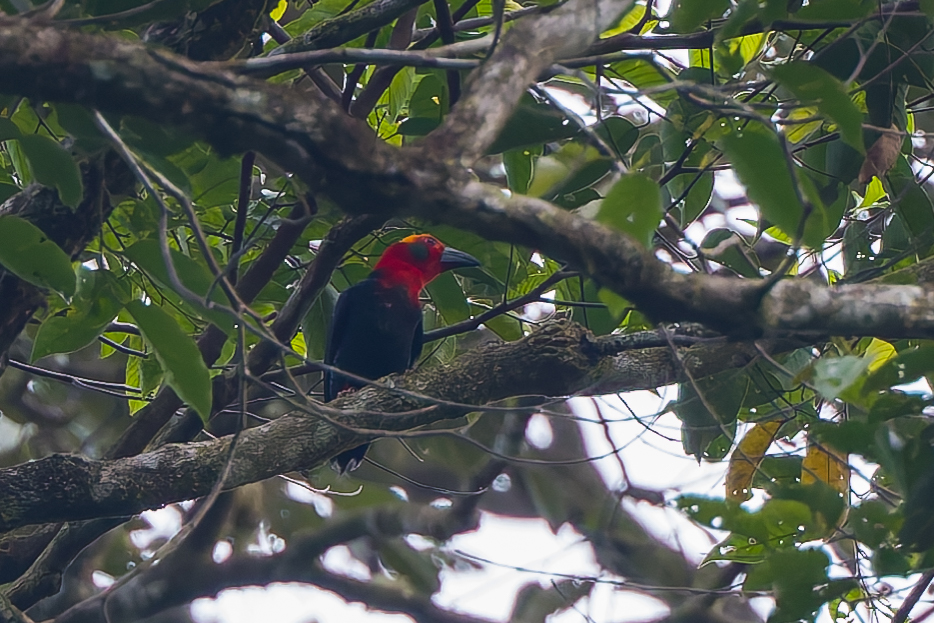
We spent most of the afternoon on the road and the canopy walkway. We heard both Helmeted Hornbill and Blue-headed Pitta, but for 90 minutes we saw very little, and the forest was very quiet. At 5pm we had been watching some Dusky Broadbills (recall that these are allegedly “friends” of the Bristleheads) and about to make our way back to the lodge to join the other guests for happy hour. Duncan and I had descended to the road, when JP and Steve, still high up in the canopy walk, saw an interesting-looking bird fly over. The call had been quick enough Duncan and I to see the tree it had flown to. It looked interesting! It flew again, a bounding flight, and fortunately it landed high up in one of the huge emergent trees. That was definitely a red head I just saw, briefly, before it disappeared behind dense foliage… what else could it be? We scanned with renewed vigour, then Duncan announced he had it! Bristlehead! There was a mad scramble, lots of swearing asking for directions, and eventually we all got on it. Manu, bearer of the one scope between us, had til now been sweet but mostly ineffective. “Now is your time to shine Manu. Do not fuck this up!” was my advice to him as he tried to set the scope onto the bird. After a tense few seconds, he announced it was done, and we all enjoyed scope views, record shots, and high fives. What a moment, victory from the jaws of defeat (well, not really — we still had a full day — but hey!).


We bounded back to the lodge and managed to arrive in time for the last bit of Happy Hour. As the other guests sat around in their nice clothes sipping wine and chatting politely, 4 loud but overjoyed birders burst their genteel bubble, bundling onto the small deck in sweaty gear, and downing an order of two beers each in short order, leaving enough time for another similar round. In our relief and joy we crammed more than our money’s worth into the mere 10 minutes of Happy Hour that remained. In the shop we bought team T-shirts and posed for a photo with Deb. Please don’t judge me as a bad person if I confess it reminds me of an infamous meme. If you know what I mean then you are just as bad as me, and people who live in glass houses and all that…


There were no birds on our night drive, but this time the unfeasibly cute Tarsier stuck around long enough for photos by torchlight (see below).
4 March
With one full day left, but with the number one target UTB, we decided to explore some different, steeper and trickier trails today, on the hillside opposite the lodge. Azmil had in mind to try yet another site for Blue-banded Pitta. These birds are shyer than the closely-related but slightly larger Black-headed, and seem to be outcompeted at lower altitudes, so we needed to go higher. After a fall for me (which fortunately only took the wind out of me but otherwise caused no lasting damage) and dodging a wasps’ nest (a couple of us were not so lucky!) we perched at a spot that Azmil decided was high enough to be in a BBP territory, and sure enough, a bird responded to our playback. It came in fairly close, but once again remained stubbornly out of sight.
The walk for me, however, was successful in another way, because we encountered my first ever Crested Jayshrike, the second of the monotypic families that I needed. On these quieter trails we also tried again for babblers. The stand-out was a lifer Black-throated Wren-babbler, and we also had nice encounters with another Striped Wren-babbler, and a Ferruginous babbler. Sadly there was still not a peep from a Bornean Wren-babbler. Sunda Blue Flycatcher and Bornean Blue Flycatchers were new for me this morning, and the only birds to pose for photos!


In the afternoon, photo ops remained limited and we compiled a fairly meagre e bird list of 10 species. This was partly due to the afternoon conditions, but also I am sure that lethargy and lack of enthusiasm for the task from the team was a factor also. We had seen all of our gettable targets and those that remained seemed a very low probability. A Bornean Paradise Flycatcher posed beautifully on the canopy walkway and I picked up two lifers: Red-billed Malkoha and Rufous-winged Philentoma. Likewsie our nightdrive was largely unproductive, with a couple of Sabah Partridge picked up in Azmil’s thermal scope and Brown Wood Owl once again a heard-only record.
5 March
Our final morning was once again spent on the trails looking for babblers. We found five species — Fluffy-backed Tit-Babbler, Sooty-capped Babbler, Scaly-crowned Babbler, Rufous-crowned Babbler, Horsfield’s Babbler — but not the seemingly non-existent Bornean Wren-babbler. Red-throated Barbet was the last lifer of my time in BRL.
You can tell by the low quality and quantity of photos, that opportunties were pretty limited. You’ll have to make do instead with this gallery of mammals we encountered.


Postscript
In the early hours of 28th Feb, while we were sitting in hide at Utan Lodge, waiting for an appearance of the Brnean Ground Cuckoo, then enjoying a stellar morning finding pittas and trogons and broadbills, Donald Trump and Benjamin Netanyhu decided to bomb Iran, starting a war that is still going on as I write this blog post in Nov 2026. Iran responded (as all experts predicted) by closing the Straits of Hormuz and sending drones and missiles to US allies in the region including UAE. My colleagues in Abu Dhabi reported many sleepless nights, with constant disturbance from alerts and exploding missiles being taken out by the local air defences.
With commercial airspace closed, it was pretty clear I would not make it back to Abu Dhabi as scheduled in a week’s time. Steve and JP, on a Malaysian Airlines ticket from mKL to LHR were unaffected, but Duncan had come from Edinburgh via Doha on Qatar Airways so he would need w new way home. His wife back in Dullater turned travel agent, and scrambled to find an alternative for him, eventually finding him route via China that did not cost and arm and a leg. He would have an extra 3 or 4 nights in Borneo to kill. I anticipated the cancellation of my flight from KL to Abu Dhabi and took Etihad’s refund option. With my boss’s consent, I booked myself to go Adelaide from KL instead of Abu Dhabi, and work remotely there until I could get back to Abu Dhabi. Louisa was just about to arrive back into Adelaide after her 3 years in Sydney and start work, so the timing was perfect. I cunningly gave myself an extra night in Lahad Datu, and Duncan and I agreed to return to Mt Silam for a final crack at the elusive Blue-banded Bastard. Azmil set us up with this driver and we booked into the same hotel as before. He promised to get in touch with his mates and book us into the hide again. It would be expensive but surely worth it!
From a birding logistics perspective everything was falling fortuitously into place. But was it all going to well to be true? The first indication it might not be plain sailing came when Azmil reported that his friends had closed the hide. Since our ill-fated trip to the hide a week or so back the bird was returning only sporadically, and they had decided to give it a “rest” for indefinitely. Bugger! Duncan and I decided we still go, but would bird the road, concentrating most of our time at the pull-in where we had prematurely abandoned the singing bird a week ago.
TL;DR. We dipped.
The more complete version would tell you about our very near miss. the bird called initially early morning, but did not aproach. So we birded the road abve the pull-in and found one or two nice things before returning. As we walked back to the spot at the top of the steep slope i heard the call and alerted Duncan. It was close. We peered down the slope and heard it agin, but we just could not get on it. then there was achatter \, a saw a brown right-sized shape fly across from where the bird has been singing, then it sang again from to our w=right, pretty much in the spot it had been concealed a week ago. Duncan, meanwhile, had got a glimpse in bins “It was orange!!”, he blurted, confirming what I already knew, that this was the bird and my best chance has just yielded only UTVs (untickable views). Though I know I saw the bird, I can’t possibly tick one of the world’s best lookig birds on a brown flight view.
Though it called once or twice it soon went silent. Over lunch we despatched the driver back to town to but some mealworms. Perhaps we could tempt it into the open in the “usual” SE Asian way? We took it in turns to descend precariously but carefully and scatter some mealworms on suitable logs that would give a reasonable view if the pitta “took the bait”. It didn’t take long for the White-rumped Shamas to work out that there was a free meal. With more time maybe we might have tempted the pitta too, but
We were distracted for a time by the regular calls of a Red-naped Trogon, but at 5pm I suggested one more try with mealworms. It was Duncan’s turn to scatter, but about halfway down he slipped and fell forward. The slope was precariously steep, but he had fallen foward in no danger of slipping down the slope, and it all looked pretty innocuous from where I was watching. But he was a bit slow to get up, and when he did he was gingerly feeling his right arm. Something was not right.
He made his way slowly back, and we realised his shoulder looked disturbingly “square-ended”. He had landed on his elbow and to our medically-untrained eyes, he had dislocated his shoulder. More birding was clearly out the window, and our driver very kindly took us direct to the local hospital. Although the adrenaline rush of the initial shock had nunbed the pain, by the time we arrived at A&E of Lahad Datu hospital, Duncan was in considerable pain. Fortunately, although the hospital looked pretty run-down and not 100% hygenic, it was very efficient. He was given a morphine lolly while they did scans, then drugged up further on fentanil so 3 people could physically wrestle his arm back into its joint — he reported that one of them planted a boot in the middle of his ribs to get enough purchase. The hospital also gave him “post-op” scans to ensure it was definitely back in, and finally discharged him. We had not even lost much birding or drinking time.
In his semi-drugged state, Duncan was too easy to convince to come for a few beers to add to the cocktail of drugs coursing through his system. We grabbed a decent Chinese meal and a couple of Carlsbergs at a restaurant a short walk from our hotel.


We returned to Mt Silam the following morning. In a sling, and still in some residual pain and with restricted mobility, Duncan could not descend into the forest at all, but would observe from the carpark as best he could. I carefully placed some mealworms, and we heard the bird distantly, but it never came as close as our near miss of the previous day.
Later we flew to KK. Early the next morning he was picked up for some birding at Trusmadi. I slept in, then walked through the fascinating Chinese New Year market outside our hotel then began the long journey to Adelaide, via KK and Perth. It was so nice to see Louisa for a few days, and ten have the chance to return to Perth and join Nikki for a trip down to Albany to see Erica. A completely unexpected and fragmented family “reunion”!
