The early part of the Festival of Ian continues in the mountains of Northern Borneo
Feb 20
After two mornings in the hides at Trusmadi, it was time to eschew the cushy life of photographers and head into the “field” for some proper rainforest birding. We travelled to Mt Kinabalu, arriving in the rain, late afternoon, and were reunited with Duncam Orr-Ewing, the final component of our staggered-start quartet.
The enormous granite protrusion of Mt Kinabalu rises to over 4000m, is the 3rd highest “island peak”, and 20th most prominent mountain, in the world. Low’s Peak at the summit is the highest point between the Himalayas and the Snow Mountains of Papua. More significantly for us, the mountain and the surrounding ranges are a biodiversity hotspot, with more than 5000 plant species, more than 300 birds species and 100 species of mammal recorded. I had previously been to Mt Kinabalu 6 years previous, to climb the mountain with Erica, in what was a simultaneously grueling and stunningly beautiful, but also completely non-birding last few days to her/our “Father-Daughter” trip to celebrate her high school graduation. Trekking as light as possible up the forest trails and bare granite of the summit, I didn’t even take my bins.
Now, several years later, I would have the chance to bird the forests that we had walked through and past on our way to the summit in 2019. Apart from one high-up endemic bush-warbler, all of the key species are concentrated in the rainforests below the Timpohon Gate where the trek officially commences. The 5 of us (SMRY, JP, DO-E, me and Azmil) would spend today and the next 2 full days, and a fourth morning, aiming for the endemics of the cloud forest, birding between 1500m and 1800m a.s.l. Top of the list for us — and for almost all birders to Mt Kinabalu — was the fabled “Whitehead’s Trio” — Whitehead’s Broadbill, Whitehead’s Trogon and Whitehead’s Spiderhunter, but the mountain forests have many other goodies as well — a real bucket-list destination.
TL;DR: Two members of the team battled through norovirus, which fortunately stayed away from me and Steve, and the weather could have been kinder — the dregs of a monsoon brought rain each day — but we got all of our targets. Though the photo quality drops off having left the cushy environs of the hides.
Although we’d had a great reunion with DO-E the night before, at our pre-dawn meet this morning, JP greeted us with ominous news: Duncan had spent the night in the loo, gushing from both ends. For obvious reasons, neither of them had got much sleep, and Duncan was in no state to join us this morning. After muttered sympathy, we boarded the minibus and jumped at the opportunity to kick him while he was down by seeing some gripping birds.
Though veiled by clouds, the presence of the mountain, towering invisibly over us, could be sensed in the climate and environment it has created. We birded the road from just above the park headquarters up and down a few hundred metres of elevation over 4-5km, with targets in the dense understory all the way up to the high canopy. The road winds trough a steep valley and along a forested ridge, either side an emerald labyrinth, with dwarf oaks, chestnuts and laurels draped in lichen and moss, tangled vines hanging in bizarre twisted shapes.


In intermittent rain and mist, the birding was slow — the forest does not reveal its secrets easily — and it was obvious why our itinerary had 4 mornings here. My three ebird lists, accounting for 5 hours from 6:15, comprise only 27 individuals from 12 species (plus one heard only). But some of the of the species were genuine 2 or 3-star birds, and we had plenty of ammo to grip off the poorly, hapless Scotsman by the time we returned to the hotel to see how he was doing.
The morning began with us hearing, and then having poor torchlight and flight views of our my first of the Whitehead’s Trio, Whitehead’s Broadbill. We would need better views over the coming days. Higher up the road, in diffuse, white, misty light, we then had our best sighting of the morning when Azmil picked up the high-pitched monotone contact call of Fruithunter, an enigmatic endemic that was formerly considered a triller but is now, rather bizarrely, lumped in the Turdidae family, of “typical world thrushes”, despite being completely atypical of a thrush. It is one of the star birds of Mt Kinabalu, sometimes tricky, and so great to have this UTB within a couple of hours of starting. When the light improved and we returned the same spot a little later, I was even able to get some passable record shots.


Aberrant Bush-warbler is an understory skulker that we worked hard for and eventually got very nice views (this was the oreophilus subspecies — I had previously seen presumed intricatus in Sichuan). A rival for the Fruithunter as best bird of the morning was an extremely confiding Bornean Stubtail, a miniscule, almost tailless warbler with just about the the highest pitched song I have ever heard. Like a little windup toy, in response to a tiny bit of playback from Azmil, one landed just a few metres away and pounded out its 15kHz song continuously for several minutes.
Other new birds of the morning included Grey-throated Babbler (one of the commonest species we encountered on the mountain), Yellow-breasted Warbler, and the smart White-browed Shrike-babbler, Bornean Whistling-Thrush, Crimson-headed Partridges, seen by S&J in Sarawak, called loudly throughout our 4 days, but proved a bugger to see, and all but one of our records, including this morning’s were heard-only.


Duncan had recovered enough to join us at midday. After picking him up we had lunch at a roadside restaurant outside the park, but was in no mood for eating. We took pity on him and deliberately failed to mention what a brilliant encounter we had had with the Stubtail and the fact we’d seen Fruithunter.
After lunch it was back into the park where the weather was a bit kinder and we had some really excellent and enjoyable birding. As we drove in past the park headquarters and accommodation, Duncan, who had managed to pull himself through the worst, was motivated to get as much as he could, and immediately called “Forktail” as a black-and-white bird flushed from a roadside gully. We all piled out of the van and were able to track down a superb Bornean Forktail (Steve’s first of this classic Asian family). Ironically, at 13:30 the forest here around the headquarters was much more lively than this morning, and in a short space of time we had great views of another goodie, Maroon Woodpecker. As we birded beyond the barrier in the same areas as the morning we found a superb Whitehead’s Broadbill, and Duncan was able to grip back Fruithunter, with a pair showing even better than the morning just up the road from our AM sighting.


Another great find of the afternoon was Mountain Wren-babbler, an endemic closely related to some of the other skulking babblers of South East Asian including Striped and Falcated Babblers that Steve and I had worked very hard (but successfully) for in the Philippines many years ago. They are the arguably the closest thing to South American antbirds that SE Asia has.
Other good new birds this afternoon included Golden-naped Barbet; Black-sided Flowerpecker; Temminck’s Sunbird; Velvet-fronted Nuthatch; Mountain Leaf-warbler; sweet Little Pied Flycatcher, chasing its reflection in a window of one of the lodges near where Eri and I stayed in 2019.


Back at the Pines Resort, Duncs had used all of his energy birding in the afternoon and didn’t join us for post-birding beers in the bar, nor was he able to face much food, though he realised that his body needed at least some fuel to fight the infection, so he forced down some plain rice.
Feb 21
Duncan had recovered sufficiently to join us for a early morning trip up to the Timpohon Gate — the highest altitude we would reach — and we drove straight to the gate and birded here and for about 1km back along the road, searching for and finding lots of the endemics starting “Bornean”.


Right at the top our first bird was a Bornean Treepie, then we tracked down our main target, finding two Bornean Green Magpies, stonking, green and black birds with a bright red bill. None of the monochrome dullness of European magpies (or Australasian butcherbirds) for these Asian magpies! Bornean Whistling-thrush and Mountain leaf Warbler were also new, important birds. We had been hearing another endemic, Bornean Shortwing regularly in the wet gullies but finally saw one this morning, though the skulker refused to show well enough for photos. Other nice birds noted in 2 hours included Sunda Cuckooshrike, White-throated Fantail, Black-capped White-eye, superbly coloured Indigo Flycatchers.


We ate our breakfast at the Kiau Gap monument, enjoying a spectacular view of the mountain. Yesterday’s clouds had rolled away revealing the imposing granite massif to us for the first time. A memorial here commemorates the deaths of 18 people when a 6.0 magnitude quake rocked the area in 2015, dislodging an immense volume of boulders and debris. Tragically, many of those lost were from a primary school group on holiday from Singapore. With a tear in his eye, Azmil privately told me that one of the guides killed with the group was a close friend of his.


We were on the look-and-listen out for the Spiderhunter. One called distantly, but we could not attract it and I did not record it on my ebird list. A couepl of brilliant red Temmick’s Sunbirds shuttled back and forth, too agile for photos. Much more obliging was a Sunda Owlet which we coaxed into a close, dense bush, and Azmil was able to pick it out brilliantly in a narrow window. It stared back at us grumpily with piercing yellow eyes. When it spun its head 180 degrees, as owls can do, it still stared back at us through its huge “false eyes” on the back of its head.
As we carried on birding back up the road, Duncan was able to grip back the Stubtail when another bird performed beautifully, just as the one had yesterday. Mountain Tailorbird was new for me, and Grey-chinned Minivet (both male and female) added bright colour, but overall it was slightly disappointing rest of the morning as we failed to get onto either of the remaining Whitehead’s species. Having supposed these not to be especially difficult I was starting to worry, especially about the Trogon, since not only had we dipped, all the other birders we met had likewise dipped.


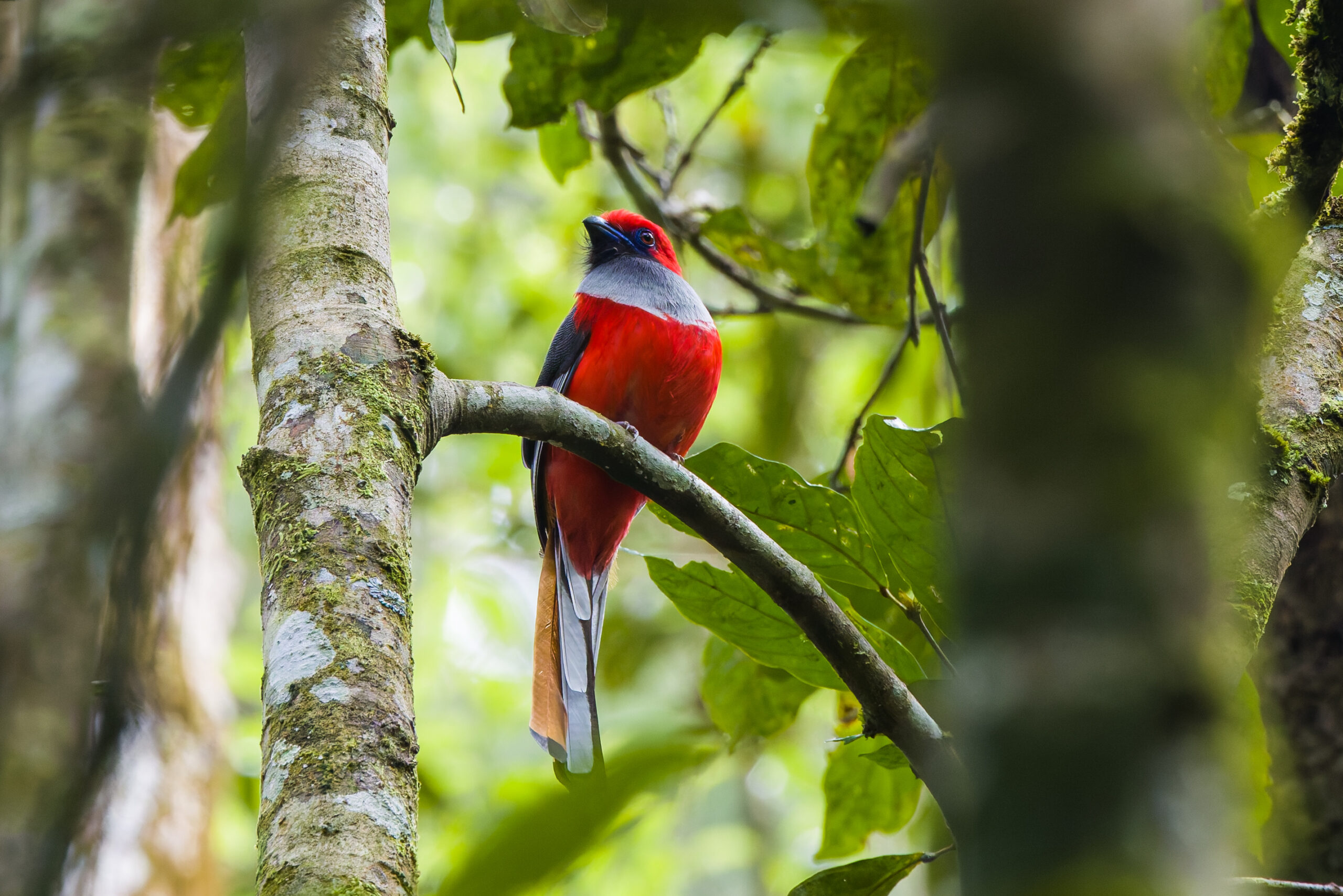
Sensing our nervousness abut the Trogon (or maybe there was no need for sensing — we were probably pretty forthright!), after lunch Azmil cooked up a new plan, and we stopped birding along the road and branched out into the forest, walking the Liwagi Trail, which winds down to the valley floor then tracks along a stream. We descended for about 10 minutes along the quiet trail when Jon called out the word we wanted to hear: “Trogon!”. One had swooped down the track in front of him and up onto a branch some way off. We bunded down along the trail following Azmil who was, as usual, quickly onto he bird and helped us all find the cracker. Another bird called softy a little further way, also a female, then the flew further away to the steep bank on the far side of the stream. Although now mightily relieved, we were still a little disappointed it had been two females. Smart birds, yes, but not the bold scarlet and grey beauty of the males.


We carried on the trail some distance, passing some other birders along the way. Azmil stopped to chat briefly with their guide — they all know each other well here — then we carried on further along the trail until we reached a bridge where the track turned 180 and rose above the stream heading back along and up the steep slope we thought the females had flown to. Perhaps there would be males there? A pair of Bornean Green Magpies called invisibly, but otherwise we conventrated on the Trogons, hoing to reach to spot we thought they had flown to. Azmil stayed in touch with his friend, the other guide, on his phone. Suddenly the chatter got more excited and announced to us: “He’s got a male”. Instantly I was striding and running back along the track retracing our steps, a terrible mix of excitement, anticipation and dread of it leaving, welling up in my gut. The bridge seemed miles back, and so as soon as we had descended to the level of the stream again, we found a shallow part and bombed straight across, regardless of wet boots and trousers. I arrived first, where the guide excitedly pointed up and I was able to take in the stonker for the first time. Brilliant! The view was not ideal, but we stayed with it as it casually moved around in a classic Trogon way– swooping down and back up short distances, silently perching on small horizontal branches, large and brightly coloured, but unobtrusive, and evenatilly yielding superb views. Instantly elevated to among the best – maybe the best of this gaudy family.
As we took selfies with the trail signage, we found our the extent of another genius bit of birding from Azmil. He had been on the phone to his friend when he heard a Trogon through the phone, evidently near his friend. Although previously oblivious, now alerted by Azmil, his friend tracked the bird down quickly and announced to Azmil he had a male. This was the point it was relayed to us and we began our mad rush down the track and through the stream.


We birded the road again in the afternoon, finding nothing new. Nevertheless the satisfied feeling of a good day’s birding with a major target in the bag can lead to relaxation and loss of concentration, which can be dangerous. As we drove out of the park in the semi-darkness of late afternoon/early evening, in the headlights Steve briefly noticed a thrush on the roadside as we rolled past a little too fast. It was dark, but he got enough of a glimpse to see orange unders — Everett’s Thrush! I had my head down, thinking the day’s birding was over, and likewise none of the rest of us saw anything. It was too dark and too late to bother trying to search for it. At least we had it on the agenda for pre-dawn tomorrow!
Two days, two out of three Whitehead’s… Steve and JP were happy and relaxed, since they’d got the Spiderhunter in Sarawak. The gnawing doubt that I’d had about the Trogon, replaced by elation on the Liwagi Trail, now was transferred to the final one of the trio.
Feb 22
For our last full day I had two main targets — the Spiderhunter and Everett’s Thrush — and various secondaries. Worringly, Jon had succumbed to whatever Duncs had suffered from, and it was now him who was laid low having spent half the night in the bathroom. Steve and I exchange glances. Would we be next? With the thrush our initial target, Jon decided to battle through his sickness and join us, feeling terrible, but armed with wodges of bog-roll. Our birding began in the pre-dawn gloom on the road near where Steve had seen the thrush the night before. Like another (former) Zoothera, Ashy Trush, that Steve and I had seen on the side of a track in the pre-dawn (Mt Makiling, 2010), Everett’s is most easily seen hunting grubs and worms on the roadside very early, before people and cars have flushed them deeper into the forest.
Above us in the dark forest a bird called back to us but refused to approach the road and show itself. Then, still pre-dawn, Azmil picked up a thrush-sized bird in his Thermal cam. We could all see the blog on his LCD and we were able to find it in the gloom as it worked its way up the road. In the dim light it was mostly just a dark silhouette, and I was skeptical when the others started to get more and more excited, since I personally could make out no plumage detail that would make the ID unequivocal. I had expected teh orange unders to be much more obvious then they appeared to be.
Feeling sick and needing the loo urgently again, Jon decided to tick off the views we’d had and got the driver to take back to the hotel. Steve, Duncan, Azmil and I carried on following it as it continued to move up the road, always staying just too far away for me to get he kind of view I needed, but close enough that Azmil could continue to track its whereabouts in the thermal. At one point I was opening skeptical, asking the others for what they were seeing that would clinch the ID, but I was too timid in my objections. Steve grabbed some gloomy video — it was too dark for photos — and then we too, called it a day. I should have had more confidence in myself — as soon as Azmil saw the brief footage he admonished: “No, that’s a Whistling-thrush”. Oh bugger.
We walked back to where the car had dropped us a little embarrassed and despondent, only to have one the encounters of the trip when in much better light, a real Everett’s Thrush materialised on the verge and hopped around us for a good 10 minutes. Duncan would have the problematic task of breaking the news to Jon, that he had strung a Bornean Whistling-thrush, while we’d had frame-filling, walk-away views of our main early-morning target.


In a second episode of deep embarrassment for all of us, Azmil pointed out that the bird we’d heard earlier in the morning, which we stupidly assumed was the thrush, was in fact Mountain Scops Owl. Oh bugger x2.
Next up was my second main target, Whitehead’s Spiderhunter. Azmil knew a spot, about a km below the Timpohon Gate, a flowering tree where the birds had been seen by others in the previous days (I wondered why we had not had a look previously, having walked and driven past this spot at least 3-4 times in the last few days). From 7.30 we staked out the tree and withi half an hour it had delivered. The bird was rather distant and the light poor, rendering this the least “whelming” of the trio. A bit of a shame, since it’s arguably the best spiderhunter, large and with interesting plumage — Newcastle United front and Norwich City vent — and my view was distant and backlit. At least I was able to grab some record shots and once again was grateful for the aggressive cropping that’s possible from the 45Mp R5ii. In an hour and half at the stakeout and walking the road up and down, we also had further views of the high altitude specialist Black-capped White-eye. Also noted were Bornean Treepie, Mountain Leaf-warbler, Pale-faced Bulbul, Ashy Drongo, Hair-crested Drongo.


Now that we had all the Whitehead’s Trio under the belt we returned to sightly lower altitude and birded on foot and in the van, dodging occasional rain, for about1.5km from our “Fruithunter site” down to the lodges. We located another two Everett’s Thrush, a pair taking nesting material to a nest over the road, and we came across another small tour group who were on a male Whitehead’s Trogon, in exactly the area we had spent ages over the last two days. A Sunda Cuckoo was new for me (but not for Steve), and in a mixed flock of small passerines we had Yellow-breasted Warbler, Grey-chinned Minivet, Chestnut-crested Yuhina, and more Black-capped White-eye. Our final day-time target was Bare-headed Laughingthrush, but we would end up dipping. We had a nice mixed flock of Chestnut-hooded and Sunda Laughing-thrush, and some Bare-headed following the Sundas seemed our best chance, but was not to be. A top bird for me this afternoon was our last before lunch, down by the lodge where a pair of photographers put us onto a superb Mugimaki Flycatcher.


Back at the hotel, Duncs had the role of breaking the news to Jon about the Everett’s. Jon: “At least we heard it”. Duncan: “Actually, I have some other bad news for you”…. We returned to our regular lunch venue, the convenient and just about adequate August Kitchen and discovered where Steve and I ate, and Duncan tried to force something bland down to rebuild his strength.
The afternoon was rather slow. Our main targets were all in the bag so we hung about for lengthy periods in spots that might yield Laughingthrush flocks, hoping for our last mountain specialist, Bare-headed. We took Jon back to the Everett’s nesting site and he was able to grip to back. At the same site we had a flock of Sunda Laughingthrush, but were not lucky with Bare-headed. I finally got a visual of a Crimson-headed Partridge, a bird we’d heard barking almost everywhere over the last few days. A male picked its way through the undergrowth below the Everett’s nest.
23 Feb
Our day began early, very early, high up in the dark. Mountain Scops had not really been on my radar up to now, but yesterday mornings embarrassing “heard-only” now felt like a dip, and it had become a “bird I need to see”. Ten years earlier, in Taiwan, I might have had a chance on Dasyueshan, but I was inadequately prepared and insufficiently targetted. Here was another chance at a tricky bird.
Owling can be tough, often with lots of waiting around. If you are in the wrong place or a bird is unresponsive, it’s not like there’s anything else to do, so it can actually be quite boring and dispiriting. However sometimes, it just works, and today was one such occasion. We piled out of the van and followed Azmil a short way in torchlight, not far from where we’d had the Spiderhunter yesterday. Torches off, Azmil played the call, a high-pitched, pure double note, peep peep. It was answered almost immediately, seemingly high up behind us. But I’ve owled enough to know the birds can be much closer than they seem. It called again on our side of the road, having crossed invisibly to check out the unknown intruder that Azmil was imitating. Next thing, he has whipped out his ThermalMaster DV2 and is waving it back and forth until a small bright blob — Mountain Scops Owl — appeared in the centre. Now we just had to work out where it, but here the built-in laser pointer on the DV2 guided us exactly where to shine our torches. Like the Owlet two days ago, the expression on this stonker’s face was rather grumpy. We filled out memory cards with frame-filling shots, as it perched unmoving for about 4-5 minutes.

We were leaving Kinabalu later this morning, but still had some time up our sleeves for a final check for Bare-headed Laughingthrush. We decided to go “off piste” again, walking the steep, winding and scenic Pandanus Trail for 2 hours back down to the lodges near the park entrance. Jon’s norovirus was taking longer than Duncan’s to shake off, and he brought extra bog-roll in case he got caught short. As it turned out, it was a good thing he brought it, because as we were chasing some vocal Crimson-headed Partridge (mainly for Duncan who had not come to the hide at Trusmadi with us) Jon was off in the bushes.
We came across a pair of Whitehead’s Trogons (of course we did –we no longer needed them), and managed tickable views but no pics of a Dark Hawk-cuckoo, a new bird for me. Our meagre list of only 10 species in 2 hours, with 60% heard-only, shows that the birding was tough. But I was very relaxed, resigned to dipping on the Laughingthrush (though Azmil continued to do his best to find us one), and very happy to have otherwise cleaned up on Mt Kinabalu after my previous “binocular-less and birdless” visit in 2019.\

After packing up our rooms, we loaded our luggage and ourselves into the van. We had barely traveled 15km, though, when Azmil directed the driver to pull over. He potentially had one more treat for us, and mysteriously wandered down to a small viewing platform. Pretty soon he was beckoning us down, because the birds he was looking for were indeed present. He challenged us to scan, and below us, about 100m range, was a gorgeous pair of White-fronted Falconets on a regular roost branch.

I’ll pick up the tale in the next episode at lunch on 23rd!
