National Day in UAE is a big deal, warranting two days of public holiday. Sometimes, if the timing is right, even three! For me and my birding friends, this affords an opportunity for a 4 or 5 day birding trip without sacrifice of precious annual leave. Last year (2024), Ted Burkett and I went to Socotra (see blog here), but this year he was thinking further afield, keen to try for one his top world targets, Yellow-necked Rockfowl. This is also a bird on my bucket-list, so the invitation to join him and and fellow UAE birder, Des Lobo, on a short trip to Ghana was too good an opportunity to miss.
Ghana is quite a long way away — 8 hours’ flight — but the extra long weekend made the trip just about viable. Ted had done all the homework, lining up an excellent local guide (Kalu Afisi) and a number of sites that promised superb forest and savannah birding. By leaving early Friday morning and travelling west with the time change in our favour, we would get half a day birding on Friday, followed by 4 full days of birding, plus most of the Wednesday before an overnight flight back to Dubai.
In this compressed itinerary we would not have time to travel to the north of Ghana — an entire day’s drive — where most tour groups spend at least a few days. The top target there is Egyptian Plover, a very unusual and beautiful grey, white, cream and black wader that on some days I would put in my top-10 most wanted. (I say, on some days, because my top-10 is a moveable feast and on any given day I might decide on a different ranking and different top-10). Either way, it’s a bird I really, really wanted, and I was disappointed to be going all that way and not have the chance to try for it. So about a month out from our trip, I had a brain-wave: if I hit Ghana two days earlier than the rest of the team, I could fly up to Tamale and twitch Egyptian Plover at a reliable site a few hours drive from there, and be back in Accra to meet Ted and Des causing zero disruption to our original itinerary. It would cost me two days’ leave, and the price of a driver, guide and internal flights, but for a top-10 it had to be worth it.
Why is Egyptian Plover so desirable? Yes it’s very beautiful and rare. But it also lives in its own family, the only one of its kind. There are nearly 11,000 species of bird in the world, and most birders will never come close to seeing even half this number. On the other hand, a reachable goal for those sufficiently dedicated (and with enough time and cash), is to see a representative of each and every bird family. The new consolidated taxonomy Avilist (a merger of IOC and Clements) describes 252 families, and it follows that to see all every family, naturally, you have to see all of the monotypic families (i.e. species that are so taxonomically distinctive that they have no very close relatives) including Egyptian Plover. Prior to the trip to Ghana, I had seen a healthy number of families, 205, which at the time of writing, placed me just outside the top-100 family listers listed on the site wf250club of BirdFamiliesOfTheWorld.com. (Of course that list is self-declared so undoubtedly there are many, many birders not on the list with higher numbers.) Still, birders love a good list and leaderboard, and a trip to Ghana was a chance for me to climb the leaderboard into the top-100 with 5 new families on offer 😉
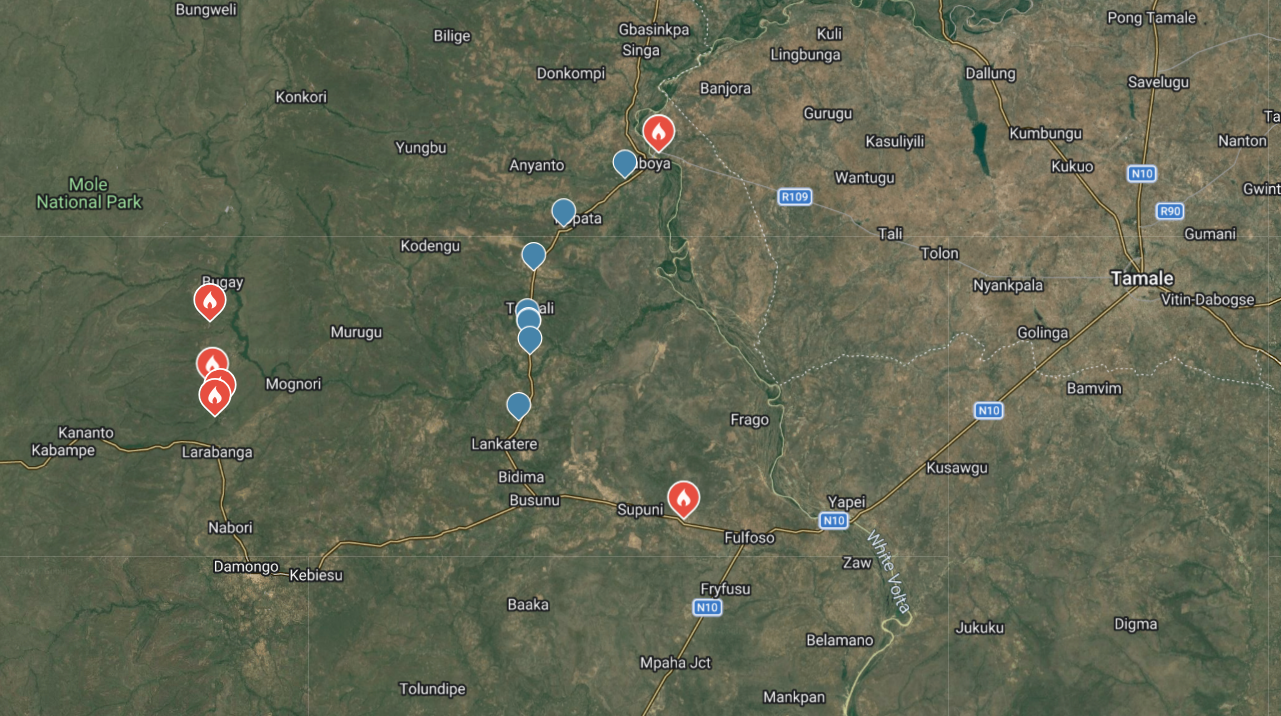
Based on my ebird research and some private comms, I worked out that a reliable site for Egyptian Plover was a small town called Daboya, on the White Volta. According to google maps this spot is a mere 60km, just over an hour’s drive from Tamale. So not only could I bag EP with my extra-curricular excursion, I might also be able to work in additional birding, maybe to Mole National Park. Just as well, then, that Kalu put me in touch with a driver and guide, because with their help I realised that that the google maps route would land me on the north bank of the river, with no way to cross. Instead we would have to leave very early from Tamale, and travel double the distance (and nearly 3x the time) to Daboya. But we could bird the savannah on the road north to Daboya, and this turned out to be very productive and enjoyable.
Day 0, Thurs Nov 27
After a comfortable evening (with an excellent meal) and night in the Best Lodge Hotel (which I will call “Day -1”), my local guide, Ilias, an associate of Kalu, and the driver met me early at 450am, as arranged. It was dark until 6am, and thereafter we stopped whenever we saw anything of interest. I laid a few ebird pins along the Fufulso-Damongo Rd, and along the Busunu-Daboya Rd which travels a slow, bumpy route north. Excellent new birds encountered that I had flagged as targets prior included Northern Red-billed Hornbill, Bearded Barbet, Abysinnian Roller, Dark Chanting Goshawk, Red-throated Bee-eater, and the very beautiful Blue-bellied Roller. At 8.15 we were approaching Daboya (and I was getting more and more excited about the prospect of EP) when we passed a herd of cattle and Ilias suggested to the driver to pull over. We scanned the backs of the herd and sure enough, clinging to the flanks of one of the beasts were a couple of individuals of one of my main secondary targets, Yellow-billed Oxpecker — my first family tick from a potential five on the trip. Plain brown but with a bright yellow and red bill, these unique birds spend their lives in a symbiotic relationship with the megafauna of of Africa, hanging around big beasts and feeding on the ticks and other irritants and parasites on the animals’ skin.


Fifteen minutes later we rolled through the ramshackle town of Daboya and down to the White Volta. A bridge is under construction here, which one day will halve the driving time from Tamale, but by the look of things, that day is still a long way off. The wide green river flows around two unfinished pylons — the only visible manifestation that some construction has taken place — through an old, broken causeway, then gently envelopes a set of sandbanks. Lined along the main banks of the river, groups of people washed clothes, and some fisherman waded and manoeuvred a small boat to set a net.


I must admit to a little disappointment that the sandbanks — the preferred habitat of EP — were more distant than I’d hoped, but I scanned them excitedly nevertheless. A Black Kite somewhat incongruously stood “knee deep” in the slow flow, and a few Wattled Lapwing loitered on the nearest sandbank. But there was no sign of my target. Fortunately Ilias did not seem concerned. A promising shape slid behind a distant bank too quickly for me to be sure, then, as if from nowhere, an Egyptian Plover materialised next to the Lapwings. Low to the ground, on the away-slope of the sandbanks, it had been working the shoreline, invisible to us.


The scope views were outstanding, and I even grabbed some phone-scoped video, though had to hand-hold my phone, having unaccountably not brought my custom phone-case scope adaptor. The record shots with the R5ii were decent, and I was very grateful for the crop factor I get from the 45Mp sensor.
We spent a good 40 minutes here, also observing several Pied Kingfishers, a single stupendously coloured Malachite Kingfisher, swallows, swifts, etc, before Ilias pointed out that it was a long drive to Mole, and we needed to get going. We retraced our steps south of Daboya, once again stopping when we noted new/interesting birds. These included the critically endangered White-backed Vulture, a Bateleur, and (lifer) Purple Roller. But the drive was a lot longer than I had expected. Google maps says 66km, 1.5hrs. In fact we had to go all the way back to Busunu, then turn west, covering 108km, and taking more than 3 hours. It had gone 12.30 as we arrived at the Mole Hotel.


The hotel sits at the top of a small escarpment with a panoramic vista over a waterhole, and we enjoyed an excellent lunch on the deck with this magnificent view. Ilias’s advice on local cuisine led to me ordering “Red Red”, a famous Ghanaian dish of stewed black-eye beans and fried plantains, and his advice was spot on — it was good! While we waited for food I scanned with bins and scope. A bull Elephant sauntered across the clearing where a couple of Kob antelopes and a Warthog were hanging. As well as more “common” stuff, a Hamerkop flew over, a group of 6 White-faced Whistling-duck loafed on the bank, along with a pair of discretely camouflaged Senegal Thick-knee. A large column huge column of Hooded Vultures sailed overhead, including a single White-headed, and a couple more White-backed Vultures.
The only legitimate way to explore the park from here is in a local safari jeep. My driver’s slightly dodgy 2wd had coped with the rough “roads” to Daboya and into Mole, but would not be able to negotiate the deep ruts and steep slopes required here in the park itself, and there is an additional safety requirement to take an armed guard. Unfortunately, although Kalu had called ahead to ensure this was all reserved, somehow the message had not got through, and we endured a wait around around the park headquarters for 45 minutes until a driver and guard could be arranged. I’ve done enough birding in 3rd world countries to know that even the best laid plans are regularly shafted by incompetent, indifference or even malfeasance. At least it was only the the worst early/mid afternoon hours for birding that we missing.
By 2pm we were finally underway in a local safari vehicle and spent the next few hours trundling down a rough track to the waterhole, driving and walking through the savannah (with armed guard in tow, in case the bull elephant was still around) along the Samole Loop and part of the drier, scrubbier Asibey Loop.


As you might expect from the time of day it was slow-ish, but we connected with some great birds including a few lifers from classic African families: Yellow-crowned Gonolek, Grey-headed Bushshrike, Brown-throated Wattle-eye, a stunning and suitably hyperbolically-named Exclamatory Paradise-Whydah. Other nice birds included Double-spurred Spurfowl, Red-throated Bee-eater, Village Indigobird, a very close Hooded Vulture, Grey-headed Kingfisher.


As we drove through the savannah, I was on the lookout for Northern Ground Hornbill, regularly seen here (and would be a new family for me) but sadly this was not to be. As the bushland gave way to more open territory, and the afternoon wore on, we stopped and walked again across some burnt grassland, finding Sun Lark and Forbes Plover, the latter one of the top targets I had given Ilias in my ambitious list. Most groups spend a few days here, and we would only have one afternoon, but we maximised the limited time. With sun setting another Paradise-Whydah posed for photos, and we tried unsuccessfully for White-throated Francolin, which we heard calling but was deep in the bush. More obliging were several Stone Partridge. An African Scops called but to my surprise Ilias led me away from the call to a spot where we managed to spotlight a Long-tailed Nightjar, but the owl had stopped calling by the time we returned to the jeep, and I also missed the silhouettes of a small group Four-banded Sandgrouse that Ilias identified on call.


It was a long, slow drive back to Tamale, and Ilias and the driver were good enough to call ahead and order some food in the nick of time before the kitchen closed. Some spicy chicken and a beer were waiting for me when we rolled up the Best Lodge Hotel after 10pm. It had been a very long day, and in retrospect too ambitious, but I had connected with my top target and my cheeky pre-trip extension had been an unequivocal success.


https://ebird.org/tripreport/441011
Day 1, Friday 28 Nov
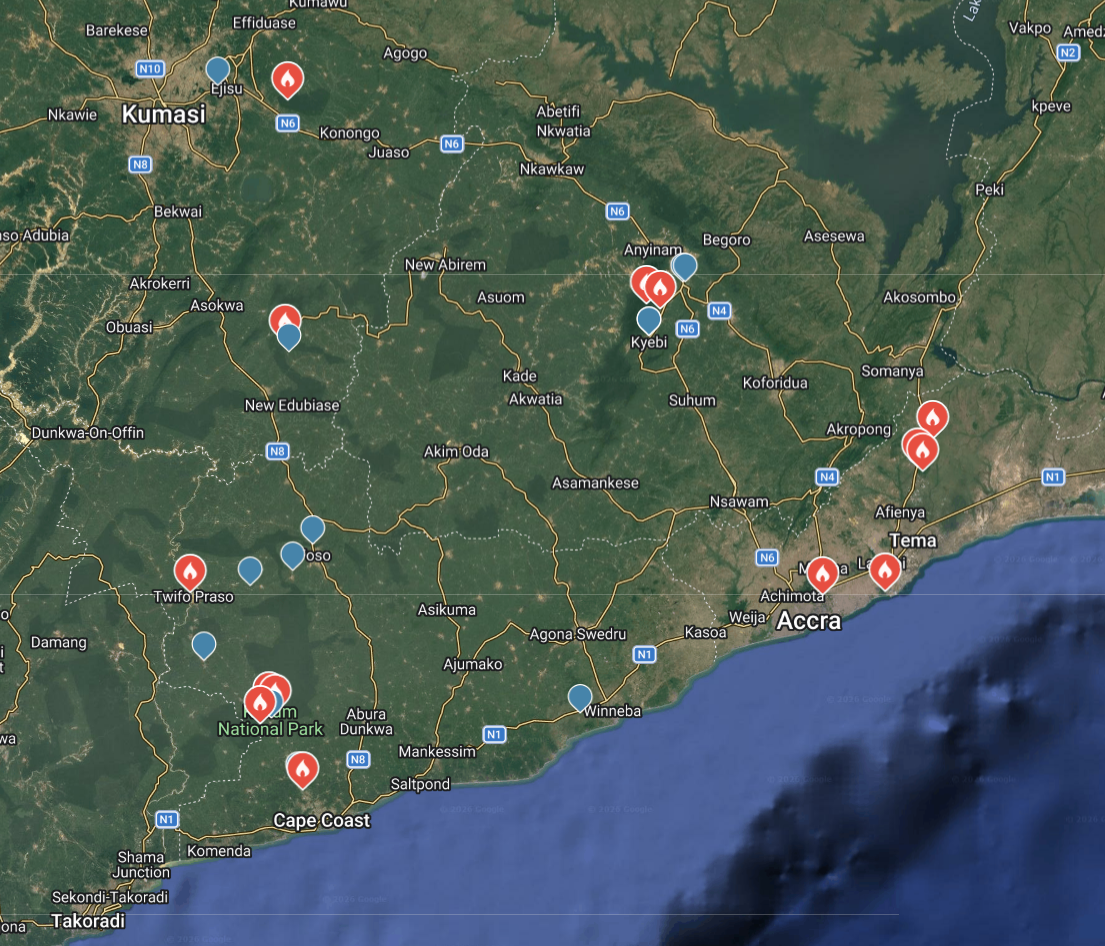
Today was almost entirely travel and waiting around — the price of my unilateral pre-trip extension. I was up again pre-dawn for a transfer to Tamale airport. I had booked on the earliest flight to Accra I could get, to make sure that any delays in my travel would have no impact on Ted and Dez, who were due to arrive around 1pm. I walked from the domestic to the international terminal then stooged around the outside airport concourse with a coffee then a light lunch, until, following their own delays collecting luggage and buying SIMs, the rest of the team finally emerged.
By the time we had loaded up our transport and got acquainted with our driver (???) and guide (Desmond, or “Cobbie”), we were hitting the roads at peak time, meaning we would get in hardly any birding. It took more than 3 hours to drive the 80km west to Cape Coast Rd, where we pulled up as the sun was setting. The main reason for coming here was to try for a couple of nocturnal birds. We scored with a key target here, Long-tailed Nightjar (the guys gripping that one back from my sighting the night before). Other common, but nice birds included Western Plaintain-eater and Double-toothed Barbet. I was reluctant to tick brief, stringy views of silhouetted Blackcap Babbler just on the basis of our guide’s identification, so it was good that I gripped this one back on the last day.
It was dispiriting to learn that we were only halfway to our hotel, and it was another 3 hours before we pulled up at the Hans Cottage Botel, our base for the next two nights. Beer, meal and bed, in that order!
Day 2, Saturday 29 Nov
It was still quite dark when we assembled for breakfast but as the day gradually lightened we could see that the hotel is a pretty array of buildings assembled around a lake with various interesting wildlife. A small island in the lake provides a roost for hundreds of Little Egret and Reed Cormorant. Also over breakfast we observed three species of kingfisher: Grey-headed, a couple of Pied Kingfisher, and best of all, we heard, then saw, a Giant Kingfisher in the early morning gloom. Later as we got ready to leave I saw it resting on one of the boardwalks, but I did not have camera in hand, and of course it had gone by the time I had grabbed the Canon.


Our original plan for today was to go to the world famous canopy walkway in Kakum Forest, but Kalu had pointed out that on a Saturday it would be very busy with locals and tourists alike, and we would be better off waiting until tomorrow. Even in our abbreviated itinerary we had ensured that we would have two days in Kakum. The alternative plan for today was to bird the fringing agricultural land and maybe head into a small part of the forest. It is often the case that the more open country created by low intensity farmland and the forest edge can be easier, more productive birding, and the guides obviously know this. So especially for a first day, this was an ideal alternative.


Over the course of 5.5 hours, we walked about 10km, and assembled an excellent list of birds. The full ebird list was nearly 60 species with some real quality in there. Turacos are a classic African family, endemic to the continent and big, distinctive and characterful. They are also often a bit shy, so although Yellow-billed Turaco was one of the first on our lists as we descended a quiet rural lane, we got no pictures. We accumulated three species of Cuckoo, Dideric, Klaas’s and African Emerald (all seen previously in Uganda). Naturally in the open country we were able to pick up various raptors, some perched some soaring. The best of these were lifer African Harrier-Hawk, and two species of Goshawk, African Goshawk and Black Goshawk (the latter was a bird I had missed in Uganda — I was photographing a Black-shouldered Nightjar at Lake Mburo when JP and Dave had a pair cruise through).


Also well represented were the bee-eaters, not an endemic family but Africa is their stronghold with around 20 species. Several were in my top targets, including the gorgeously-coloured (and aptly-named) Rosy Bee-eater. Sadly, although we saw several, they were all fly-overs, picked up by Cobbie on call, and we only ever managed high-up, silhouetted, flight views. If I crank up the over-exposure on a few of my pics you can start to pick out the lovely rose-coloured unders give the bird its name. In the farmland we also had Little Bee-eater and White-throated Bee-eater, which would turn out to be one of the commonest birds of the trip.
Wattle-eyes are another excellent African family and we had West African Wattle-eye and Brown-throated Wattle-eye. Sadly, these birds are very sweet but also elusive and although the views were great, we were unable to get any pics. Less interestingly, we had three species of Greenbul, and a couple of Cisticolas. Africa is also the stronghold of the sunbirds. By rights I should find them more exciting — they are the old-world equivalent of hummingbirds, small, fast and brightly coloured nectar feeders — but somehow they just don’t do it for me. I’m not sure why. Maybe its because they can be tough to identify and their true beauty needs good light to shown off their metallic colours to best effect. We noted seven species on the day (Little Green, Collared, Green-headed, Blue-throated Brown, Buff-throated, Olive-bellied, Splendid), but none very memorably or well photographed.
Other notable passerines included Red-vented Malimbe (*), Olive-naped (*), Chestnut-and-black (*) and Village Weavers, Bronze Mannikin, Black-and-white Mannikin, Orange-cheeked Waxbill (*), Bar-breasted Firefinch (*) and Northern Grey-headed Sparrow. Birds marked (*) were all lifers.
The best bird of the afternoon for me was one we nearly didn’t get. After a couple of hours we approached denser forest. Cobbie had had a Rufous-sided Broadbill here last week but we could hear a heavy vehicle and the sound of logging activity below us, and Cobbie was strangely reluctant to enter. Ostensibly this was because he was worried that the truck noise would diminish our chances of finding the broadbill and other forest goodies, but maybe he was privately worried about potential conflict with the loggers. Whatever the reason, I pushed for us to try. I had flown thousands of km, driven 6 hours, and walked more than 5km to get here and I was buggered if I was going to be deterred by a revving engine.
The truck itself was propped up by a makeshift jack and they were trying to unclog its axle that had so much mud caked on that it couldn’t turn. We walked straight past and began birding a couple of hundred metres on. The noise was actually not too bad and, brilliantly, within a short time a broadbill responded to Cobbie’s playback. Finding it was another matter, and we spent a good half hour trying different tactics and different angles. Eventually we found a spot where we could tell it was close, and probably stationary, in a very small, inaccessible clearing. Peering carefully through the dense vegetation between us and the clearing I worked my way systematically through all the possible perches, and my patience and persistence was rewarded with a bird shape with a flash of chestnut. Chestnut-sided Broadbill! Possibly my #3 target of the trip after EP and the Rockfowl.


“I’ve got it!”, I indicated to the others, but, having been gradually sweeping my gaze through bins, I didn’t really have much idea where I was looking and I knew I would probably lose it if I took my bins away, so my directions were almost useless. They were unable to get on it before it flew a short distance out of my sight. Bugger! Fortunately, it had flown just a little way back and now Des, standing a short way away with a different angle, was able to find it, and get the rest of onto it for fabulous views and nice (albeit dark) pictures. This was family number three for the trip, since I had never seen any of the Asian green broadbills that Rufous-sided Broadbill is bizarrely lumped with.
The chase for the broadbill had been exciting, but now that I could stop concentrating I realised that I had a crushing thirst, no water left to quench it, and a 5k trudge back to the van. We picked up a few more good birds on the way back but my mind was not really on the job.
We followed a late lunch back the hotel (the “botel”) with a stroll around the lake and picked up some nice new birds, including Orange Weaver, Shining-blue Kingfisher and Woodland Kingfisher.


Our afternoon walk, from the same village as the morning but in the opposite direction, was shorter and lower key. Notable species seen that added to the day list included lifers Red-necked Buzzard, Fire-bellied Woodpecker, and Melancholy Woodpecker. But our best bird was not actually a lifer for me. At the top of our walk, Cobbie led us down a steep narrow trail to a densely covered rivulet, where he began to play White-spotted Flufftail. We could hear it approaching from the right, but then somehow it managed to walk within metres, bypassing us and the called from off to the left. WTF?! But Cobbie’s playback kept it interested and it began to come back, and we were ready. We each scanned deep into the gloomy rut, and through bins got the mega-skulking White-spotted Flufftail picking its way along the tiny stream edge. Pictures would have been impossible so I didn’t even try. Later, just after sunset, we dipped on Akun Eagle-owl which the guides sometimes have here. Back at the hotel, we walked and slowly drove a road in a “suburb” above the hotel. The Eagle-owl is sometimes here too, though we dipped again. We did have nice views of a Long-tailed Nightjar before the call of beer and meal was too strong.
Day 3, Sun 30 Nov
We were up pre-dawn (as usual) for the most important day of the trip, visiting arguably the two best and most famous sites in southern Ghana, Kakum National Park and Nyamebe Bepo Reserve. Overnight we had been joined by Kalu. His previous punters had been affected by unavoidable flight schedule changes, so he had arranged for Cobbie to guide us for the first day and half, before he could travel up to meet us having dropped his previous clients off. In a bonus for us, it became clear that Cobbie would continue with us, so we would have two guides for the price of one for the next 3 days.
Just beyond the now familiar village of Odumase Abrafo we drove into Kakum National Park itself. From the carpark, we ascended a steep path, before climbing up to the famous canopy walkway. An African Piculet called, identified by Kalu, but he was unable to coax it into view.
As I climbed the staircase to the platform with Cobbie, some 15-20m ahead of Ted and Des, I saw a black bird fly up and land on the rope that suspends the canopy walkway, just beyond the platform. “Drongo”, I called to Cobbie. But something was not right and almost immediately, we both realised that this first bird was also one of my top two targets for the canopy walkway, Black Bee-eater, a stunning bird that I had targetted but missed in Uganda, adding to its desirability.


Before I could get a decent pic, and before even Ted or Des could get on it, it flew to a more distant perch, in much poorer light. It was not far from the second platform, so Ted and I walked as quickly and smoothly as we could, realising that photos from the moving suspended walkway would be impossible and we would have to make it to the platform and hope the bird stayed put. It did not :-(. We relocated it further away still, and then after a few minutes it disappeared altogether, before any of us could nab decent pics.


We walked and swayed our way along the suspension bridge to the third platform where we would spend the next few hours. Disappointingly we could not get all the way to the fourth platform because of maintenance work. Kalu explained that this is probably the best of the platforms for general viewing and also his “go-to” spot for Purple-back Hyliota (the other of my top two targets from the walkway, because it would be one of the five new families on offer for me — but we would leave here without getting a sniff of Hyliota).
Nevertheless the birding experience at the third platform, apart from feeling a bit claustrophobic and vertiginous (!), was excellent. Good new birds kept appearing throughout the morning, including Western Long-tailed Hornbill, Blue Malkoha, African Green-pigeon, Hairy-breasted Barbet, Cassin’s Honeybird, Fire-bellied Woodpecker, (at least views of the fire belly today, after head views in the nest hole yesterday), Yellow-browed Camaroptera, four species of the ever-present, ever-dull Greenbuls (Slender-billed, Honeyguide, Yellow-whiskered and Grey), Violet-backed and Splendid Starlings (in small groups, conspicuous but high in the canopy), Collared Sunbird, Maxwell’s Black Weaver and Grey-headed Nigrita. A Wood Warbler reminded us that December in sub-Saharan Africa means wintering Eurasian warblers.
After an hour or so we even had a return from the Black Bee-eater, now on the suspension cables between the third and fourth platform in much better light. Getting focus lock was tricky with multiple distractors in the foreground and background. I switched to manual focus and was now able to grab a couple of reasonable record shots of the beauty. The suspension ropes were also attractive perches for several White-throated Bee-eaters and a Speckled Tinkerbird.
After 3.5 hours in the canopy it was time to get moving so we could arrive at our afternoon/evening destination for the most important rendezvous of the trip. We stopped a few times along the way at places that Kalu clearly knew from numerous previous trips. A Red-necked Buzzard cruised overhead at ne impromptu stop and allowed great pics for Ted, who’d had poor views of yesterday’s bird. We made a scheduled stop at the Pra River bridge where we were excited to scope four Rock Pratincoles (I have said elsewhere on this blog a few times that I do like Pratincoles 😃) and we also had nice views of the very smart White-throated Blue-swallow and a few White-faced Whistling-duck. By a small bridge which Kalu identified as a nesting site for Preuss’s Swallow, initially we could see nothing and were resigned to dip. But just before we were about to leave we picked up some distant hirundines high in the sky. They came down low enough before we left to confirm the identity as Preuss’s Swallow. Thirteen km on, we stopped again at another small bridge and had a very smart Marsh Tschagra (and a Broad-billed Roller and more Preuss’s Swallow).


At 3.15pm we rolled into the village of Nyamebe Bepo and Kalu made the appropriate arrangements. We followed a pair of locals up through gardens and degraded forest, gradually becoming better and denser, for about half an hour. At one point we were caught by another local who made us turn back and take a different track. It seems the main site for our target was pre-booked by another group, and we would head to a secondary place. We held our breath that this would be be a problem.


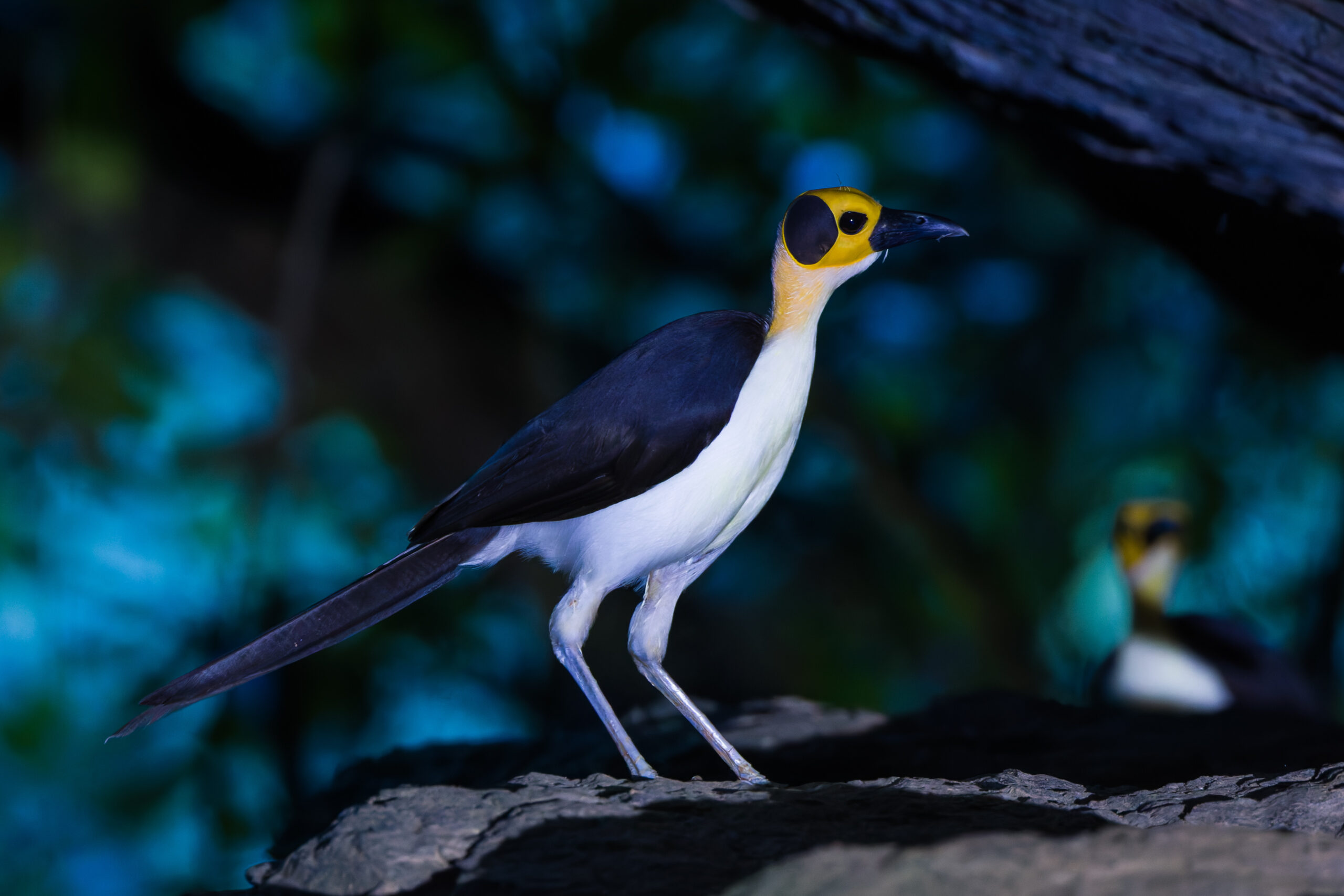
After about 1500m of mostly uphill walking, we reached a large rock with a big overhang, and two makeshift benches set back about 5m. On the underside sloping face of the rock, in the dark shadow, we could make out a few nests. The benches, where we were to sit, felt very exposed, but we had to assume the locals knew what they were doing. Earlier than expected, not long after 4 and still a long time to sunset (though already quite dark in the forest) our quarry arrived. Materialised before us on the other side of the huge boulder, was a superb, prehistoric-looking Picathartes or Yellow-headed Rockfowl (also known as White-necked Rockfowl). Structurally, and size-wise, like a crow, but with pure white unders and a bizarre, bare yellow head it looks like nothing else (except the only other member of the picathartes family, the Grey-necked Rockfowl). It bounded across the bare ground below the overhang, lingered tantalisingly for pictures in a small patch of sunlight at our end of the rock (all of which I spoiled by having my shutter-speed set too slow), then disappeared behind another huge boulder behind us.
We would wait, excruciatingly, for another hour before it reappeared. It was behind us, with another bird, and we thought this might be our lot, until a little while later, more birds started to arrive on the far side of the rock, as the first had done. By now it was quite dark, but the locals shone torches into the darkness under the rock and we were able to enjoy outstanding point-blank views and decent photographic opportunities, since the birds seemed totally unconcerned by our close presence.


In all we saw approximately 8 birds, and left them in peace at about 5.30. On the descent I heard the distinctive ratchet song of Rufous-sided Broadbill, and we stopped to attract it. Directly above our heads, in the incredibly dark forest, the view was terrible and I was grateful we’d had much better views yesterday. Ted managed to record a few bursts of the song. We also played the call of the forest-dwelling Brown Nightjar as we descended, and although we elicited a vocal response, we were unable to see one, so it stayed on our heard-only list.

And now we began another long drive, of around 3 hours, to get to our overnight accommodation. I actually recall very little about the Excelsia Hotel on the outskirts of Kumasi, though I do remember that Kalu gave us a choice — either wifi and hot showers, but a drive to tomorrow’s site, or an isolated, solar-powered, wifi-less homestay right in the middle of the park. We ended up with the comfortable dudeish option! I guess it was unremarkable — neither especially good, nor especially bad — because I don’t even remember if we were able to celebrate a stellar day with a few beers. Maybe the availability of the amber nectar was even the deciding factor for staying in town… !?
Day 4, Mon Dec 1
Mercifully our drive last night had located us reasonably close to this morning’s site, another famous Ghanian birding spot, Bobiri Butterfly Sanctuary. This is a protected 56km sanctuary of primary forest quite close to Kumasi, and holding a different diversity of birds, and some fabulous old, large trees.
Birding around the hotel grounds before 6am, as we waited for our transport to be ready, yielded a few new species for the trip including Variable Sunbird, then it was just a quick 25 minute dash to the reserve. With only one morning at our disposal, our birding was restricted to the entrance road, which leads to the visitor centre and accommodation, and then a short way beyond it. It was slow but steady, and over 4 hours we observed around 30 species, with more than half being lifers for me, showing the value of visiting different sites and habitats. For me, the highlight species was Red-billed Helmetshrike (Bobiri is a known hotspot). They were conspicuous in a couple of groups of 7-8 , but rarely stationary or in the open. These were my first helmetshrikes anywhere, but they are part of the Vangidae family, of which I had previously seen one or two, so not lifer family.


Blue-headed Wood-dove had eluded us at the canopy walkway (heard only) so we were gratified to claw this back via flight views when one shuttled back and forth over the road a couple of times in response to Kalu’s playback. We also clawed back African Piculet, another bird heard in Kakum. I ticked off a slightly stringy Thick-billed Cuckoo, whose silhouette I saw flying over, identified by Kalu. I normally like to make sure I can ID on my own on features that I have seen, but in retrospect, my view was good enough to take Kalu’s word for it 😜. Two Tinkerbirds showed themselves, Red-rumped and Yellow-throated. This latter species was the second of a hattrick of “yellow-themed” Tinkerbirds that we got confused by, but also eventually managed to see all three — Yellow-rumped, Yellow-fronted, Yellow-throated.
The guesthouse accommodation was set in a beautiful lush green garden, and I felt some pangs of regret that we had stayed at the completely unmemorable place last night. Maybe we should have sacrificed wifi for just one night to wake up in the middle of primary forest, surrounded by butterflies and interesting birdsong (actually the number of butterflies was low compared to other places not named as a butterfly sanctuary, but peak season is apparently March-June).


Kalu and Cobbie led us to a spot beyond the guesthouse, deeper into the forest, where African Grey Parrots are known to breed and we were able to pick out one protruding from its nest hole. Although an iconic, well-known species, it is now classified as Endangered by the IUCN, largely because of the international pet trade. Between 1994 and 2003 it is estimated that nearly 360000 of the birds were traded, with more than 20% of the world population “harvested” year-on-year. The species in now protected and it is illegal to own one without a permit in most places. Nevertheless it is estimated that the Grey Parrot population in Ghana is down around 95% from its 1992 numbers.
Another cracking bird and real highlight was Blue Cuckooshrike, a beautiful, unmistakable all-blue-grey bird with red eyes. We heard one, and saw one, but I was unable to get any photos.
Other notable species (mainly the lifers) included Black-winged Oriole, Yellow-chinned Sunbird (unaccountably, yawn), smart Chestnut-capped Flycatcher, Tit-hylia, Lemon-bellied Crombec, and Red-fronted Parrot (another flyover bird, sadly).


Final lifer and last bird at the site was Swamp Bulbul, which had been tormenting us by singing invisibly in several spots. As we returned to the car I heard another and finally we were able to get good views of a bird that is not normally so difficult and skulking.
After another 3-hour drive on terrible roads, our next site was Atewa Hills. A foray into nice forest would have to wait for tomorrow, and today we walked the fringes, where gold mining has ripped up large tracts of both agricultural land and prime forest alike. We poked our way around some scrubby ground at the edge of Atewa Forest known on ebird as “Sagyimase mining concession” and also “Atewa Range farm scrub“. While avoiding the attention of the miners we accumulated a quite nice array of birds, including the pick of the bunch, a fabulous Dwarf Bittern. New birds for the trip included Blue-headed Coucal, Double-toothed Barbet, Yellow-rumped Tinkerbird,(completing the hattrick), Winding Cisticola (as well as Tawny-flanked and Red-faced), Leaf-love, Grosbeak Weaver, Copper Sunbird, Orange-cheeked Waxbill and Plain-backed Pipit.


Although our digs for the night at the K-Archy Lodge were quite comfortable, the service was very off. The waitress clearly resented that we were here, forcing her to work, and her grumpiness became an in-joke at our table. You meet all sorts on a birding trip!
Day 5, Tues Dec 2
An 8-hour walk this morning up into the Atewa Forest yielded some of the best birding of the trip (55 species and 14 lifers), but also the hardest photographic conditions, with birds skulking or high the canopy. I took only a few photos and missed killer shots of our top targets, even if we did see most of what we wanted.
At the edge of the scrub, the limit of our walk yesterday, we tracked down a stunning Red-cheeked Wattle-eye after a lengthy wait while it skulked inside dense scrub. Des finally barged his way inside, Ted and I followed, and once we were there had great views of the little beauty.
After this it was slow going as we tried to coax into view a Puvel’s Iladopsis. Ebird describes it aptly as a “midsized chunky drably coloured babbler…. shy and skulking and rarely seen unless searched for”. We can attest. Eventually we did get reasonable views of the dullard after much searching. Even harder was Western Nicator, which we heard in three separate spots but try as we might could not get even a glimpse as they stuck to dense foliage in the canopy. Likewise Black-bellied Seed-crackers remained a glimpsed shadow, low down and deep in dense cover. At the time I had not appreciated what a stunner these skulking waxbills are, and in retrospect should have made even more effort to see them.
As we climbed higher and higher, penetrating into better forest, Yellow-billed Turaco were heard regularly, calling loudly from high in the canopy. We got visuals of a few but they were always too distant for pictures.
Easier to see, but mostly still hard to photograph were various flycatchers. The gaudiest of these were the Paradise-flycatchers, with both Black-headed (Red-bellied race) and African Paradise Flycatcher present, flitting about energetically just below the canopy, sporting crazy long tails. African Shrike-flycatcher, Blue-headed Crested Flycatcher, Ussher’s Flycatcher, Dusky Blue Flycatcher, African Forest-flycatcher, Grey-throated Tit-Flycatcher and even a reminder of European migrants, a Eurasian Pied Flycatcher.


Mid-morning we had become strung out along the trail, and I heard some discussion below me. I returned (without the urgency that I now realise was warranted) to the news that Kalu, who had been hanging back, had just had a pair of Violet-backed Hyliota right next to the trail, but they had flown high into a much larger tree some way off before we could be alerted. Hyliota was the last of my 5 target families for the trip, and so Violet-backed Hyliota had been elevated to my now most-wanted bird. I scanned the distant canopy and detected some movement but there were a few birds moving rapidly around, never stopping in the open to allow any kind of ID, and eventually even these birds disappeared, leaving me to rue these ones that got away.
The value of a knowledgeable local guide came to the fore for two of our main targets for this site. First Kalu played the call of Chocolate-backed Kingfisher in a couple of places, with the second spot yielding dividends. We heard it calling back in response, but took a while to track down. Eventually it was the sharp eyes of the local guide that picked it out on an open perch but high in the canopy. Near the top of the our walk, Kalu had also been playing Blue-moustached Bee-eater, another of the local specialties We did not hear a peep, but suddenly Kalu announced that he had it, high up on a dead branch. This was evidently known behaviour, arriving noiselessly to check out a potential rival, and Kalu had been on the lookout in a known territory.


Beyond the Bee-eater, activity from a few different species in a massive emergent tree drew our attention and I was stunned to find a distant Violet-backed Hyliota, seemingly clawing victory form the jaws of defeat. I got Ted onto it and we grilled it for a minute or two before high fives and relief all round. But these joyful emotions were soon crushed by Kalu, who pointed out the the unders were too white, and we were looking at a quite similar African Flycatcher-shrike. Kalu even confessed that he might have been tempted just to let us continue in our joyful but ignorant state, but the fact we were taking pics meant we would work it out sooner or later, so better for his reputation to help us there now, even if it meant bursting our bubble!
Also getting interested in the family-listing theme, Ted had a similar list of family targets to me, though did not need Egyptian Plover (otherwise he would probably have come on the pre-tour extension), but he also needed a Hylia, and after much searching, and hearing of possibles, we finally laid bins (but not cameras) on a Green Hylia, for a family tick for Ted.
Other interesting quality species noted on this walk included Levaillant’s Cuckoo, Naked-face Barbet (what an ugly mf), Buff-spotted Woodpecker, Western Black-headed Oriole, West-African Wattleye, West African Batis, Grey Longbill (a warbler masquerading as a dull Greenbul), Green Crombec, Yellow-browed Camaroptera, Black-capped Apalis, Rufous-crowned Eremomela, our regular reminder of Europe, Wood Warbler, and Johanna’s Sunbird, which I will grudgingly admit is quite smart with a crimson breast and purple throat, was new for the trip (and a lifer). Gazing up into the skies yielded a flyover Crowned Eagle and a few Mottled Spinetail.
Getting around in Ghana is not straightforward, because the roads are utter shite! After a late-ish lunch we endured another very long drive if 120km — about 3-4 hours on increasingly slow potholed roads — from the Atewa Range to Shai Hills, a well-known savannah site on the outskirts of Accra. We arrived after sunset in time for some owling, which was our first unequivocally successful owling of the trip. As well as nice views of Senegal Thicknee, and Plain and Long-tailed Nightjar on the track, Kalu tracked down two separate, fabulous Greyish Eagle-Owls. Our basic accommodation felt like it had been opened up specially for us, and we invited ourselves into the closed “dining room” where we rearranged some of the stacked chairs and tables to be able to eat the takeaway chicken and rice that Kalu had pre-ordered.


Day 6, Tues Dec 3
The following morning from just before 6am we cruised the tracks, skirting the base of the rocky outcrops and winding through patches of grassy savannah and scrubby woodland, racking up a nice array of new birds now that we were in new habitat.


We began on Adwuku Route where key highlights, and new birds for the trip included African Cuckoo-hawk, Senegal Parrrot and White-crested Helmet-shrike. A pair of Snowy-crowned Robinchat sang invisibly from inside dense cover, but when I returned to the same spot about 15 minutes, they were chasing each other through a small clearing and I was able to squeeze off a decent shot of one. We tracked down some vocal but distant Violet Turacos in bigger trees 2/3 way up the outcrop, but they were too far away even for record shots. As well as Brown Babbler, I was able to claw back Black-cap Babbler, the bird I had missed on our first evening. A pair of stunning Yellow-crowned Gonolek gave excellent views, a lifer for Ted and Des, but I had seen one in Mole a few days ago. This time our regular reminder of Europe came from a Spotted Flycatcher.


On the north-western side of the hills on the Kandra Route (where we had birded the previous evening) and past Mogo Hill, the diversity was lower, perhaps because it was later in the day. As we scanned the cliff face for Mocking Cliff-chat (which stubbornly refused to show itself) we observed soaring Gabar Goshawk and Shikra. We clambered up the steep slope trying to track down the Cliff-chat, as an African Barred Owlet sang, also invisibly, and we noted Guinea Turaco and enjoyed a superb view of the surrounding plains, once we emerged precariously to the top of the outcrop. On the dry grasslands as we drove out of the reserve we noted Croaking Cisticola and Flappet Lark, both new for the trip.


By midday it was time to return to the hotel and load up, ready for our flight back to Dubai. We had one more bit of birding in store. Just east of the airport, the Sakumono Lagoon had produced some strong lists for our UAE-birding friend Jeff Kingma a few weeks earlier. Although we would not have time to enter the reserve, we could detour along the coast and walk along railway tracks that skirt the lagoon, a site known on ebird as the Sakumono Lagoon overlook . Although we had to keep our wits about us and eyes and ears peeled for trains as we birded along the tracks, it was very worthwhile with some nice wetland birding — another new habitat — and including a lifer Kittlitzs’s Plover, my final new bird.
https://ebird.org/tripreport/437388
A summary of the overall trip in numbers then: 245 species recorded, of which more than half — 127 — were lifers; four new bird families; and some top, very desirable taxa, including Egyptian Plover, Forbes plover, White-necked Picathartes, Rufous-sided Broadbill and Black-Bee-eater; and importantly these days, excellent craic!
