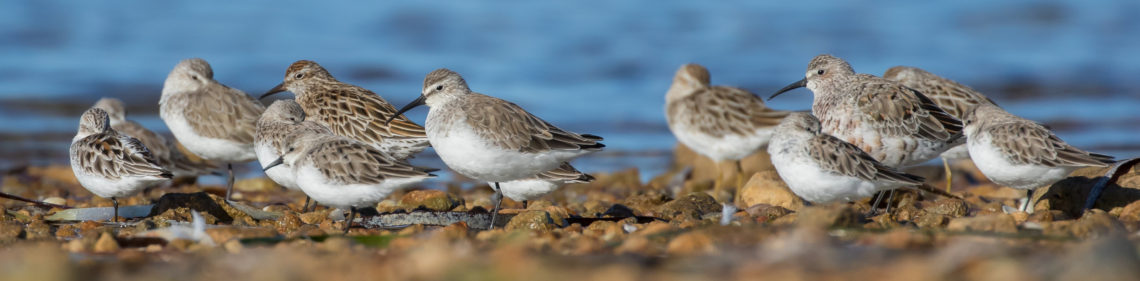
I have just finished writing this blog and it’s now end of Jan 2026, some 5 months after my short weekend trip to Rajasthan in August 2025. It has taken me a long time and multiple further birding trips for the pain to dim sufficiently to begin reliving the experience, and I didn’t even start writing until a few days ago, in late Jan.
Sometimes I wish I was more like my “patch watching” colleagues who will spend many many enjoyable birding hours trapsing over the same local ground, enjoying the walk and occasionally finding something a little rarer for a bit of excitement. But if there’s nothing rarer, so be it. For them, the pain of missing a bird barely exists, because you do not go with any expectations. Twitching, on the other hand — which I used to do and still do sometimes — is more hardcore, and creates the possibility for greater excitement from the anticipation and the expectant thrill of the chase. But it also creates the conditions for much lower lows: the “dip” in birding terms, failing to find the specific bird you are looking for. Targetting particular iconic species on a foreign trip is not exactly twitching, but it’s closer to twitching than patch watching. It creates the possibility for spoiling what would otherwise be an exciting and often scenic foreign adventure, and the lows can be even more acute because it’s usually the case (at least for me) that you will never be able to return to try again. It would be great to travel somewhere nice and just enjoy what I see, but I cannot help myself — I have to find out what might be available and go for it if possible.
This blog, then, is the tale of some outstanding birding in an amazing, beautiful area, rich in nature and culture, but punctuated (some might say, spoiled) by one of my worst dips ever.
How did it come to this? I decided early in the year to try to bracket my “twitch” (ok, so maybe targetted foreign birding is a kind of twitching) of Great Indian Bustard of 2023 by trying now, for the smallest and rarest of the family, Lesser Florican. Lesser Florican is poorly known and numbers have plummeted catastrophically and potentially terminally in the last decade. Just about the only way to see one is to be in Rajasthan in the Monsoon Season, when they congregate in one or two areas and the males perform a popping, jumping ritual to attract the ladies. If they are not jumping up and down then they are almost invisible in the grasslands or lentil fields that they favour. Noone really knows where they go or what they do for the rest of the year. Consequently outside a small breeding season they are impossible to see.
I knew I could use my base in Abu Dhabi for a long weekend shot, so I worked out the optimal time and booked a guide and flights to coincide with my first weekend back on campus at MBZUAI. My first, but least problematic, logistical cockup happened in the week leading up to the trip, when I fell for a hotel scam: the “manager” contacted me, not through the booking.com app, but over whatsapp, to tell me that the hotel would be closed for renovations and I could go to another, a bit further from the airport. I should have spotted this as a scam straight away from the whatsapp comms, but evidently was not thinking very clearly. Besides, this turned out to be the least of my logistical mistakes. It was about to get much worse.
A few days later my fatal logistical cockup bit hard. As I tried to check in for my flight the day before, I was refused: I realised that I had forgotten to organise a visa for India. In a panic I went to the appropriate Indian Govt website and was horrified to discover that they say to allow 72 hours. Looking back at my previous visa correspondence for the 2023 trip, I saw some hope, because that visa was granted in 12 hours. Maybe I would get lucky. You guessed it, a big fat NO, I did not. The next day, visa still pending, I could wait no longer, and had to rearrange my trip entirely. Fortunately my guide was still available and the flights could be changed (at a price). I would now go a week later than planned, and for 3, not four days. Even so, it should have been plenty of time for my main target, and still within the critical display window for the Floricans.
Sat 16th Aug
On arrival in Jaipur Airport at 2am, I poured my tired body into a taxi and headed to the replacement hotel. Because of the scam, there was of course, no booking for me. I managed to communicate enough with the people at the desk that they found a tuk-tuk, and sent me (and another woman in the same situation) to yet another hotel, though by now the room was double the price of the original one I had booked. I was too tired to argue and it probably would have been pointless anyway. Finally, close to 3.30am, I was able to get a couple of hours sleep.
The following morning at 7 I was met by my guide, Ghani Singh of Birding9. Ghani spoke great English, was a really nice guy and easy to talk to, and very sharp in the field. Highly recommended. We travelled immediately SW towards Ajmer. As we drove, he broke the worrying news that the last sighting of Lesser Floricans had been three days ago. There were at least 3-4 groups out looking in the same spots and in other likely places, talking to locals, but continuing to draw a blank. Floricans love to display in the rain, and the last rain was — unseasonally — several days ago, so maybe the lack of rain was putting them off. I would, of course, have seen these birds had I not self inflicted a right royal shafting on my original plan. Ghani was confident we’d be fine, but I was already on edge, having thought this might be a sure-fire foreign “twitch”, despite the species precarious “Critically Endangered” classification.
By 9am we were just SW of the amusingly named town of Dudu and we left the highway to explore back roads where the habitat would be better for birding in general, and we might even have a chance of a Florican.
The Rajasthani countryside at this time of year is lush green, punctuated by ponds and pools that have been filled by monsoon rains. In the small villages, men squat in the shade and chat, while the women walk around in brightly coloured saris. Cows are everywhere, sharing the streets and paths with people. Bigger villages and towns are a riot of colour, bustle, noise. barking dogs honking horns, revving motorcycles.


We did not, of course, find a Florican but I did enjoy some excellent birding, finding relatively common species like Indian Bushlark, Ashy Prinia, Singing Bushlark, Large Grey babbler, Jungle Babbler, Wire-tailed Swallow, Streak-throated Swallow, Rosy Starling. Ashy-crowned Sparrowlark was my second lifer of the trip after a distinctive Pied Cuckoo was the first, but it was seen and then gone before I could wield camera. The best birds of the morning were actually non-lifers, a superb pair of Painted Snipe.


As we arrived in to the environs of Shokaliya, I added Knob-billed Duck to the list, and had brief views of an uncooperative Rain Quail for more quality. As the day wore on, the birding was a lot slower, as it usually is, but it picked up considerably after 4pm, when we visited (for the first time of several over the weekend) the area in which a Lesser Florican had been observed over several days in a row, but most recently 3 days earlier. The whole area is unprotected grassland used for goat herding, and crops such as lentils and cotton. We stared out from a raised mound across the flat grassland hoping to see a head appear or hear and see the popping display from the distant lentil fields, but of course we did not see one. The birding, nevertheless, was excellent. Rain Quail performed brilliantly, we heard 3 Painted Francolin and saw one very well (if distantly), observed a couple of Rock-bush Quail, a few Indian Thick-knee and both Rufous-tailed Lark and Common Woodshrike were smart lifer passerines. Arguably the best bird was was quite rare for the area, Bristled Grassbird. We worked hard for this but in the end were rewarded with excellent, unequivocal views.


We retired to our base for the next two nights, Clarks Resort, about 40min away, a comfortable 3-star place that seems to be where most birding groups stay. After freshening up, I met Ghani in the restaurant, where delicious spicy food washed down with Kingfisher beer — a highlight of any Indian trip — helped me put the logistical mess-ups of the last week to the back of my mind, reflect on some excellent birding today, and be optimistic for tomorrow.
Sun 17th Aug
We were on the road at dawn, passing through the lush green countryside and flooded meadows as the sun rose.


We picked up a local conservation guy who directed us to a different site from yesterday where he’d had a male Florican for several days in a row — until two days ago… We walked into the middle of a lentil field and spent a good 3 hours scanning in all directions. Spotting the heads of Cattle Egrets above the crop was a good exercise to stay alert, and also a clear indicator of why the Floricans are so hard to see, even in what appears to be very low crop. Even at this early stage of the season, egret heads only just reached above the tops of the plants and they would regularly disappear completely as they bent down to feed. We finally and reluctantly gave up on the Floricans, then had a very extended battle with two Small Buttonquails that a times felt like they were under our feet but refused to show even a glimpse to either myself or Ghani. As we drove away, we heard, then spied, a distant Black Francolin. I insisted on stopping because, although I had ticked off a much better view in Cyprus in 2003, this would officially be my life bird in ebird, because the Cyprus birds are introduced.
We returned to yesterday’s viewing mound, and scanned from here again for a while, also noting that there were at least two other bird groups in other distant parts of the same area, all, like us, dipping. We heard more Small Buttonquail, reacquainted with yesterday’s Bristled Grassbird, and also noted Zitting Cisticola, Common Babbler and Sykes’s Warbler, before moving on to a third site. Ghani had previously had Florican’s here but none had been reported this year. But with nowhere else to go it was best for us to be out trying to find where they might have gone. A local passed us on his bike and stopped to talk to Ghani. He knew what we were looking for. Ghani later translated that he had seen them last year, but nothing at all this year.


Late afternoon we visited some different sites, aiming to resurrect a disappointing day with a couple of my secondary targets. First we visited an area where we connected with absolutely superb Indian Coursers. These birds allowed excellent photos in pure late afternoon light. Other nice additions included Blyth’s Reed-warbler and Bay-backed Shrike, as well as common, but still good Yellow-wattled Lapwing, Indian Thick-knee (again) and Indian Robin.


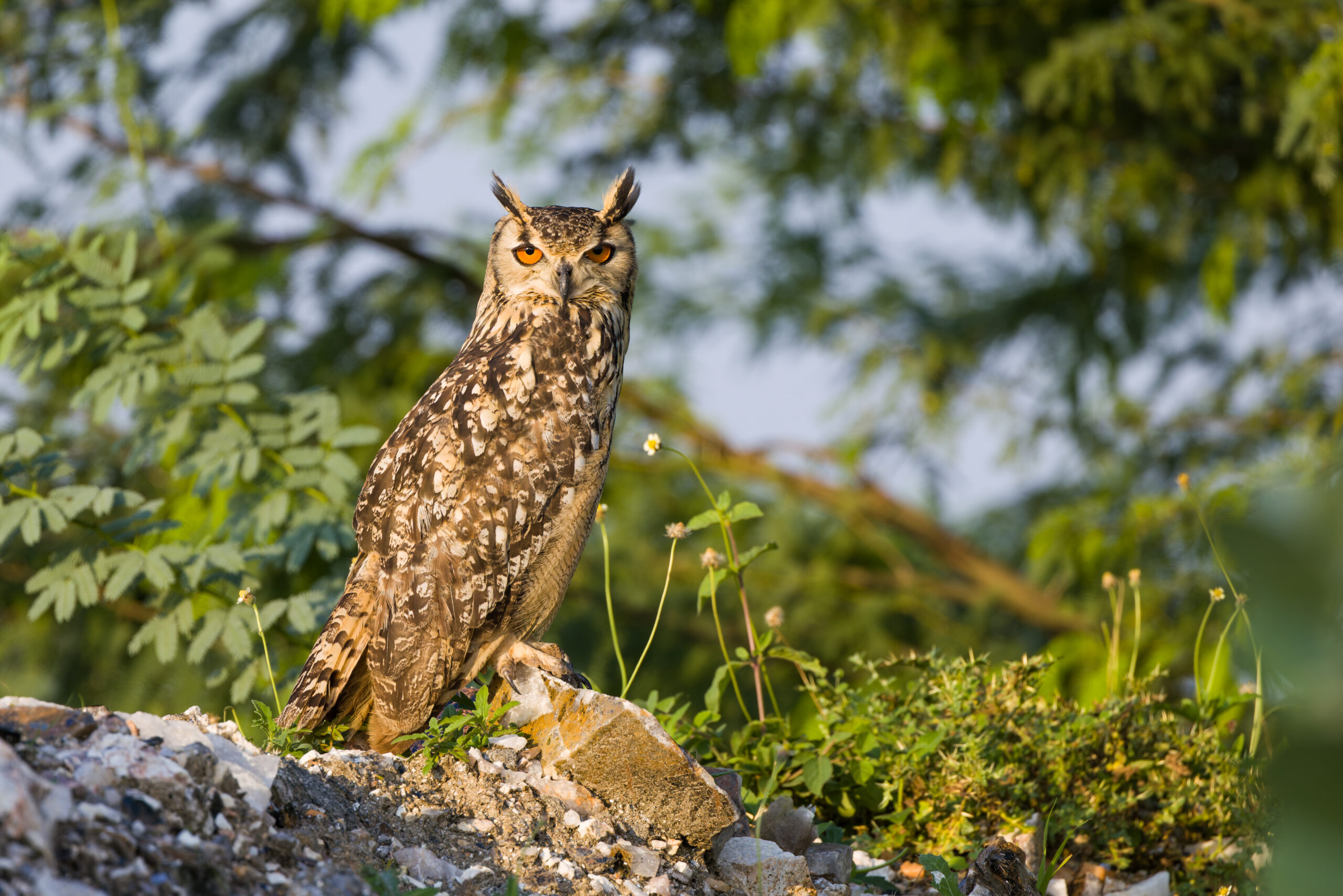
Later still we drove further afield to a quarry. Creeping slowly in the car along one edge, Ghani got the driver to stop quickly. About 60m away, he’s clocked an Indian Eagle-owl. Fantastic. Even better, the road coursed around the quarry to the other side and we were able to approach this stunning beast to within about 10m. Even Ghani, who hs seen these birds many, many times, was in awe. After jumping out of the car (a safe distance from the owl), we walked along the top edge of the quarry and amazingly Ghani found a roosting Indian Nightjar. Even as he was giving me precise directions I struggled to find it, so can only imagine the skill (or detailed knowledge and experience) he was drawing on to have found it. As we drove away something scuttled away from the side of the track and Ghani realised this was Rock-bush Quail. With patience we were able to get great views of a pair in the fading evening light.


Over dinner, Ghani remained optimistic that our final morning would deliver, but I struggled to agree. We had had a pretty good afternoon though, catching up with two A-listers that I really wanted to see, the courser and the owl.
Mon 18th Aug
First port of call this morning was our fourth visit to the area where just a few days ago I would have seen a Florican had I not messed up. You know by now that we didn’t see one. In the misty morning in light our first bird was an Indian Roller (a similar UAE resident also). The Bristled Grassbird was still behaving nicely and we also found and grabbed some record shots of a local rarity, Grasshopper Warbler, looking slightly bedraggled. It was reported earlier in the weekend but this morning was the first time we were able to see it. Small Buttonquail were calling all around. We heard at least 4 and flushed a few.


Ghani then navigated the driver to a couple of spots where he knew we had good chances for new trip birds (and lifers for me). First, around 8h15, we stopped for breakfast in one of the attractive grassy, sparsely wooded areas. Yellow-wattled Lapwings sauntered about as I munched my brekkie, but very soon Ghani spotted something even better: 4 Painted Sandgrouse were feeding quietly on the grass about 100m away and allowed reasonably close approach in the car (it never ceases to amaze me how on foot we would have flushed the birds a long distance away, but 2 tonnes of steel and rubber is much less threatening, apparently). A few elegant River Tern swooped low over one of the ephemeral lakes that dot the area, a Baya Weaver posed nicely on a reed stem, then at our next stop we successfully chased Yellow-eyed Babbler, a lifer for me. It took some time but eventually one posed in the open for long enough for a decent record shot.


Sadly, it was now time to leave the area, and reconcile that I would have no further chance of Lesser Florican, not just on this trip, but maybe ever 😬😢.
We still had most of the day at our disposal, and I there were still a few local specialties to chase. Near Ajmer we diverted up a road into hills towards Pushkar, and pulled in at one of Ghani’s “commercial-in-confidence” sites.

Here we had some excellent birding, initially chasing after a White-naped Tit which gave brief unsatisfactory views and then played hard to get for about 30 minutes (eventually I got views and pics I was happy with). As we tred for the next target, Rufous Treepie and Pied Cuckoo both iut in nice appearances, and then we did connect with the very smart White-bellied Minivet. Finally, Ghani was able to coax a White-tailed Iora for a hattrick of local scarcities.


We actually made good time to Jaipur, so we stopped short of the airport and I drank a masala chai (very sweet, very fragrant, milky tea) before Ghani and his driver dropped me back at Jaipur Airport. This could have been yet another self-inflicted error because initially we had come to the wrong terminal. Ghani had driven off before I realised. But luckily I was able to call them and they were not too far gone.
Thx Ghani, for a great trip! I managed 21 lifers and some great encounters with top birds like Greater Painted Snipe, Indian Eagle Owl and Indian Courser. To say “Shame about the Floricans” seems like an understatement given how much I was pinning on this one species and how gutted I was to be leaving empty handed. I hope, for the sake of the species, they will not be extinct next year (now this year by the time I am writing). And if they are not, maybe, just maybe I’ll give it another crack in 2026.
