Family holidays and birding are like oil and water, not mixing well. Nevertheless, like old Italian nonnas working out that starchy pasta water can encourage those sworn enemies to emulsify, so too I have discovered one or two ingredients that allow me to combine a spot of birding with a family holiday for a harmonious whole. If you have followed this blog you will immediately realise that success in the past has always involved some or all of the following: beaches (usually tropical); good food and drink; a level of accommodation that is a notch above my usual birding digs; and a small but high quality list of birds that I can target in a few mornings rather than be out birding 24/7. This formula has now worked for New Caledonia, Tropical North Queensland, south-west WA and Lord Howe Island.
Where next? Well, if you are asking that question then you obviously didn’t read the title of the blog…
With the girls living at either end of the continent, one in Sydney, one in Perth, and mindful of the formula above, I made two suggestions for a July 2025 family holiday: we meet in Perth and have a trip to Bali; or we meet in Sydney and fly to Fiji. I removed myself from the final decision-making, and the consensus was in the end for Fiji. Nikki and Lou would be spoiled for pools and beaches for sunbathing, Eri could do some diving. And importantly (but not most importantly, you understand), I would have a few high-quality endemics to chase.
I was especially keen to see the stunning, outrageously-coloured, but unimaginatively-named, Orange Dove. I am very grateful to Quentin Paynter who pointed out that OD is not available on Viti Levu, the main island, and I would need to go either to Vanua Levu or Taveuni to get this top target. Vanua Levu and Taveuni are also the only places to see the enigmatic, poorly known, but much-desired silktails. There are two: Taveuni Silktail and Natewa Silktail. The former is only found on Taveuni, while the latter is restricted to the Natewa peninsula on Vanua Levu. They are closely related to fantails, in the genus Lamprolia, but with dark, velvety-black plumage apart from a silky white tail and blue spangly crown, they have been described as being a bit like tiny birds of paradise, adding to their allure.
Armed with this important knowledge, I steered Louisa to look for somewhere that would tick all the boxes, and she came up trumps with five nights at at Koro Sun Resort, just east of Savu Savu on Vanua Levu. Great work, Lou! I also wanted to spend a bit of time on Viti Levu because I realised that there were some endemics that were either only found there, or were likely to be easier. In particular OFD’s close relative Golden Dove, is only found on Viti Levu. So we also booked two nights on our arrival to Fiji at the Intercontinental, about an hour south of Nadi on the “coral coast”.
One other aspect to the logistics of the trip is worth adding to this preamble: the weekend before I was due to travel to Australia, I had booked myself into a Open Water Dive course over on the east coast of UAE, just south of Dibba. The objective was to get my certification so I could do a dive or two with Erica once we got to Fiji.
But then a couple of days before my course, Iran bombed the Al Udeid American airbase in Doha, airspace was closed over Qatar and UAE, and I found myself wondering if the Al Dafra Airbase, barely 20km from where I live, might be next. Used to the sound of aircraft taking off and landing at nearby Zayed International (5km from my apartment), I found the night of 23 June eerily quiet. I seriously thought about cancelling or postponing my course and bringing my flights to Sydney forward to the first flight once the airspace opened up again, and getting the hell out in case things did escalate. But the next day things seemed to have calmed down, and as various new information emerged, we felt a little more relaxed that we would not see the military action spill over to UAE.
I stayed for my course, joined the ranks of PADI Certified Open Water divers, and flew to Sydney arriving at about the same time as Nikki’s flight from London. Even now there was further drama: shortly before landing, someone on my flight had sadly passed away, and we were held on the tarmac at Kingsford Smith Airport for nearly 90 minutes while paramedics and quarantine officers boarded the plane and eventually gave us the all-clear.
Next day, bright and early on 3rd July, Nikki, Louisa and I were boarding our Virgin flight to Nadi, the capital of Fiji. Erica was still completing an important course in Albany and would join us in a couple of days on Vanua. It’s about 4 hours to Fiji from Sydney, and you lose two hours, so it was mid afternoon by the time we arrived in Nadi (pronounced “Nandi”). Then another hour to clear immigration and collect our rental car, and google maps said another hour to Natadola where our resort was located on the coral coast south of Nadi. In fact, battling horrendous traffic, it was nearly double that and we arrived to the very swish resort after dark, having spent all day travelling.
Although very beautiful and very comfortable, the vibe of the Intercontinental, from the greeting with traditional drums and free cocktail, to the layout, the restaurants, the pools, the slick after-dinner entertainment and the clientele — mainly rich Sydney yuppies — screamed “White Lotus”. We enjoyed our time here, sure, but it did not feel like our kind of place.


Quentin had put me in touch with Fiji’s best-known bird guide, Vilikesa Masibalavu. I arranged to meet Vilikesa near Suva, his home town, at dawn the next morning. We would bird along the Namosi Rd where a lot of nice forest remains, and most of the endemics can be found. I rose at 3.30am and drove in the dark for two hours along the slow coastal road until I reached our pre-arranged rendezvous. I departed under a starry sky, but as I drove further east, I realised I could no longer see any stars, and then spots of rain appeared on my windscreen. It would drizzle, on and off, for the rest of the morning.
Vilikesa arrived a few minutes after me, and transferred into my car, while his son drove home. Looking at the poorly surfaced road winding its way up into the hills to the north, I was not 100% confident my small 2WD would have sufficient grip and power to get us up to where we needed to be, but it was the only option!
We began by birding from about 5km along the road for another 4km, stopping and walking in spots where either Vilikesa had heard something, where there were fruiting trees, or where historically he has had good birds.

Immediately we had several Collared Lory in a tree above our heads and White-rumped Swiftlets zipping through the valley, but even when it was not raining, the light was dull and grey, birds in treetops appearing as colourless silhouettes. The views of most were rather poor, especially the Masked Shining-Parrot, a near-endemic to Viti Levu. We heard several, but saw only one, above us in a tree-top so that if I craned my neck I could make out the large shape of the bird moving in an ungainly way around the canopy. The other major excitement came when Vili tracked down a Chestnut-throated Flycatcher, one of the few birds that I managed to photograph.


We racked up a nice array of endemics — in all 10 species seen, of which 9 were lifers (in addition to the 3 above, also Fiji Shrikebill, Barking Imperial Pigeon, Duetting Giant Honeyeater, Slaty Monarch, Yellow-throated Fiji Whistler and Fiji White-eye, with a couple of others heard only).
We stopped at a few more spots but the birding was slow and photography non-existent in the cloudy and washed-out conditions. At one spot a Golden Dove flushed from tree overhanging the road as walked towards it, but all I saw was a shape powering off. I hoped this was not our best chance just gone begging.
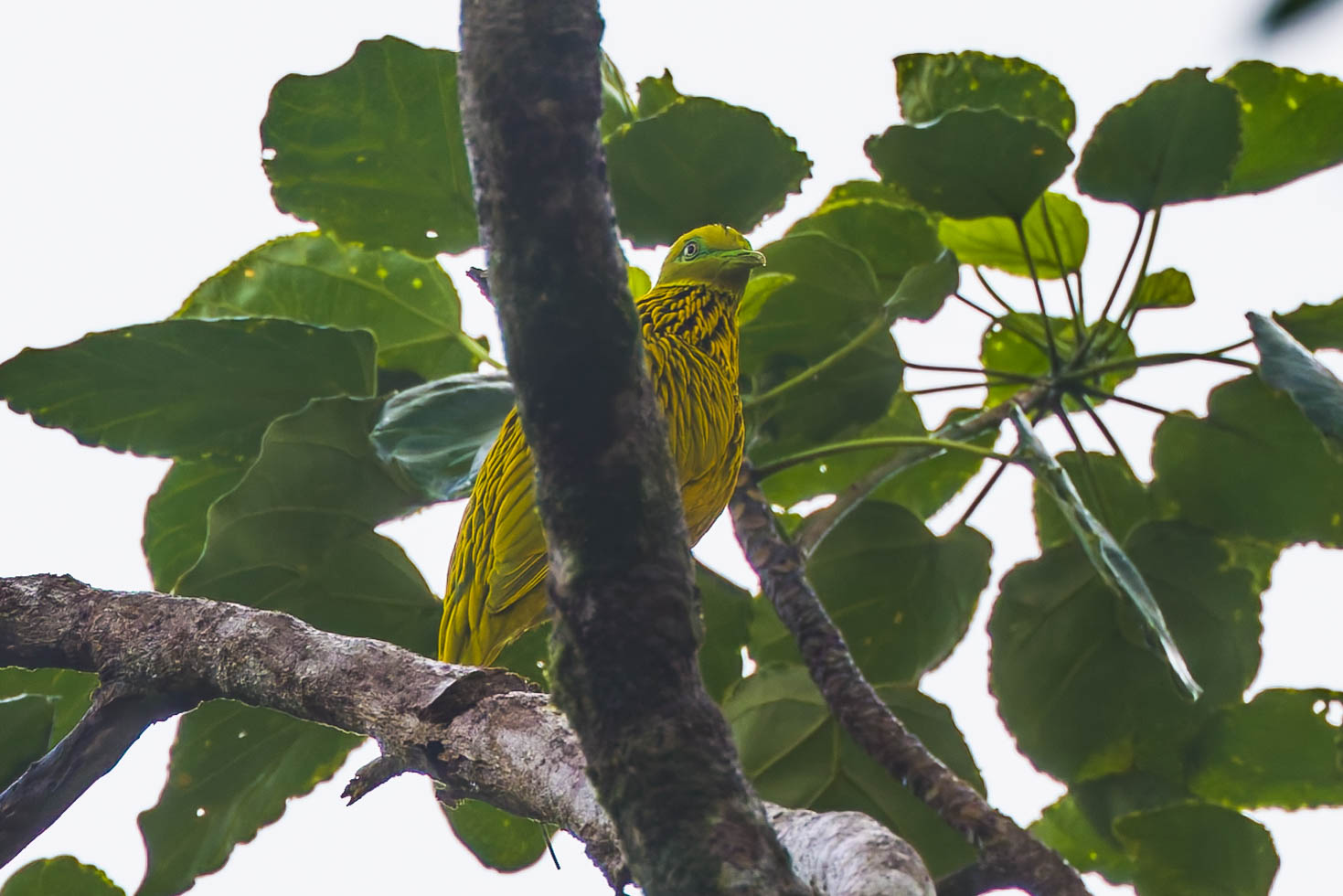
My tiny 2wd managed to cope with the worst of the slopes and we reached a point where the track flattened out. Here we finally hit the jackpot. I saw some activity in the crown of the largest tree, and landed my bins on one of my top secondary targets, Many-coloured Fruit-dove. There were at least 8-10 MCFD chasing each other around the boughs and in and out of the tree, and Vilikesa warned me to be on high alert. Since this tree was fruiting there was a good chance that there would be other species of dove here too! Sure enough, as I tracked one silhouette fly out I saw it land in a neighbouring tree. I was expecting another MCFD, but when I landed optics on it, here was my main target for the day, a stunning male Golden Dove, its textured bright yellow plumage making it look like it is wearing gel in its feathers. I soaked in the views and don’t recall taking any photos, but was super glad to discover when reviewing my meagre collection for the day that I did have a passable record shot, even though I had zero memory of taking it.


Other endemics noted as the morning wore on included a couple of Sulphur-breasted Myzomela, Black-throated Shrikebill and Fiji Yellow-throated Whistler.


After my early start and some good but slow birding, by midday I had seen most of what I hoped for. Even though I’d paid Vili for a full day guiding, I was also keen to get back to the girls at the hotel in good time. On the descent back to the coast we saw nothing new, though the light was a bit better at the “Many-coloured FD tree”. We did have one final noteworthy encounter, when Vilikesa heard a Pink-billed Parrotbill. It initially responded to some playback by flying fast across the road, but it would not show itself. This was an unequivocal “heard” bird, but I failed to get a visual other than those initial, untickable views of what could have been any small bird zooming across the track.
I left Vili on the roadside waiting for his son to return. I grabbed some lunch at a roadside cafe, before bombing back to Natadola, noting roadside lifers Pacific Kingfisher, Fiji Goshawk and Fiji Woodswallow.


Nikki and Lou had had a very chilled day, lying by the infinity pool. We’d each managed to do exactly what we wanted on day one and the holiday was off to a flyer!
The following day we didn’t have much time to enjoy the facilities at the resort before we were driving north again to Nadi Airport. Here we boarded a dinky Dash-8 turbo-prop for the short flight to Savu Savu on Vanua Levu, where would would stay for the next 5 nights. For Nikki this short flight was a highlight of the trip: squeezing into the tiny 18-seater (I had to stoop to get in and walk along the aisle), flying low across Viti Levu and the reefs in the Pacific between the islands, before skimming the trees on the approach to Savu Savu airstrip — basically a km of tarmac with a shed next to it — added to the adventure and feeling that we were going on the road less travelled.
Louisa had booked for us Koro Sun Resort (picture below taken from their website and used without permission — sorry guys, pls tell me if you need me to remove). We stayed in a “floating bure” each, one for me and Nikki, one for her and Erica. Basic, but comfortable, these mini-houseboats floated in the little harbour next to the in-house Dive Centre. We could reach each other either by a short walk, or an even more direct paddle in the kayaks moored up at our respective bures. A couple of decent restaurants, a nice pool and little beach area and bar, and some intact rainforest up the back of the resort gave this all the ingredients we needed. Not as upmarket or “White Lotusy” as the Intercontinental, but several tiers fancier than my usual birding digs, and perfect for us.


Our first full day was spent around the resort, reading, sleeping, sunbathing, and for me, a walk through the grounds, and up to the rainforest trail to get the lay of the land and see what I could find bird-wise. Collared Lories turned out to be regular visitors to the palms next to our bure, and I found Northern Wattled Honeyeaters in the flowering shrubs by the beach cafe and near the main reception. In the trees around the golf course Vanikoro Flycatchers were common and conspicuous, along with a Polynesian Triller. Up at the back of the resort a trail leads up the hill, forking left to the spa, and right to the nature trail. Naturally I took the right fork and noted Barking Imperial Pigeon, Fiji White-eye, Yellow-throated Fiji Whistler and Fiji Shrikebill. I also spent ages trying to see a Pacific Robin which was singing invisibly from high in the canopy. Eventually I got eyeballs on this to round out a very successful recce.


Later, Erica arrived to join us after her own epic journey which had started in Albany two days ago: a 5 hour drive to Perth, flight to Sydney, connection to Nadi, followed by a terrible night in a cheap hotel near the airport, then her own turboprop scoot across to Vanua, enlivened by a young girl who had a panic attack from the claustrophobia of the tiny plane.
You’ll recall that diving features in the title of this blog post, and Erica and I did two dives together on reefs easily accessible from Koro Sun. Eri had got her PADI a year or so ago, and done a couple of dives since in WA. It was her encouragement and enthusiasm for me being able to join her diving in Fiji that had pushed me to get my licence in Dibba two weekends previous. Years ago I had done a “practice dive” at Ningaloo Reef, which I really enjoyed, but also realised that diving would be a lot more expensive than birding, and would compete with birding for my precious, limited leisure time. Hence, up til now, I had always resisted getting certified.


We were both pretty nervous heading out a mere 5 minutes beyond the harbour to “Turtle Alley”. But our dive master, Gina, was super-chilled, and very reassuring. As she gently cruised like a mermaid, pointing out exotic fish and stunning corals, gradually we both began to relax, do the “basics” more instinctively, and enjoy the scenery rather than worry about breathing and buoyancy and the like. Almost immediately after we had descended to 12m, she pointed upwards through clear waters where a shadow morphed into a turtle swimming lazily above us. Gina knew this part of the ocean like her back yard and led us along what was presumably a standard route; to us it was all new, and incredibly beautiful, colourful fish of all shapes and sizes and different corals at every turn. Eri had brought a go-pro along and took a series of excellent videos, but these do not do justice to the true colours, nor to the amazing weightless feeling while experiencing it all. Two days later, went barely 10mins further, and dived “Lepers’ Wall”. Hovering over the drop-off at 18m, staring down into blue-blackness almost gave me vertigo and the 40 mintes we spent underwater felt like about 5.
But enough about “fish watching”. Let’s get back to the birds.
The day in between the dives I had allocated to searching for two key endemics, Orange Dove and Natewa Silktail. Vilikesa had put me in touch with a friend of his, who, while not a birder himself, was a landowner with a patch of forest holding both species. I arranged to meet Inosi, who was staying not far away, but whose land is some 90km east of Savusavu. This did not go entirely smoothly — our arrangement was for him to come to Koro Sun, but what I did not know was that he would not have a vehicle. We would need to get a taxi into Savusavu, 15 minutes in the wrong direction and meet another friend who had agreed to drive us to Inosi’s place. When we arrived in Savusavu, Inosi’s friend was nowhere to be seen. I had spotted a Budget rental office in the town so I suggested that I rent from them. This involved around 30min wait in the rental office, followed by another 30min of paperwork, but eventually we could hit the road in a crazy-expensive, but probably fit-for-purpose, Toyota Hilux 4WD.
Finally, we were on our way. But then, just a few km after we had gone back past Koro Sun, now after 9am (following my dawn start), Inosi cleared his throat and said, slightly coyly: “Ian, I have a question…”. I did not know at the time but I would come to dread these words, because each time they were uttered, it turned out to relate to some kind of diversion. “Let’s turn right here. Would you mind if we take my grandson with us for the outing”. Ah well, ok. It was not much of a diversion and we didn’t have to wait very long before his very sweet 7y.o. grandson had had a daypack filled by his mum and he was installed in the rear seat of the hilux. Then: “Ian I have a question: could we stop here at the shop”, so we stopped again to buy a treat for the grandson. Then another slight diversion to see if a friend was at home (he wasn’t). By the time we had negotiated the unsealed road most of the way up the east coast of the Natewa Peninsula, and turned of into Inosi’s place, it was nearly midday.


I was grateful for the 4WD as we picked our way carefully along a poor track to a small settlement of 4-5 huts. It was then a short walk (and a stream crossing) to the largest hut where Inosi introduced his brother, who would take my into the forest where they know there is a Silktail territory.
I followed up a narrow trail for about 600-700m into a forest of dense, spindly, young looking trees with a few emergents. This is the territory of a Silktail, I was told. They are supposed to be quite responsive to playback also. As I prepared my speaker I was listening to the forest, and heard a “click click” sound. “Is that Orange Dove?” I asked? Yes!
OK, so I decided to hold back on the silktail and try to get a visual on the dove, which sounded fairly close, but also high up. I wandered back and forth along the trail trying to find narrow window through the lower vegetation to the tall trees, but realised that I could only see a fraction of the canopy. Back and forth I wandered, repeatedly scanning every inch of visible canopy from several viewpoints. Then a hit of orange appeared. Was this a funny leaf? Hard to say from this angle. I adjusted my position slightly and the orange leaf morphed into a bird. I had found my top target, Orange Dove! Now could I get any kind of photo? I returned to other viewpoints to see if I could relocate it better, and eventually I pushed my way a few metres into the dense undergrowth to get a slightly better view. The views and photos were definitely not A+ but at least a decent record, and sweeter for being a (sort-of) self-find.
Now I returned my attention to Silktail. I played the call and waited. Nothing for a 30 seconds. Played the call again, and instantly a dark streak dashed across the track and landed metres away. On landing my bins on the bird as it clung to a tree trunk I could see immediately this was a gorgeous Natewa Silktail. As it turned its head I could see the iridescent blue crown streaks flash against the overall dark appearance (the same colour scheme as 10x longer Black Sicklebill) Of course I needed to see the eponymous feature and when it turned away from me I was also able to see the silk-white tail feathers that give the species its name. Immediately I reached for the camera, but for once the R5ii struggled with auto-focus, the combination of dark bird in a dark forest, probably closer than the minimum 3m that I had the 100-500mm lens set to, causing it to hunt in a way I’ve not seen since I was on the forest floor in Kibale Forest trying to snap a Green-breasted Pitta (nice name-drop, Reid!). In worse poses and a bit further away I finally bagged some record shots that I have cleaned up using DXO and Topaz Sharpen. But this is nit-picking — I just had my top two targets in the space a few minutes, both viewed from exactly the same spot. The Silktail disappeared deeper into the forest and I looked up — I had not moved — and I could still see the dove from where I was standing.


I was hopeful of further opportunities with the Silktail and over the course of the next 45 minutes I waited with occasional playback, but it was not to be. I was discovering it’s a species that is curious once but smart enough to know not to return. With no further sign I finally decided it was time to head back to the settlement and reconnect with Inosi and his grandson. Of course the return journey to Savusavu involved a few more diversions, including one where Inosi had to meet with a local school head teacher. I sat in the car for 20 minutes wondering how I’d got myself into this predicament. But then, when we finally left, pulling slowly away from the school, some unfamiliar doves flushed up to a roadside palm. My brain finally jumped into gear and I realised these were White-throated Pigeons (or Metallic Pigeon), a bird I had chased unsuccessfully in New Caledonia and New Guinea. Now, thanks to Inosi’s extra-curricular activities, I had finally got it on my life list. I immediately felt bad that I’d begrudged the diversion.


The next day I went on a dive with Erica. Once again, it was fabulous, and I was grafetul to Eri for pushing me into getting my licence and joining her. Maybe we have to return one day and explore some of the more famous dives the region has to offer.
Our final full day the girls took advantage of the rainforest spa, each having an open-air massage up in the rainforest above the resort. I also went up into the forest, but I took a right turn heading up the forest trail instead of to the spa. It will be of no surprise that I was seeking more birds, not a massage.
I explored the trail a bit further than previously and had nice encounters with a Pacific Robin, much less elusive than a few days earlier, now taking a bath in the stream below my vantage point, instead of high in the canopy with neck-craning from three days ago. I also had fantastic views of Yellow-throated Fiji Whistler, with at couple of birds putting on quite as show, and I finally picked up Fiji Parrotfinch, a common bird that I’d contrived to miss in my few days of birding the islands. One desirable and rarer endemic missing from my list was Azure-crested Flycatcher, a close relative of (and recent spit from) Chestnut-throated Flycatcher that I’d seen on Viti Levu. There were no ebird records, but the location and habitat seemed right to me, so I gave it a good crack, spending 2 hours listening, watching and just occasionally prompting with some playback. During a half-hour period when I sat still above the stream just listening to the forest and observing Streaked Fantails, Slaty Monarchs, Fiji Bushwarblers I registered the high-pitched trill for about a minute. Try as I might I could not get a visual, but I did have the foresight to record it singing on my phone; Vilikesa agreed with my conclusion that this was indeed an Azure-crested Flycatcher (recording here: https://ebird.org/checklist/S258505960).


We all chilled at the beach bar for the afternoon, me taking the chance to photograph some of the birds visiting trees around the bar. As the sun set, the local villagers arrived to sing and dance for the entertainment of the punters like us. It may not have been as polished and professional as the performance at the Intercontinental, but it was joyful and authentic, and all the more enjoyable for it. Most of the guests (including us) then adjourned to the restaurant for a fabulous Fijian buffet dinner.


The following day we sadly bade farewell to Koro Sun and flew out from Savusavu on the exciting Dash-8, back to Nadi for a final night’s stay at Wailoaloa Beach, just behind the airport. Sunset cocktails, then an early morning walk along the beach, were a fitting way to round out the holiday. Our plans had really come together: we’d each got to do our favourite things, while spending some quality time together as a family.


Here is a link to the ebird “trip report”, with all of my lists and birding sites https://ebird.org/tripreport/433004
