The last time I went to the International Conference on Computer Vision was a decade ago. Dec 2015, in Santiago, Chile. Deep learning was taking the field by storm, but was still “new” during its second or third coming. Among other highlights at the conference, I checked out Cambridge PhD student Alex Kendall’s poster “SegNet”. It was a bit shit, but it was real-time! Could deep learning also revolutionise robotics and other time-critical applications? It seemed so, and I gave a keynote at a workshop on a similar theme, showing how real-time deep learning would turn a mapping system (SLAM) into a live scene understanding system. A decade on and Alex is CEO of Wayve, a self-driving car company he founded on the idea that the whole pipeline of pixels to control could be learned “end-to-end”. Wayve is valued at several billion dollars😮 and has investment from Softbank and Microsoft among others. Meanwhile I am still an academic. But I have seen Diademed Sandpiper-Plover, Andean Condor and Inca Tern, birds I saw on day-trips either side of the conference. Priorities😜!
So 10 years on, it was time to get back to ICCV. And the fact that this year it was Hawaii gave me that extra push to make it happen, since this was a destination where I could productively indulge my hobby for a couple of days beforehand, trying to track down some of the unique avifauna of he Hawaiian islands. I had been to Oahu once before, a 3-day stopover en route home, after my first year studying in Oxford, but that was most definitely pre-birding days.
The Hawaiian Islands — the most remote on earth in the middle of the Pacific — were once a bird paradise. Free from mammalian predators and supported by lush tropical forests, they were a haven of endemism, with more than 100 bird species unique to Hawaii. However they have also been the scene of the world’s most catastrophic wave of extinction. Since human habitation, more than 70 have gone extinct, 35 of these since the arrival of Captain Cook and Europeans in the 18th centrury. Of the remaining species, nearly 2/3 are listed by the IUCN as Vulnerable to Extinction (VU), Endangered (EN) or Critically Endangered (CR). The usual suspects — deforestation and introduced predators — are the main culprits, but recently a new threat, mosquito-borne avian malaria has devastated populations. The populations at higher altitudes where the mozzies don’t go have been spared, but as the planet warms, the mozzies go higher and higher each year, inexorably reducing the viable range, irrespective of the quality of the habitat.
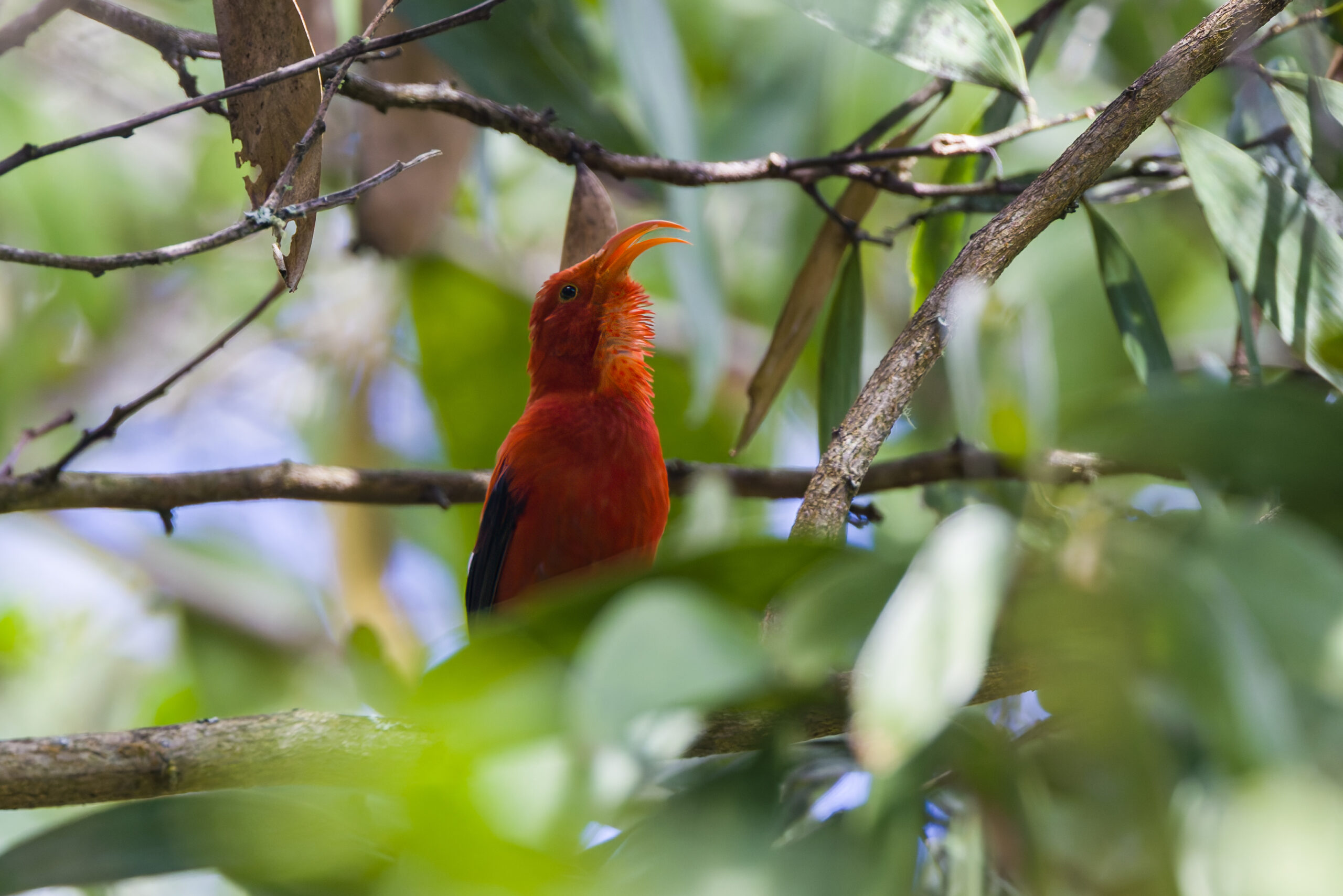
My main target for the trip was to see I’iwi, a bright red-and-black honey-creeper with a large yellow scimitar bill, adapted for extracting nectar. It appears at #22 in the book “100 Birds to See in Your Lifetime”. Understand that I don’t follow this slavishly — it’s the choice of just a couple of birders and I disagree with a number of their choices — but I do like to flick through it occasionally and work out how many I have seen (57, since you ask).
To have a chance of I’iwi I could not stay just on Oahu, and I decided to spend the weekend prior to the conference on Big Island which had the most extra endemics on offer. More on the logistics of that part of the trip below.
I arrived from Sydney into Honolulu early morning and immediately picked up a car and drove straight to the ʻAiea Loop Trail, a walking track in the forested foothills a mere 6 miles from Daniel K. Inouye International Airport. My pre-trip research had revealed this site as reliable for both remaining Oahu endemics, Oahu Amakihi, and Oahu Elepaio. There were a couple of red ebird pins for each endemic along this trail, so I had some confidence.
The scenic trail leads along an undulating ridge through secondary forest (regrowth from 1920s with a mixture of endemic and imported flora) with views down to Pearl Harbor.


I took a while to get my eye in but I gradually picked up various of the introduced species that dominate in Hawaii these days: Red-whiskered Bulbul, Red-vented Bulbul, Warbling (Japanese) White-eye, Common Waxbill. A yellow bird attracted my attention: could this be Amakihi? No, it was just a Yellow-fronted Canary. The most exotic of these naturalised species were Red-billed Leiothrix, and White-rumped Shama, both species that I have seen in SE Asia.
Eventually I observed a yellowy-green bird that was bigger than a white-eye, and as it turned side-on I clocked the large down-curved bill — Oahu Amakihi. I noted a few more as I carried on deeper into the forest but there were no photo opportunities. I had been walking for around an hour and a half with no sign of the other endemic, Oaho Elepaio, a monarch flycatcher. Approaching the point where the trail bends back on itself I noted a distant bird that, when I inspected with bins, I noted had a rufous head. The jizz looked good for a flycatcher, and I could not place it amongst the naturalised species, but it didn’t click with my memory of Elepaio, a brown, black and white bird with a black and white chin and throat. But a quick check of ebird and I realised I was looking at a female Ohao Elepaio, plainer but with a rufous wash over the whole head. A burst of playback and she had flown over to check me out before continuing busily flitting through the low vegetation looking for insects. At this same spot I realised there were also a few more Amakihi, and I was finally able to bag some passable record shots. I decided not to complete the loop and returned along the trail much faster than the outward journey.


The other birds that Oahu is famous for are the seabirds — two species of Albatross (both of which I need), Tropicbirds, Hawaiian Petrel and others breed on the islands. But visiting in October is the worst time. The albatrosses and pterodromas have mostly dispersed post-breeding. However a visit to the North Shore would still worthwhile for me, to seek out Bristle-thighed Curlew on its wintering grounds.

After a couple of false starts I found the Kahuku Golf Course and Pasture and wandered out into the golf course and down to the beach. Pacific Golden Plovers by the dozen skuttled over the fairways and down at the beach I noted several Ruddy Turnstone and a lifer Wandering Tattler. Four Bristle-thighed Curlew were feeding in a fenced-off area dotted with burrows — presumably Wedge-tailed Shearwater burrows.


As I write this it is frustrating to realise that at least one Laysan Albatross has hung around for the winter, photographed by some birders a few days ago on 20th Nov. Maybe if I had spent more time looking I might have found this guy too! Oh well. At the time I was congratulating myself that I had just had just nailed 100% of my targets. I rolled back into Honolulu and followed google maps to the conference hotel. Tepanyaki at the excellent Japanese restaurant below my room would have been the perfect end to the day, apart from a drunk, annoying American tourist who, when he found out I was a Professor of AI, wanted to talk about AI stocks and shares all night. Sometimes I wish I gave fewer fucks and could just tell someone like that to his face that he’s a moron and should shut-up.
A few weeks before I travelled, I contacted Lance Tanino, a bird guide on Big Island, to see if he was available for either or both of Saturday or Sunday, the days I planned to be on the Big Island. He replied immediately and suggested I join two other birders whom he was taking to Hakalau Forest National Wildlife Refuge. Perfect! The Refuge protects some of the best (only) remaining natural forest, holds all but one of the Big Island endemics, and is only accessible with a licensed guide. Naturally, I jumped at the chance: “The Hakalau Forest walk/hike sounds ideal… Do you need anything else from me to confirm participation?”. I also asked a few questions about the logistics for another target bird that would not be available in Hakalau Forest, Palila. He responded: “How many people and which outing?” The first part of the question, fair enough, but I was confused by the second part. Hadn’t I been clear? I confirmed: “One person, Hakalau Forest, 19th Oct”. But then I didn’t get any response from Lance either to this, or any of my questions about Palila, and started to worry why the comms had gone dead. I prompted again a few days later. Lance did now confirm, but he never did respond about Palila — had he suggested it, I would even have paid him to take me there on Saturday. Go figure.
Enough preamble.
I landed in Hilo at 7am, and picked up a small 4×4. It was pissing down with rain — not what you want when birding, but not unexpected in one of the wettest places on earth. I grabbed breakfast and supplies at Walmart then found my way to Saddle Rd and the Daniel K Inoye Highway that would take me to the other side of the mountain where Palila can be found. As I climbed it continued to rain but also now became foggy as I ascended into the clouds. It was still raining and misty when I pulled off the highway at the Kaulana Manu Nature Trail (a site I had read about in the in-flight magazine on my way over). I decided to spend some time here hoping that the weather would clear. There seemed little point in carrying on to an off-road ascent of Manau Kea in the current conditions.
The stop was both worthwhile and not worthwhile. I’ll explain. I trudged around an beautiful short trail but with my umbrella unfurled, the only way I could keep optics dry. Birds were still active, especially the Apanane, loud and conspicuous. But unfamiliar calls and the dark, wet, foggy conditions meant I struggled to identify a much else until I did finally latch onto most-wanted I’iwi. Of course, photography in the rain, holding an umbrella, was basically a non-starter.


I had spent more than an hour at Kaulana Manu, which at the time had felt like the best option in the conditions. But as I crested the saddle between the two mountains, Mauna Kea and Puu Waamwaa the fog and rain cleared. I realised that it had been clear on this northwestern side, rain-shadow side, all along.
Nevertheless it was still not too late, and I had the rest of the day if necessary. Sadly, a combination of unforced errors and the conditions (which deteriorated over the day) meant I did not connect with the Critically Endangered Palila.
I followed my google maps to the GPS coordinates of a red ebird pin from a couple of weeks earlier, and walked for an hour, ascending one of the obvious 4wd trails, but saw very few birds and certainly zero Palila. Having drawn a blank at the first spot, I decided I would risk trying to get to the second pin, which, now I was actually on-site, I realised was high above me on the mountain side, and I would need very careful driving and every bit of 4WD capability from my SUV soft-roader if I was to have a chance of reaching that pin. Once again I set navigation on google maps to go to the GPS coords. By now, unfortunately, clouds had begun to roll in and much of the 40 minute ascent was in fog at times so dense I could only see about 10m in front of me.
Mercifully it cleared as I reached the spot I thought I needed to be, at about 8500ft a.s.l. But despite another long walk, during which time my phone battery died, I did not have a sniff of Palila.
Eventually I pulled the plug and began the descent, at least grateful I had not damaged the rental car which was surely uninsured for what I was doing with it. I noted (and photographed) a few Hawaiian Amakihi, and also spied a Hawaiian Hawk perched quietly. A few minutes later I flushed a Short-eared Owl of the local endemic sub-species.


That evening, at my Hilo resort hotel after a fairly hairy drive in the dark and rain, I recharged my phone and double-checked the satellite view. Oh fuck! Although I had plugged in the exact GPS coords, Google Maps had in fact taken me to an approximate location, as close as it thought the “roads” would take me. I worked out from the satellite view that I had been short of the ebird pins by at least 700-800m, and maybe another 300 feet or more of altitude. If my phone had not died, there’s a chance that I would have realised my mistake in the field. But my error of blindly following Google Maps was compounded by not having a suitable charging cable with me. Bugger! Bugger! BUGGER! (I’ll quietly add it to the list of Critically Endangered Species I have missed this year through unforced error).
Feeling tired and upset by my mistake I decided to cut my losses and have an early night. This was yet another big mistake. Just 35 minutes down the road, Hawaii’s Kilauea volcano, the world’s most active, was experiencing its most spectacular eruption in years, with lava spouts 500m high viewable from the crater rim at standard tourist spots. I slept through the whole thing, and only found out through social media as I woke at 5am, soon after the eruption had died down! The images below are screenshots from instagram (used without permission).


Fortunately I woke to a day that would be much more successful. The weather was decidedly better as I cruised up Saddle Rd. I could even see the peak of Manua Kea at over 4000m, instead of just clouds and mist. It’s worth noting here that more than 50% of Manua Kea is below the sea, and if you measure from its base on the floor of the Pacific, it is more than 10000m high, making it more than 1000m higher than Everest!

I met Lance and the two other birders at 7am back up on the mountainside. We drove across the deforested slopes, now populated by gorse and ferals: Erkel’s Spurfowl, Eurasian Skylark, Ring-necked Pheasant, Warbling White-eye, House Finch. Amakihi and Apanane were the only endemics holding the fort for the “locals”.
We arrived at a locked gate and entered the Hakalau Forest, noting our first endemic of the morning, Hawaiian Goose.


Immediately Lance got us onto Hawaiian Creeper, initially on song, but then nice visuals. Soon after, a call alerted Lance to my next-most-wanted, Akiapolaau (Aki for short!). My views were disappointing as I struggled to pick the bird up as it moved swiftly around the canopy, but later we would have views of three more, including an adult feeding a begging chick.
In the period to lunch we picked up all of the endemics on offer — Hawaiian Goose, Apanane, I’iwi, Omao, Hawaii Amakihi, Hawaiian Creeper and Hawaii Elepaio (this latter species proved surprisngly elusive) — apart from the smallest and rarest, Akepa. We also had a few close encounters with one of the more spectacular naturalised species, Khalij Pheasant.


Regarding Akepa, we’d all had almost-tickable views of a female, and I had even seen some flashes of orange behind foliage, but nothing I would have claimed for a lifer, until after lunch, above our picnic spot, a pair arrived and we had excellent views of both make and female.

We’d cleaned up by 1pm, and if this had been a trip led by someone like Rob Hutchinson we would have been off to look for Palila too by now. I would happily have paid quite a bit more to head over for another crack at the rarest endemic, and so I joking suggested this is what we should do. But Lance’s response — “It’s called the Hakalau Forest trip” not the “Palila trip” (or something similar) — shut down those ideas, and reinforced for me the idea that he was not very comfortable doing anything that deviated from his standard routine. Don’t get me wrong, he is an excellent birder and found for us all of the key species. I just did not gel with him the way I have with some other guides.
I called in again at Kaulana Manu and the very first bird I saw was an Aki. I tried hard to improve my pics of I’iwi and Apanane, but without success for the former.


Finally I headed for Hilo where my flight back to Honolulu awaited. I did just have time for one final bit of birding. I nipped to Lokowaka Pond where I was able to add a final endemic, Hawaiian Coot, before rolling into the airport in the nick of time.


