Telupid: Alcohol is not the only sin
After our time on Mt Kinabalu, we drove south-east through the mountains, calling first at a local Ai-Cha ice-cream shop for a treat, checking out some White-fronted Falconets (see previous post), then on to Poring Hot Springs.
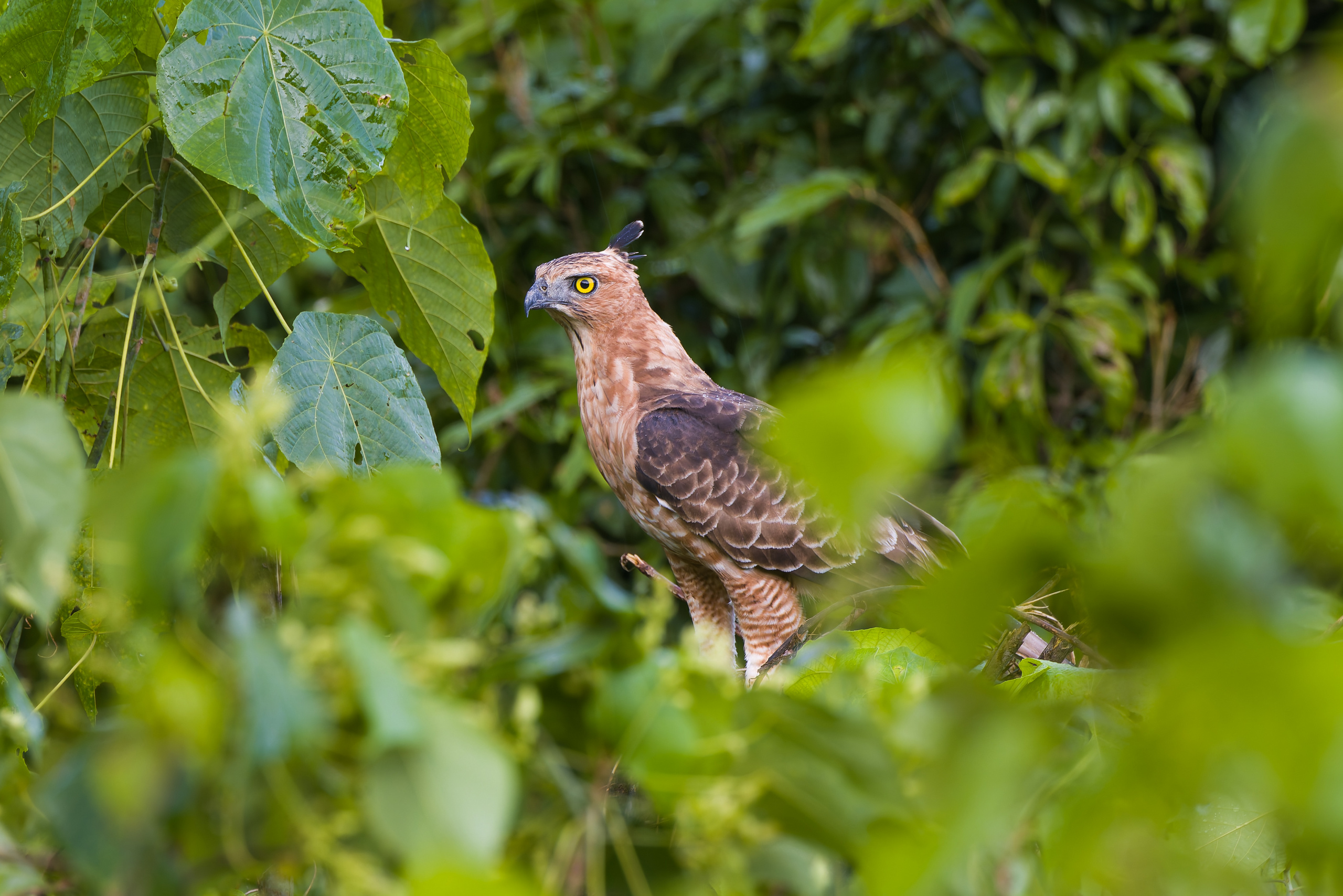
Arriving at our lunchtime restaurant, we immediately noted a couple of soaring raptors, one of which we tried hard to turn into a Mountain Serpent-Eagle. However on inspection of photos it became clear that we were stringing and this was the commoner Crested Serpent-eagle (the other raptor was Changeable Hawk-eagle). A few km back along the road I noticed that we had passed a couple of farms advertising flowering Rafflesia, an amazing botanical wonder that I would love to see. I wondered whether my fellow birders would poo-poo a diversion for some plant spotting, but over lunch, experiencing some FOMO, I explored with the lads the idea that we call in on our way back. Slightly to my surprise, everyone was receptive to the idea and since we were in the slowest part of the day for birding, Azmil recommended we do it straight after lunch. Once the three of us had downed our noodles (JP was still off food!), we jumped in the van and drove 5km back to the spot.
Rafflesia arnoldii is the world’s largest flower, and attracts insects for pollenation not via perfume but by emitting a smell a bit like rotting flesh. It germinates only from the roots of woody vines of the tetrastigma genus, takes 2-7 years before it flowers, and then blooms for just a few days before the flower turns black, rots and dies. At a minimal extra cost to us, Azmil arranged our tickets, and we wandered into the farm where 3 separate Rafflesia had been staked out. A real non-birding highlight!


Many tour groups spend a full day or more at Poring hot Springs, because the forests are rich with pittas, trogons, kingfishers and broadbills. The beautiful and rare Hose’s Broadbill is usually top of the list, but at the time of our visit had not been seen for several months (ironically as I write this 6 months later there is a pair seemingly been seen regularly). We would have only 2 hours here, so the chances of finding anything rare were very slim. Azmil led us past the baths and pools, fed by natural hot springs, and into lovely secondary forest. We saw nothing remarkable, with the best birds (for me) being Olive-backed Woodpecker (looking as much like Woody as any ‘pecker I have seen in Asia), Ventroliqual Oriole, Fulvous-chested Jungle-flycatcher (smart, but much duller than it’s impressive name), Raffles Malkoha, and a flock of several Silver-rumped Spinetail.


Our journey to Telupid from Poring took us along the route of the notorious WW2 Sandakan Death Marches. Between January and August 1945 — when, of course, no road existed — more than 2400 Allied POW servicemen perished as they were marched at gunpoint 260km through the jungle from a camp in Sandakan to Ranau. Most died from tropical illness, or collapsed from exhaustion en route and were killed by the guards because they were too weak to continue along the route. Those who survived to Ranau were herded into insanitary huts and died soon after from dysentery. It is thought to be the single worst atrocity suffered by Australian servicemen during the Second World War, and there were only 6 known Australian survivors from the Sandakan camp. Despite this dark and ignominious “distinction”, the route and its bleak history are much less well known than the Kokoda Trail in PNG, and I have to confess that everything I know about the events, I learned that afternoon; about 20km from Telupid, at a secluded and seemingly unmarked spot in the road, we dropped off the tarmac onto a short track and emerged at a memorial lookout, peering down to where the soldiers would have staggered through the jungle, if they had made it this far. A series of plaques around the memorial described the awful history, and commemorated the soldiers and villagers who had died.
As well as our botanical and historical diversions this afternoon, we did also stop for a 3-star bird, one of my very top targets for the whole trip. Looking out over primary and secondary forest we could hear Rhinocerous Hornbills calling, but then our driver, Ray, picked up a bird flying and immediately called “Helmeted Hornbill!!” What a beast this is, huge with an unfeasibly long white tail, massive square casque and loose, ugly red skin around its neck; the last of the Bornean Hornbills for me, and unarguably one of the best. Helmeted Hornbills are critically endangered because their solid casque is made from “red ivory”. Driven by demand from wealthy buyers, mostly in China, who turn them into ornaments such as belt buckles, the price of the red ivory makes the Hornbills targets for organised crime syndicates, who employ local villagers to poach them from national parks then smuggle them out of the country. Sickening.


We arrived at the small town of Telupid for an overnight stay, and checked into one of the worst hotels I have ever stayed in — and I’ve been in some pretty bad ones! It was clean-ish, but the room was barely large enough for the twin beds, so we had to hurdle our luggage to move around, and the bathroom was just a wet-room that doubled as shower and toilet in one. Steve and I would be cozier than usual. I suspected this was, in fact, the best that Telupid had to offer.
We went out exploring, past the bazaar which was in full post-sunset swing, to find the only beer-selling place on the outskirts, the aptly-named “Sin Sin”. The warm, knowing greeting of the shopworn hostess, deeply unattractive but effusing the provocative confidence of someone who has been around the block several times, made us realise that alcohol was not the only sinful thing on sale here. We ordered an ice-bucket of Tiger each, and texted our mates the location so they could join us shortly for some food and more beer.

Why were we here? Because a short drive away is a hide where another rarely seen forest denizen, the Bornean Peacock-Pheasant, is a regular visitor. The following morning, then, half an hour through farmland from Telupid, we transferred from our van into a beaten-up but functional 4WD, bumped and rolled our way along a rough track to the forest edge, then hiked about 20 minutes into the forest to the hide. Unusually, it was already light, but I knew that the locals and guides do this most days, and the birds are creatures of habit, so it must be ok.
Like the other hides, this one has a wintering Siberian Blue Robin; the one here was the closest to a smart adult make that we saw. Ferruginous and Short-tailed Babblers jumped about with various squirrel species eagerly grabbing mealworms scattered moments earlier by their human hosts.


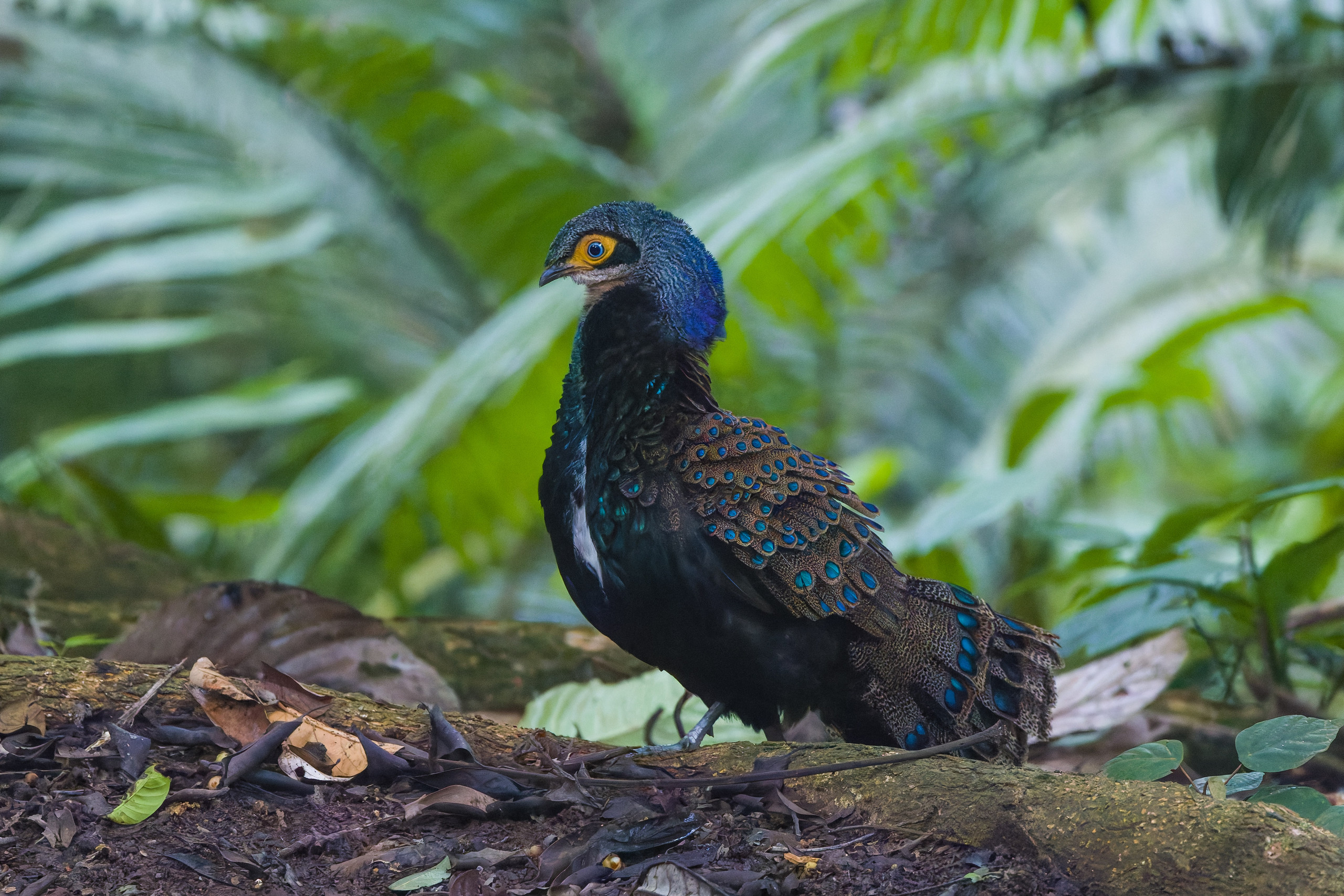
We could hear a Peacock-pheasant barking from down a slope to the left of the hide, but I never did work out if this was a real bird, or the locals calling to the regular: “Brekkie time!!”. As we sat in a line scanning the open area a whisper came from behind — “coming”. I thought I heard one of the locals say its a female, and as I trained my bins to the right I braced for the disappointment of a drab brown chicken. I could just perceive the movement of a head which then began to emerge from the scrub. This was no female. It was fantastic male Bornean Peacock-pheasant, one of the most ridiculously plumaged birds of all. Having already exhausted the entire team’s allocation of adjectives like “preposterous” and “audacious” on the Bulwer’s on my previous blog, I’ll just let the pictures do the talking here. It’s an amazing blend of stunningly beautiful, yet probably amazing camouflage when it needs to be incognito. As it ruffled and splayed its crazy tail feathers, we got a sense of what it must look like in full display (which we were not fortunate enough to witness, even though he ended up being accompanied by a two females).


This was not the adrenaline rush that would have accompanied an encounter with proper jeopardy — the risk of dipping — but still definitely worth travelling and paying for, since there is likely no other reliable way to see this bird, which spends its entire life in dense forest. Yes, they are wild birds, and yes, they’re tickable. But when at 9.30 a local wandered out with the bird to scatter more grain, we realised exactly how habituated these birds are. Duncan decided to diminish our experience further by christening the pet “Brian” and insisting in the truck on the way back that we had just spent 2 hours at the zoo. Maybe be he’s right. But f$%k you Duncs you f-in killjoy! I’ve seen a Bornean Peacock pheasant.
Almost incidentally, we had a Diard’s Trogon just outside the hide and collected a few species in the farmland as we chuntered through to and from the forest: Pink-necked Green-pigeon, Greater Coucal, Grey-rumped Treeswift, Dollarbird, White-nest Swiftlet, Sunda Crow.
Kinabatangan: “That’s not a trunk. This is a trunk”
It was now a long drive, via a lunch stop, to the famous Gomantong Caves near the mighty Kinabatangan River. The caves are breeding grounds for 4 species of swiftlet whose nests, made from the birds’ saliva, are harvested (sustainably) to sell for Bird’s Nest soup. This is a “delicacy” in China, and nests can fetch upwards of $6000/kg. I still have no idea how someone, once upon a time, looked at a swift nest made from bird spit, probably covered in shit and feathers, and thought “I wonder if that would make tasty soup!”. The caves are also home to millions of bats which emerge at dusk, to be greeted by various raptors, most notably Bat Hawk. More on this later.
From 3pm we birded slowly on the drive in, where decent forest remains. The Kinabatangan and nearby forests like Gomantong are heaven for hornbills and we had four species on the way in and in the carpark before we walked to the caves: Oriental Pied, Black, Rhinocerous and White-crowned. This latter bird was, to some extent, “the one that got away”. Although I had ticked off a stringy flight view with no plumage detail 6 years ago, I marked it down as BVD (Better Views Desired) and still on my most-wanted list. Today, it went like this: unidentified Hornbill lands after brief flight view; get it in bins just as Azmil calls “White-crowned!”; have a nano-second view before it flies off behind the tree never to be seen again. So the views were marginally better than in 2019, but it remained in the BVD column. Other birds seen as we made out way in included Green Imperial Pigeon, Asian Fairy Bluebird and a Bay-banded Cuckoo, which responded to Azmil’s playback and we had some nice, if distant views of this small, sweet cuckoo.
The dregs of monsoon rain that had affected a lot of our birding on Kinabalu were felt here too. The creek that runs at the bottom of the carpark had swollen and flooded the boardwalk. There was no other way than to wade through to get to the trail and boardwalk that would take us to the cave.


Six years ago Eri and I had had a teenage female Orangutan on the boardwalk itself, one of the most magical encounters of our 2019 trip. Today we observed Red Leaf Monkeys, but no Rangas. We braved the smell, cockroaches and wet, very slippery walkways to wander through the cave, noting bats and swiftlets. On the boardwalk near the cave entrance we had lovely encounters with Red-backed Dwarf Kingfisher and Hooded Pitta.


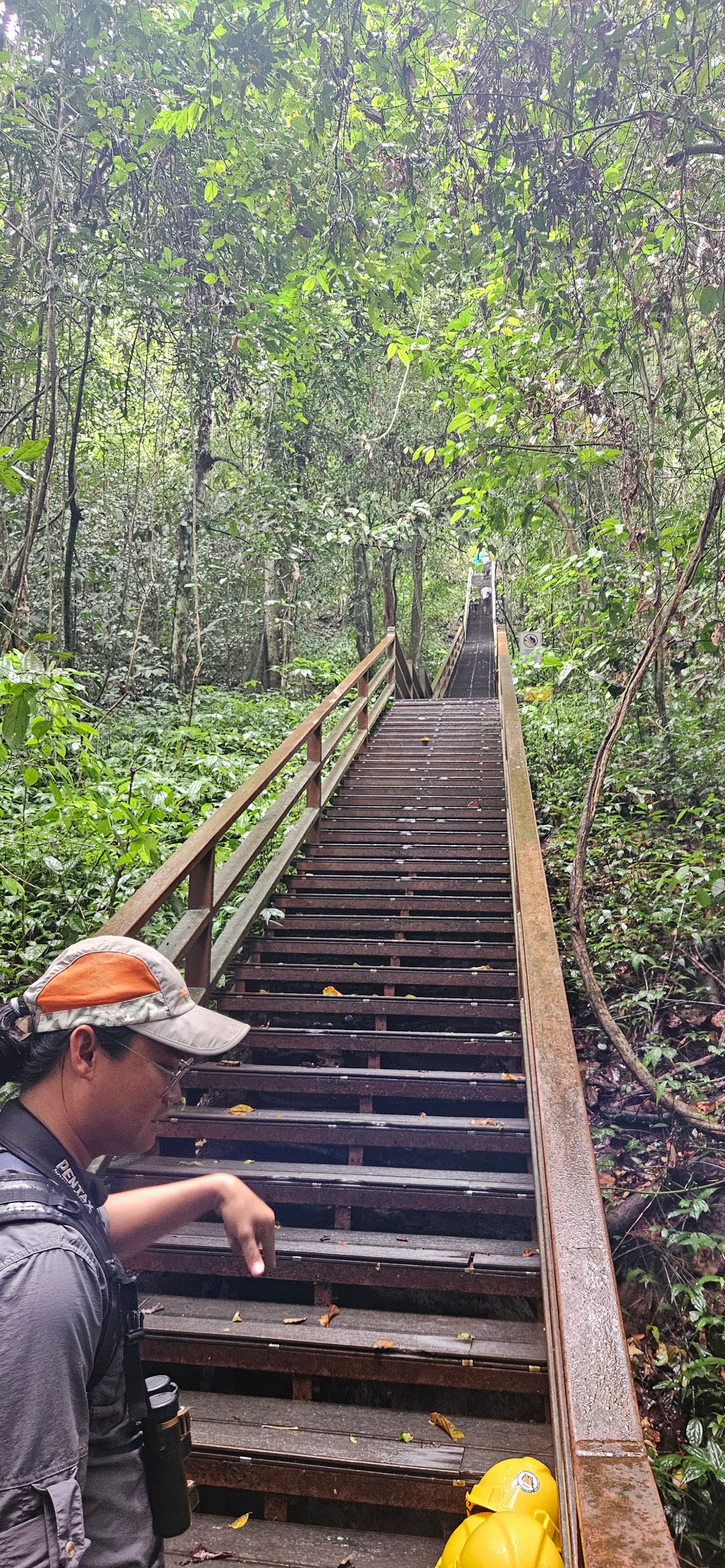
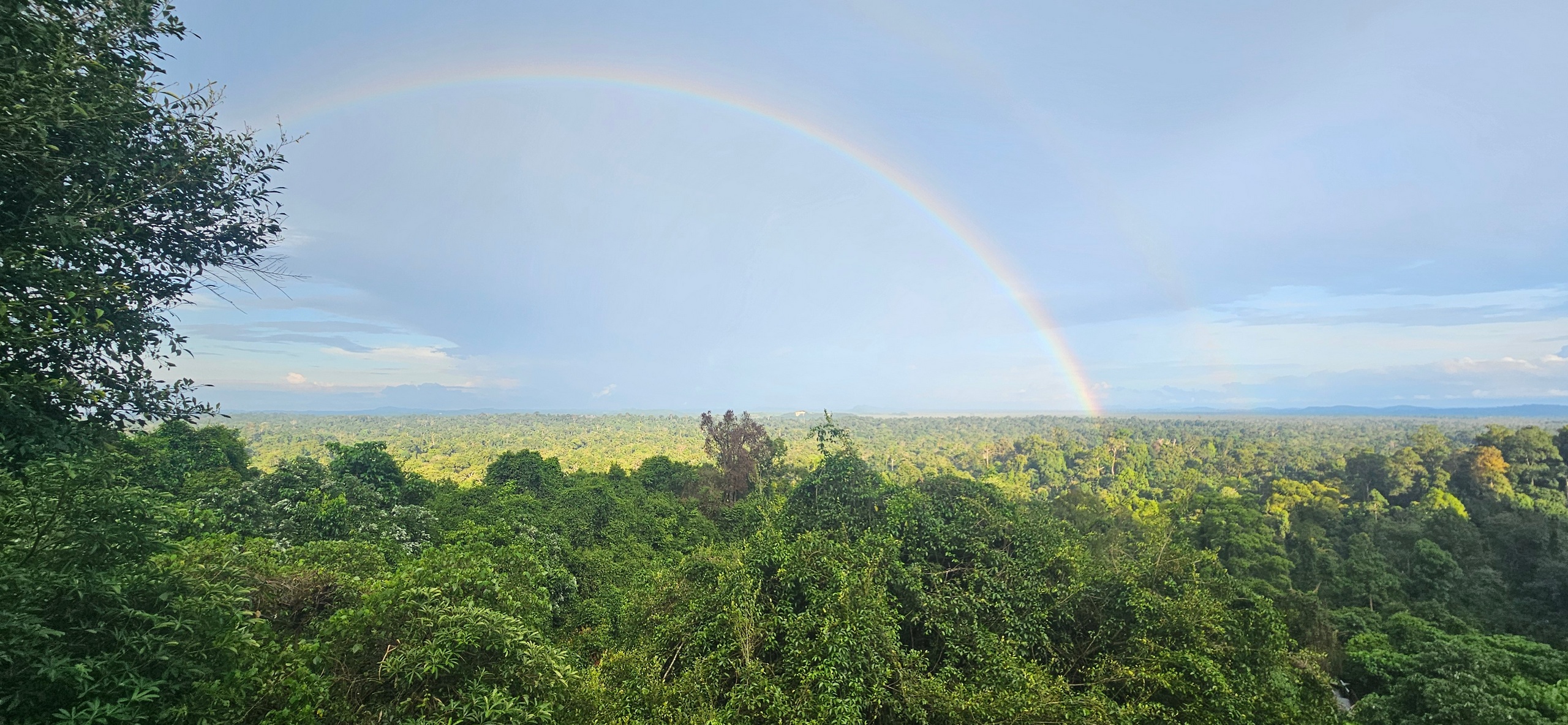
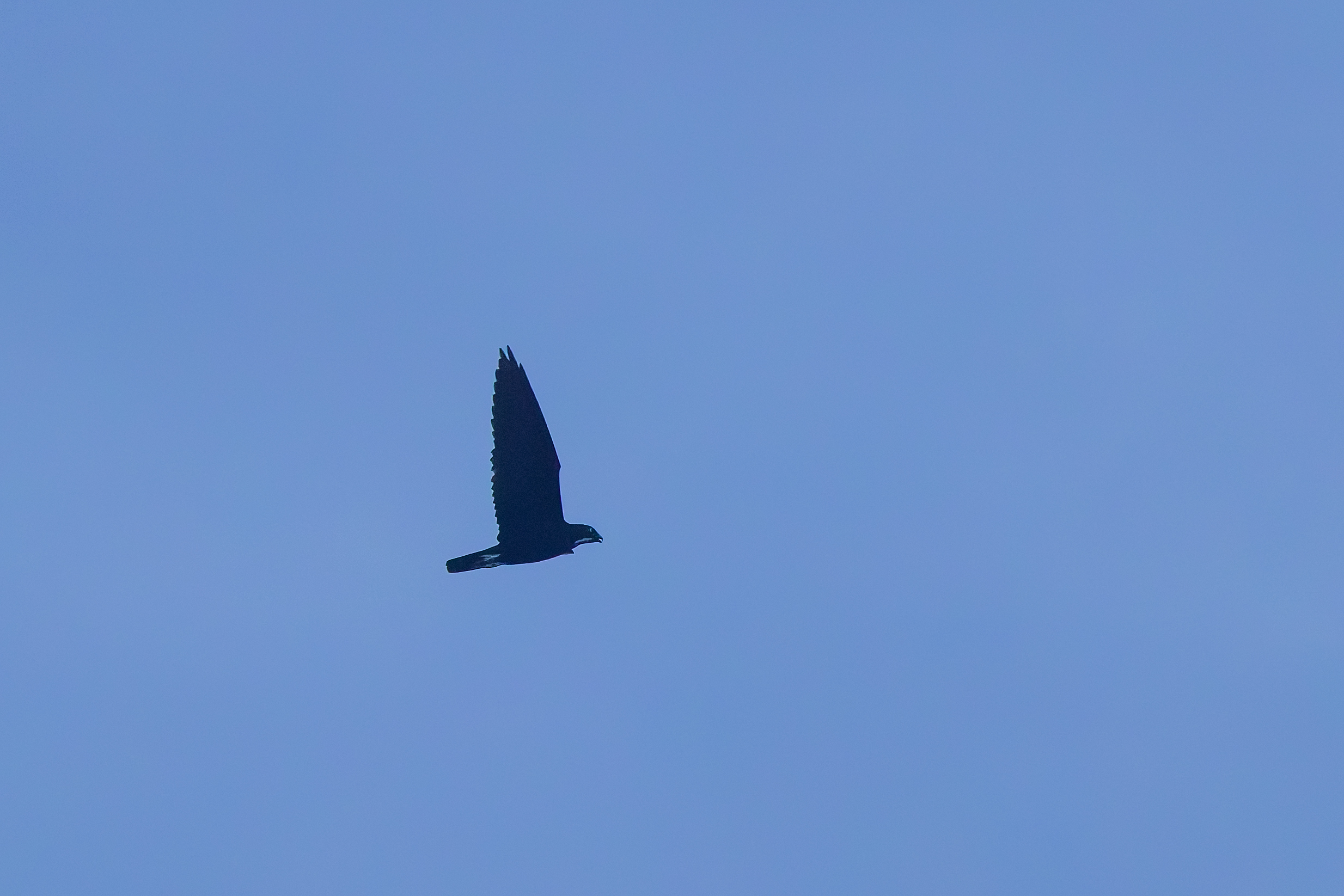
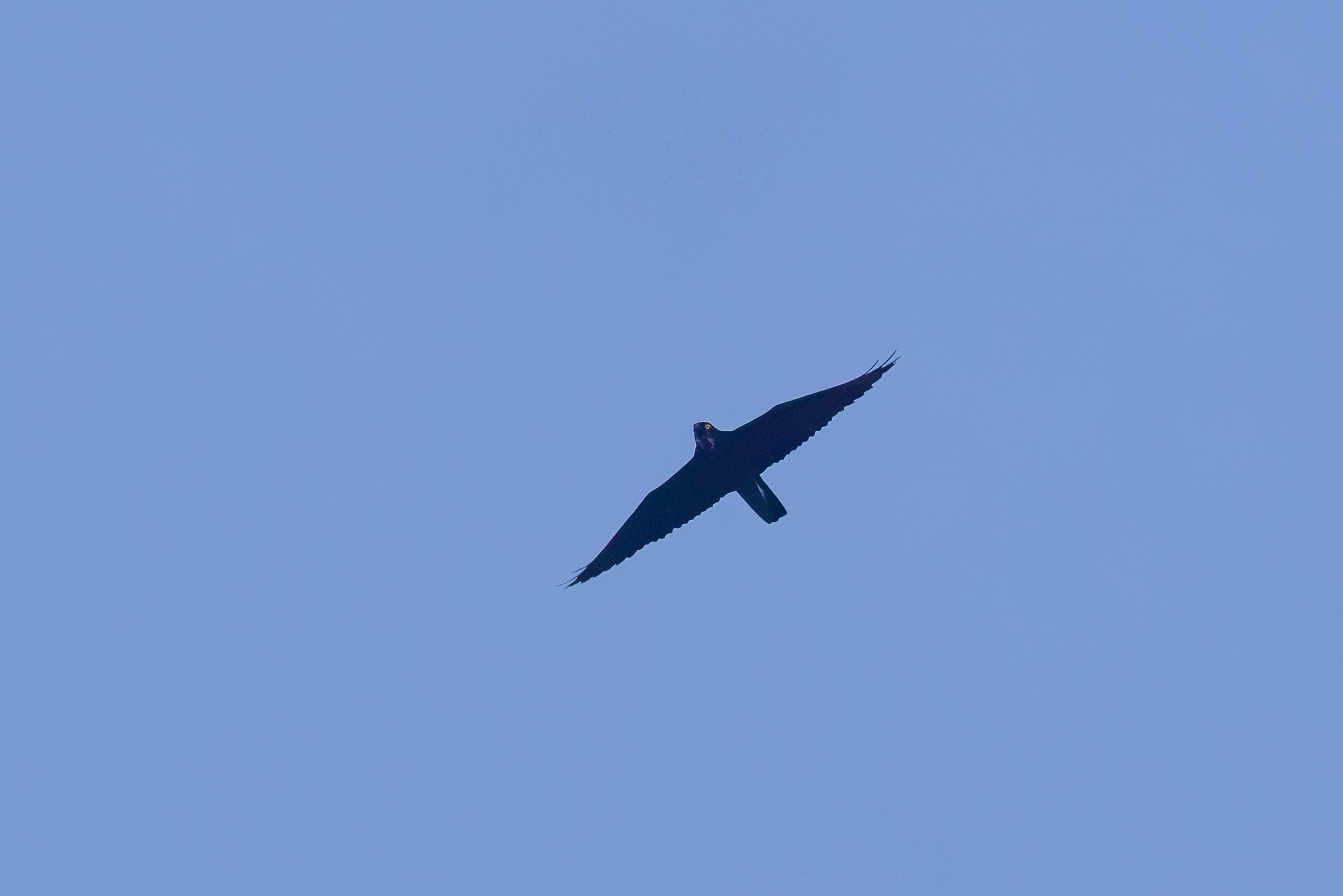
Then pre-dusk we ascended 550 steps to the top viewing platform to wait for the emergence of the bats. Azmil had warned that if it rains, sometimes the bats do not emerge, and the raptors that assemble to feed on them don’t come out to play either. Worringly, we endured an on-off drizzle. As the sun sank lower, the rain eased, and there was enough light for a stunning rainbow. Still we waited. Would they come? As Steve and I were conferring, worried we were here on an “off night”, in the post-sunset gloaming a thin wisp of “smoke”, a thickening stream of bats, began to snake its way almost horizontally, hugging the treetops on the far side of the valley, before turning back into more open sky. Now, seemingly out of nowhere, but just in time for dinner, we started seeing a few raptors. A magnificent Rufous-bellied Eagle sailed past and landed in a tree no more than 50m away. Then distantly we picked up the silhouette our first of 3 sinister Bat Hawk. Widespread (I had previously seen in Borneo and Uganda) but still a mega, this was probably Steve’s #1 raptor target of the trip. For 20 minutes or more we scanned the skies and had the Bat Hawks powering through the plume, plucking dinner from mid-air. We also had Changeable and Wallace’s Hawk-eagle here. As the steady flow of bats streamed out of the cave, swiftlets were gathering and then in huge numbers swooped past us into the cave, like shift-workers taking over manning the cave from the bats.
Because we had stayed so late for the raptors, it was dark by the time we re-crossed the flooded stream, treacherously by torchlight. It was a short drive through the dark palm plantations to bank of the Kinabatangan where we loaded up a small dinghy and sped downstream to the Borneo Nature Lodge, one of the many riverside lodges that dot the banks of this stretch of the Kinabatangan. BNL proved to be a small, comfortable and quiet base for the next two nights.
Birding — and wildlife watching in general — on the Kinabatangan is mostly done from boats along the main river and into various small tributaries. We would have 4 trips in the boat, this morning, this afternoon, a short night cruise this evening, and a final crack tomorrow. Many tours spend a lot longer here but we had opted for hides and other sites and really only needed a couple of nights to give ourselves good chances of most targets. And having been to this place twice previously (best bird, Giant Pitta in 2014, worst dip Bornean Ground Cuckoo in 2014 and 2019) I was glad that it was this site that we had squeezed and not one of the others.
Out first foray onto the river was at a fairly civilised 6.15. Immediately we cruised to the far side of the river where Azmil had a spot for Straw-necked Bubul staked out. Although bulbus are, by-and-large, a bit meh, and this bird conforms to the rather plain plumage of its numerous cousins, it has a beautiful song. Unfortunately for the species, because of the song, it is prized by “collectors” for their aviaries, and is now endangered by illegal trapping for the caged-bird trade. In the almost-dark early hours we had tickable views but the light was too poor for pics.
As we headed up a small tributary, we worringly seemed to enter a slow queue of other boats, all filled with non-birding punters, and all seemingly heading up the triburary. Oh shit! Luckily we soon discovered why — a shot way up the tributary an early at had found a Pygmy Elephant and had alertd all the other boats. We stopped for obligatory viewing and photos of the beast noy ding much in the dark forest at the water’s edge — it was after all, a lifer for Steve ad Duncs — but then cruised on by while all the other boats turned back to the main river. In the now much quieter small part if the river, we picked up White-chested babbler, Black-and-yellow Broadbill, Stork-billed Kingfisher, Blue-eared Kingfisher, Brown Barbet, and Ruby-cheeked Sunbird.
As we returned to the main river we found a young male Orangutan at the top of the sparse tree, stripping bark and licking the sweet sap.


Underneath his tree, as we craned out necks for view of the Ranga, we also found a cracking cartoon-like Black-and-red Broadbill. The riverside trees are a perfect roost for the huge variety and number of raptors, and this morning we observed six different species: Changeable Hawk-eagle, Lesser Fish-eagle, Grey-headed Fish-eagle, White-bellied Sea-eagle, Brahminy Kite and and Crested Goshawk.


A short way upstream from the Ranga we came across a small group of elephants and spent some time with them. A few other boats congregated for a while, but did not hang around. We too were keen to move on, with important targets still to get. However a big disadvantage of birding from boats for an aging dude with enlarged prostate and weak bladder, is the need for regular pit-stops. With no suitable landing spot in sight (all occupied by Elephants!) and pressure building, I realised I would have to ask a favour of the crew. I begged the team to turn their backs while I clambered to the front, with the boatman doing his best to keep the boat steady against a steep part of the bank. Despite the unstable platform I managed to keep my balance, but part-way through my release, a huge grey shape pushed its way through the dense vegetation, and I was confronted with a full-sized Pygmy Elephant barely 3m directly in front. Do not be misled by the “Pygmy” moniker: these guys weigh about 3 tonnes. Time almost seemed to stand still as we fleetingly stared straight at each other, until the young bull trumpeted, swished his enormous appendage over his head as if to say “call that a trunk?”, turned and fled. As I tucked my own appendage back into my trousers, the guys behind were roaring with laughter, and I was reflecting that the encounter could have gone much worse.


Along another tributary Azmil’s sharp ears picked up the call of a White-crowned Hornbill, and working with the boatman, they were able to manoeuvre us to a point where he found a narrow window to the bird which was settled, eating fruit. So narrow was the view through the foreground to the canopy behind, we had to shuffle our positions in the boat, taking it in turns to join Azmil at the stern for our views and photographs. These were still of the “record shot” variety, but at least I could now remove the BVD asterisk from White-crowned. The Kinabatangan is hornbill-city-central, and this morning we also picked up Black Hornbill, Oriental Pied Hornbill and the magnificent Rhinocerous Hornbill. Another Kinabatangan specialty is the endangered Storm’s Stork and we had a pair on this same tributary as it started to rain, fortunately not too heavily.


For a full list of our bird sightings in the 5 hours this morning, check out my ebird list.
Over lunch we wandered the garden at BNL and climbed the viewing platform. It was hot, and not a lot of activity, but we picked up Brown Barbet, Ashy Tailorbird, Black-headed Bulbul and Red-eyed Bulbul, all relatively common “garden birds” in this part of the world.
Our afternoon cruise started in bright sunshine, but within 30 minutes black clouds rolled in bringing cold, heavy rain which seemed to track us as we headed upstream. Of course, I had forgotten both waterproof jacket and umbrella. I used my camera bag to store camera to avoid the worst, but I got soaked through. At least skin, unlike my R5ii and 100-500, is waterproof. I would spend the next 2 hours regretting my mistake, freezing, and wondering how ironic it would be to get hypothermia in the hot, sweaty, Bornean jungle. The birding was solid but not spectacular and we didn’t add a lot to the morning’s haul, and I had no lifers: new species for the trip included Pink-necked Green-pigeon, Wandering Whistling Duck, Greater Coucal, Indian Cuckoo, Wallace’s Hawk-eagle, Blue-crowned Hanging-parrot and White-breasted Woodswallow. Azmil directed the boatman to pull into a couple of secluded, wider banks, hoping we might attract a Ground-cuckoo. But the high water level had reduced the areas where an encounter might be likely, and I was destined to dip, yet again, after my failures in 2014 and 2019. Re highlight was arguably when we came across a small troupe of Proboscis Monkeys, including a male with his unfeasibly large nose and permanent red erection, several sizes smaller (although I too have a big nose, fortunately I do not suffer from those other afflictions).


After dinner we boarded the boat again for a short cruise hoping for night birds. We began with yet another Elephant enounter, but the avian highlight was a fabulous Buffy Fish-owl. Azmil’s thermal camera got us onto roosting Black-and-red Broadbills and a Stork-billed Kingfisher, but Large Frogmouth and Oriental Bay-owl were heard only. The latter managed to fly over our heads from one side of the rive to the other undetected, but would not come close enough to the bank for Azmil to capture in the thermal.


Nevermind! We returned to BNL, donned welly-boots and headed off into the forest along a damp, muddy track. Disconcertingly, we could hear the distant crashing of elephants in the forest, and an occasional gunshot as locals attempted to scare them away from their houses and lodges. As is usually the way with owling in foreign countries, we were almost totally reliant on the guides to get us to the right paces and to locate the birds. They assured us that the elephants were on the far bank, we were safe, and we followed on, deeper and deeper into the pitch black forest. The ebird track tells me we covered only 900m in 100 minutes, but it felt a lot further in the eerie jungle by torchlight. It was worth it — at eth end of our journey the team got us onto a superb Oriental Bay-owl, one of Steve’s most wanted. I had seen one in 2019 on the Kinabatangan not far from here, and I was not sure what brought Steve more satisfaction — the grip back, or the stunning little bird itself. Once we’d had our fill with the OBO, we headed to a new spot not far away, where we heard, but could not locate Large Frogmouth. When some crashing sounds were much closer, and clearly on our side of the river, we all agreed it was time to retreat to the lodge for beers and bedtime.

Lists for the pm: lunchtime; afternoon; evening; night
Our final morning we ventured onto the river again for a 2-hour sortie. For me the highlight was a Bornean Black Magpie which arrived overhead an sang from the lower canopy by the riverbank. Ruddy Kingfisher is a spectacularly coloured bird with rusty-orange unders, violet back and wings, a large orange bill. We spent a long time following one along one of the banks and I eventually spotted it high up. Like the White-crowned Hornbill the day before, the viewing window was narrow and though JP and I had an adequate line of sight, on the left-hand side of the boat Duncan and Steve (and Azmil) could see nothing. We swapped places, and Steve was able to get onto it, but Duncan missed out. A BLue-eared Kingfisher gave us brief but much better views shortly before. We would have to hope we could claw it back at one of our remaining sites. Other good birds this morning included Bushy-crested Hornbill (new for the trip and a lifer for Steve and Duncan), Oriental Pied-hornbill, White-bellied Sea-eagle and Crested Serpent-eagle. A Great Argus called tantalisingly (but of course invisibly) from the hills forest on the right bank; I had heard this previously in Panti Forest many years ago, but it was not a bird I ever expected to see. Fittingly, our last bird as we cruised back to BNL was a superb Rhinoceros Hornbill, one of the so-called “Big-5 of Borneo”: RHB, Pygmy Elephant, Orangutan, Proboscis Monkey and Saltwater Croc. We’d seen 4/5 and I was not too unhappy about the one we missed 😉
