The next few days were, for me, among the most important of the trip. Twice previously, in 2014 and 2019, I had been to Kinabatangan and heard, but failed to see my top avian target, Bornean Ground Cuckoo. And, as you may have read in the previous installment, we had dipped again at Kinabatangan, for 0/3. However two of the next three nights were to be at a new lodge, Utan, on the edge of Tabin Wildlife Reserve in the far north-west of Sabah where BCG is the star attraction.
Mt Silam
Before we headed to Utan, we had a date (I hoped) in a hide with another of my top targets. Most Pittas can make a reasonable claim to be “best looking pitta”, but Blue-banded, a Bornean endemic, has a stronger claim than most. Bright orangey-red head and front, olive back, and a stunning blue “necklace” and lightning-bolt eyebrow make this beauty stand out from the crowd. It is also, unfortunately for us/me, one of the shyest. Steve and Jon, expertly guided by Azmil, had enjoyed an amazing encounter with one on their hike to an isolated forest camp, high in the mountains. I had glimpsed a pic on Steve’s phone when we rendezvoused on our first night in Tambunan. I was gripped off, but at the time fairly confident we would have good chances later in the tour.
“Later” was now, since we had arrived in Lahud Datu, a short drive from Mt Silam where previously a hide had given daily views of BBP for more than a year, during most of 2024, after which the birds stopped coming 😬. My mates Ted Burkett and Des Lobo had missed it in their Feb tour in 2025 (in fact they didn’t even try, because of the cost and very low probability at the time). But the good (ish) news for us from Azmil was that his friends had established a new hide and were “training” another bird. We would have two shots, the afternoon of our arrival, and the next morning.
We arrived at 3pm to the mournful sound, the single note song of a BBP. The fact it was so loud, even audible from the road where we parked, made us immediately realise that they were using very loud playback to try to coax the bird in to view. Our hearts sank, disappointed at the blunt tactics. Nevertheless, we dived down a narrow trail for about 200m and arrived the hide, where we arranged ourselves (as everywhere else) in a line looking out to a small clearing with a few somewhat artificially placed logs. The gen was that it had appeared 3 times this morning, coming in to find the mealworms that had been strategically placed. The guides/hide owners speculated that this bird was breeding somewhere fairly distant down the steep valley, had been attracted initially by the loud playback, and now realised that there was a plentiful food supply for its mate and checks.
We had just about tolerated the intrusive playback, used on and off for 45min, when we heard, distantly, the drawn-out whistle of a real bird for the first time! Tension rose. It sang again! Was it coming closer? Maybe, but then it went silent. Bugger! At least we had tomorrow morning. Almost incidentally, we had observed a White-crowned Shama which flushed from the road as we drove in, and Short-tailed Babbler and Grey-chested Jungle-flycatcher were regular visitors the hide as we waited in vain for the Pitta.
We stayed in a modern satellite city just outside Lahad Datu, above the local supermarket and bustling streets. We walked for miles trying to find a place suitable for both beers and decent food, but could find nowhere open, and ended up in the front room of a “sports bar”, the only place we could find that advertised beer during Ramadan. Drinks all round, but the food menu looked uninspiring, and as the table next to us filled with ladies who had materialised from nowhere, we realised that this place was not unlike Sin-Sin from a few nights ago, though rather more overt about all of the vices on offer. We downed our beers and went off in search of food and landed in a truly terrible curry-house. Tonight, about the only good choice we made, was to resist the manufactured charms of the barmaids.
The following morning we headed back to Mt Silam. As we drove in, Azmil explained that instead of going straight to the hide, our tactic would be to bird various spots in until he got a call from his mates in the hide to say a pitta was coming. It’s not what I would have done, but we had to trust the locals. After a wait at the gate we travelled up the steep road all the way to the top of the mountain. The view from the mountain top at dawn was stupendous.

From the summit, a short hike through the forest brought us to the hide where BBP had visited a year or so back. We added Rufous-tailed Shama, Spectacled Bulbul, Grey-hooded Babbler, Horsfield’s Babbler Grey-chested Jungle Flycatcher here, but of course no pitta.


So after checking out the upper hide, we drove down slowly to a pull-in where Azmil has previously had BBP. Compared to the prospects in a hide, peering down into a small, but dense, inaccessible ravine this seemed rather low probability. But amazingly within minutes we had heard the simple song. The 5 of us clambered a few meters down the super-steep slope, using tree roots and trunks to stop ourselves tumbling and the voice came closer and closer in response to judicious playback from Azmil. We could it pin it down to a small area about 20m away down the slope, but completely hidden behind tree trunks. As it continued to sing fro its concealed spot, I felt sure it would adjust its position or one of the 5 pairs of eyes or Azmil’s thermal a flash of red. But it stubbornly refused to move, and then Azmil’s phone rang — the other bird was coming to the hide! We had to make an immediate choice: wait here and risk it arriving at the hide without us, or leave this singing bird in the hope we arrive on time.
We dragged ourselves up the slope — literally, it was impossible to do using feet/legs alone — into the car and drove/walked as quickly and quietly as we could to the main hide. The bird was calling and it sounded like it was slowly coming closer. We held our collective breath.
Suddenly, there was a commotion behind us. Four people, a pair of Chinese photographers and their wives had just arrived, late, and were being directed into position. The photographers themselves were fairly discrete getting their kit ready and fairly quiet, settling quickly at the viewing window to our right, but behind us their wives fidgeted and wriggled to get themselves comfortable, squirreled around in their bags for snacks, and generally raised the noise level worryingly. We glared and shushed pointedly, but the hide owners, Azmil’s friends, seemed to be expecting the newcomers and did nothing to quieten them. The pitta called again — maybe the locals knew what they were doing?
But then it went quiet. We waited for 2 hours in the hide but did not get another sniff. Dejected, we trooped out of the hide, leaving the noisy group to “enjoy” the empty view. Our itinerary required that we be back in Lahud Datu for a transfer to our next destination, so we had very limited time left here. Instead of the spending the last hour in the hide, we tried back at the pull-in and heard that bird once more, but it was distant and unlike the early morning, it would not come back up the slope closer to us. It was impossible to escape the feeling that the late-comers had ruined our one and only chance. Azmil confessed that he too felt that this was the likely cause, and this made it even more mysterious to us why the hide owners had double-booked and not sent them packing when they arrived late.
This was my first major dip of a key target for the whole trip, which had been tracking at 100%. The stakes for the next two days had just been elevated several notches.
Lahud Datu
Back in Lahud Datu we grabbed some lunch at a Chinese restaurant (during Ramadan it’s mainly the Chinese restaurant that are open for lunch, because most other fare is owned/run/cooked by Muslims) then assembled in the plush surroundings of the Utan Rainforest Lodge headquarters, awaiting our transfer to Utan. As we admired the merch, and refreshed with tea and biscuits, we got our first inkling that the quality of the accommodation and food was about to go up a few notches. The birding would be pretty good too!
Utan Rainforest Lodge
It was a slow, 3-hour drive, through almost continuous palm plantation, a depressing sight. However as we bemoaned this state of affairs, Azmil gave some perspective, that most of the plantations in the north east are cooperatives, co-owned by the local communities. Sabah has more than 30% of its area as designated “Totally Protected Areas” and more than 50% under forest cover, a higher percentage than anywhere else in Malaysia. [ref]
We settled into our plush rooms, and had time for a brief and largely unproductive session in one of the hides. I did tick off the endemic Sabah Partridge, but would hope for better views over the coming few days. On my way to dinner — a fantastic spread with the food quality matching the accommodation — a Rhinocerous Hornbill perched on a huge tree near the open-air dining room.


After dinner Azmil led us back into the forest for some owling. We bagged Large Frogmouth (a non-lifer — I had seem this in 2014 on the Kinabatangan) and he brilliantly tracked down a gorgeous lifer Reddish Scops-owl.

The following morning was one of the most crucial of the trip, our first proper chance of Bornean Ground-cuckoo. It was the reason we had come here. Worryingly, there was drizzle about, and we were told that the birds often do not come if it’s raining. So once again we sat in a hide, hoping, praying, that our luck would be in, with regular flashbacks to yesterday’s debacle. It was tantalising to hear from the locals that a couple pf weeks back a Clouded Leopard had casually walked though this area, though we knew we would not see one.
Almost immediately, when it was still too dark for photography, a Bornean Crested Fireback strolled through at the back of the open area in front of the hide. A good start, but we then endured a nail biting wait for more than 30 minutes. Would the rain abate? Would it come anyway?
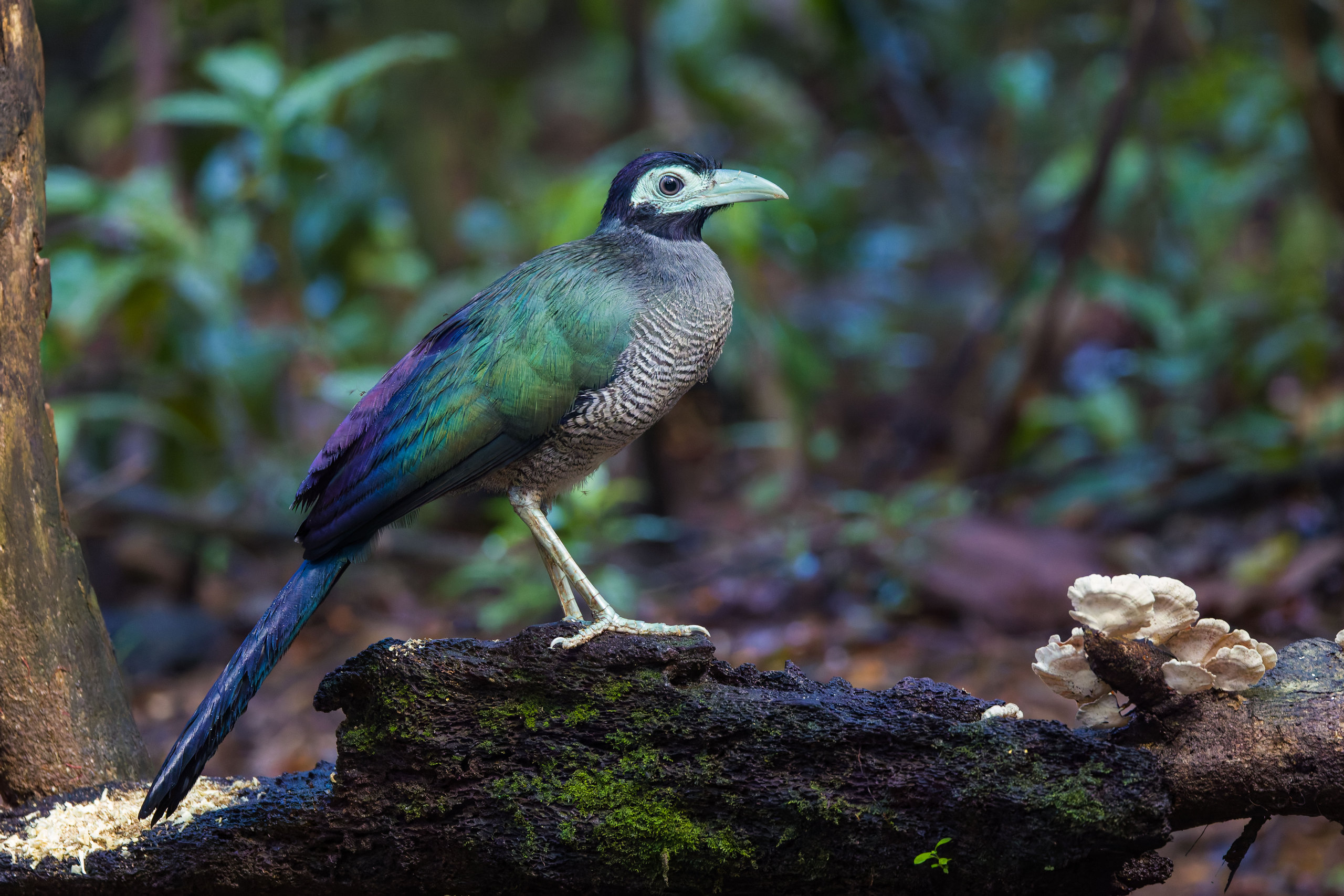
And then, despite the rain and as my confidence was waning, it materialised from the dense forest in front of us. It was magnificent: larger than I had expected, with a huge imposing green bill, and brilliantly coloured all over in turquoise and mauve. I may have taken a few photos, trying out all different settings.


After a wonderful performance of more than half and hour the sun just started peeking though and I even managed one or two pics as it allowed itself to catch the light. We celebrated with whisky from Steve’s hip-flask!


With the number one target UTB, I raced back to the room 5 minutes to grab something I’d forgotten (ironically, as write this, I have remembered forgetting something, but have forgotten what I forgot 🤣). As I returned, I observed some lifer Little Green-pigeon and heard a song that was surely Giant Pitta?? I grabbed my phone to record the sound but it had stopped. But when I met the guys back at the BGC hide, and said what I’d just heard, Azmil confessed he’d been playing the call on the off-chance. At least I knew my ear was “in” 🙂
Azmil and one of the local guides now led us onto a loop trail in the forest for a spectacularly productive hour or so. Banded Broadbill was the first good find on the trail, then a Blue-headed Pitta. We all got decent views but getting photos was another matter, as it would hop rapidly across slightly open areas between hidden perches. I gave up on photos as we became distracted by other goodies such as Diard’s Trogon, and Black-crowned Pitta. I had seen BCP at Rainforest Discovery Centre in 2014, but was still eager for a photo. It proved to be very elusive for 20 minutes until eventually I found it singing from a dark, dense bush, yielding half-decent views. But then JP picked up another much bolder bird, attracted by the first bird’s song, and it posed much more obligingly for photos. Another (or more probably the same) Blue-headed Pitta sang again as we started to walk out, and it seemed close and for once, stationary. I scanned along a fallen log and there it was, in the open for once, and we could get the kind of pics we’d hoped for. Along the way we also observed lifer Charlotte’s Bulbul (oh, and one or two more common species “spoiled” the elite list: White-crowned Shama, Scaly-crowned Babbler, Yellow-bellied Bulbul) but this was almost incidental to a morning that had yielded a Fireback, a Ground-cuckoo, two Pittas, a Trogon and a Broadbill. For good measure, a Wallace’s Hawk-eagle gave fabulous views as we positively bounded back to the lodge for lunch.


At the lodge the lads availed themselves of the pool. I was initially tempted, but after a refreshing shower decided that the thought of a swim was likely better than the real thing, and indulged a beer instead. We all enjoyed a well-earned post-prandial afternoon rest after this morning’s “clean up” and the lunchtime beers. But by 1530 we were back in a different hide, now enjoying much better views of Bornean Crested-Fireback, with 5 birds, including 2 males visiting the hide. Outside the hide, trail and roadside birding yielded a few nice sightings, including a couple of Rufous-backed Dwarf-kingfisher, Blue-throated Bee-eater, and Long-tailed Parakeet, but just one more lifer, Dark-sided Flycatcher. Overall a day of few birds but very high quality! And the day was not over yet…


A major advantage of staying at a lodge right inside the forest is the possibility of birding (or nature watching in general) even after dark and after dinner. Tonight we loaded up into one of the lodge’s 4x4s and drove towards the coast looking for owls. A haul of 7 Large-tailed Nightjar, Sunda Frogmouth (lifer), 2 Large Frogmouth, and a Brown Boobook (lifer), as well as Reddish and Sunda Scops both heard was not bad going for a couple of hours. In addition to the birds we noted Banded Civet, but our foray just outside the reserve hoping for Leopard Cat was unsuccessful.


Our final morning we decided to go to the Fireback hide instead of the Ground-cuckoo hide. We had a great encounter with some Sabah Partridge that came in for grain at the hide, and the spent our final hours birding along the road, with occasional short forays into the jungle. Diversity and numbers were much greater from the road than in the hides (as is often the case) and we added stunning Banded Kingfisher, three species of Woodpecker (Grey-and-buff, Buff-rumped, and Crimson-winged), Violet Cuckoo and host of other nice species (full list here)


Our time at Utan had been an unqualified success. It was hard to fault on any front: food, accommodation, birding, all stratospheric! We had a long drive back to Lahud Datu, a change of vehicles, then another drive to Danum Valley, perhaps the most famous birding destination in Borneo!

