I left you, dear reader, on the docks at Durban where the MSC Musica had just pulled up following a week long cruise to Marion Island. It was early Friday morning, and in my last missive I promised an update on the weekend’s terrestrial birding near Durban.
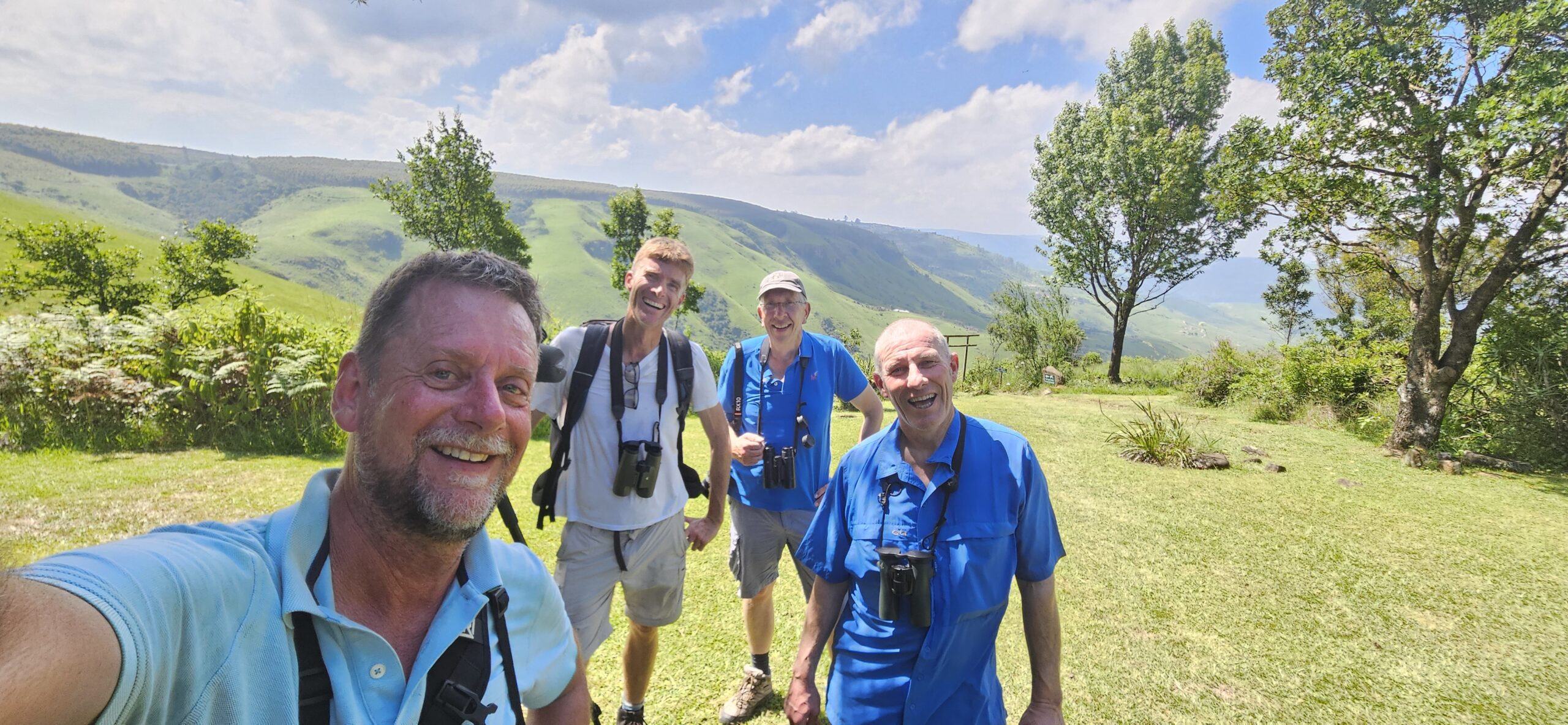
Originally my plan was to use all the time at my disposal before I had to be back at work, nearly 3 full days: most of Friday, all Saturday and most of Sunday, returning to UAE on an overnight flight on Sunday. But sorting out an itinerary and logistics alone felt quite daunting, so instead I took Oscar up on an offer to join him, Andrew and Chris Mills birding all day Friday and most of Saturday, coming back to UAE on the same flight as them Saturday evening. My contribution to the joint logistics was to book a suitable vehicle, and be the driver for the two days.
This turned out to be a good choice for multiple reasons. It was a fabulous being in the field with experienced, brilliant birders, and the birding and the craic were both top-notch. I ended up seeing 41 lifers, including some genuine A-listers, a far better haul than I would have got on my own in unfamiliar territory, even if I had used the whole weekend.
In terms of birding, my previous blog left off just as we were waiting to disembark the MSC Musica, with a lifer Lanner Falcon found by Oscar perched on a dockside crane. And this seems as good a spot as any to pick up the narrative again. I’d already said goodbye to Tom and Andy, who were no doubt waiting at the airport for their flight as the four of us waited nervously outside the Mandela Terminal. The driver I had booked to take us to the rental car company was late, and initially unresponsive to my messages. But eventually he rocked up and we were able to locate him amongst the endless taxis and shuttles and private lifts that were clogging roads not suited to 3000 people disembarking at once. Soon enough we were back in Umlangha, seemingly the closest rental car company to the port. the guys were already birding as we were waiting around for the rental car, and got me onto two lifers — Golden-tailed Woodpecker and Cape White-eye.
One of the reasons I was keen to join, rather than birding on my own, was that I knew the guys were targeting the rare and very beautiful Blue Swallow. We had solid gen on a good site in the hills to the SW of Durban and travelled more or less straight there. We arrived at the site unannounced after a couple of hours’ drive, but after paying a small fee, a local showed us down a trail through the dense “jungley” gardens, emerging to a lovely viewpoint overlooking rolling, uncultivated grasslands, the so-called Mistbelt Grasslands of KwaZulu-Natal. This habitat is where the swallows breed. Devastatingly, very little of it remains, lost to agriculture and afforestation, and this has caused the Blue Swallow population to plummet; it is now classified as Critically Endangered. At least here some of the remnant habitat is protected, and we knew from others on the ship that there had been a successful breeding event earlier in the summer, so we were expectant of a successful twitch.

The trail led about 1km from the lookout down into the long-grass meadows, dotted with a few large trees. Within a couple of minutes Andrew’s cry went up — he had a Blue Swallow already! At this stage my views were not brilliant, and although it had seemed a very easy twitch given the speed with which we’d found the target, it took a long time before I’d had views that I was truly satisfied with. Unlike the other hirundines — Barn Swallows and Lesser Sawwing — which seemed to be constantly on the wing, the Blue Swallows would appear briefly, fly overhead fast and far, then disappear for long periods. We eventually spent 3 hours here, getting occasional views and even fewer photo opportunities. But the grasslands were also rich with other interesting birds. Most notably we had great views of Fan-tailed Grassbird (also known as Broad-tailed Warbler) which is widespread but nowehere easy to see, but we also had Cape Rock-thrush, African Stonechat, Southern Fiscal. Fan-tailed Widowbird and Yellow Bishops (display flights), while Jackal Buzzard, Forest Buzzard and Cape Griffon soared overhead. Lower down in the valley we found a Sombre Greenbul where several Lesser Striped Swallows were hawking.


As we started the short trek back up out of the valley, needing to move on to get in a bit more birding en route to our overnight accommodation near the coast, another birder alerted us that he’d just had a Blue Swallow perched in view lower down. Andrew and Chris were gracious enough to wait without complaint, despite the heat and the fact they’d now seen all they needed, while Oscar and I returned for distant photos. I also managed some reasonable (though washed-out) phone-scoped video. Although nothing like the frame-filling in-flight shots I had imagined I might be able to capture with the new gear (Fat chance. Really, Reid, what were you thinking!), lingering a bit longer was definitely worth it. As we finally did walk out, I picked up the birds in flight for the final time, giving just about my best views, and we saw all four together, two adults, two immature birds (lacking the long tail streamers) which swept over us and drifted further and further off into the valley.


We checked out various wetlands and other decent looking habitat on our way to Scottburgh at the coast, picking up a nice array of species, though not finding a Blue Crane, which had been on my wishlist. At one spot a tall grey bird got the pulse racing initially, but was “just” a Grey-crowned Crane, which I’d seen in Uganda in 2022, where it is the national bird (ebird lists S212029065 and S212029067).
As I mentioned above, I was in charge of the car, and this (up to now) had worked out very well, with our large Toyota Fortuner just what we needed for 4 of us and luggage to ride in comfort. Oscar was in charge of booking accommodation. He had found a cheap place on airbnb, and was directing us down increasingly unpromising-looking lanes while Chris jovially expressed skepticism that this was going to work out, and comparing Oscar’s penny-pinching choice of accommodation unfavourably with my excellent choice of vehicle. When we reached a closed gate right at the end of a single-lane poorly kept “track” it really did seem like Chris was right. But we managed to attract the attention of someone – a gardener, perhaps?? — and finally the owner came to the gate and let us in. Our rooms were actually rather good, and the location superb. The apartment had a balcony with a view of the extensive gardens, through to an estuary and the ocean beyond. We would have some excellent birding here tomorrow morning, but tonight, after completing the written apologies that Oscar insisted on, we followed our host’s directions to the Stone Pub and Grill for beer and decent pub-grub.


We woke to the the wails of African Thick-knee, which we later saw well on a small island in the estuary, viewable from our accommodation (“I, Ian, do solemnly promise not to mock Oscar’s choice of airbnb again…”), and as we wandered the gardens a superb Purple-crested Turaco bounced around in the treetops (though evading my lens). Also in the gardens and down by the estuary edge we had several weavers, including Village Weaver, African Golden-weaver, and a dozen or so unidentified weavers, probably Southern Masked. Also Yellow-rumped Tinkerbird and a pair of Bronze Mannikins were hanging around the house. A walk down the adjacent abandoned railway line and across the estuary yielded Brown-hooded Kingfisher and Pied Kingfisher, as well as view of African Fish-eagle, Black-headed Heron, Goliath Heron, Blacksmith Lapwing, and a stonking Grosbeak Weaver (ebird lists: S212029034, S212029029).


Our main reason for staying in Scottburgh tonight (thanks and apologies again Oscar 😜) was that Oscar had identified Vernon Crookes Nature Reserve, some 25km away, as a potentially interesting location for some birding. Eight months later as I search for more information about the reserve online I have found the following nice description:
Set high upon a plateau, 610 m above sea level, overlooking picturesque rondavel-dotted hillsides of the nearby Zulu villages, clear views of the ocean to the east, rolling grasslands and lush indigenous forest makes an ideal setting for bird watching and game drives. The terrain is primarily grassland with forested ravines. [https://www.thesaunter.co.za/listing/vernon-crookes-nature-reserve/]
Oscar’s ebird list describes it similarly poetically: “Native, flower-rich grassland with rocky outcrops, a small dam and extensive scarp forest.”
Our hosts downplayed the “quality” of the reserve, saying it had gone downhill, but we later came to realise this that this was a comment on the mammalian fauna, now harder to see, and not a comment about the avian diversity which we really enjoyed. We followed google maps navigation faithfully (but at times skeptically) along a winding, rough drive down increasingly precarious unsealed roads, through the above-mentioned quaint zulu villages, to Vernon Crookes, we finally arrived at what was evidently the “back entrance”. Interestingly, the same website that describes the reserve also concludes with directions as follows:
Directions: Please note, you take the Southern Freeway past Scottburgh and take the Umzinto turn off, turn R. and follow the road past Umzinto until you see the signs indicating Vernon Crookes Nature Reserve. Turn R. and follow the gravel road through the Sugar Cane farm for 6k until you get to the Main Entrance. DO NOT FOLLOW GOOGLE
Our unadvised entry actually took us through some nice-looking “forested ravines” (which we would revisit as we left), climbing up through the forest to the top of the plateau where we encountered some Burchell’s Zebra and Common Wildebeest in the open grasslands.


For the next couple of hours we birded the grasslands in what might be described as “slow and steady” birding. We found various classic grassland birds like Cisticolas — Croaking, Piping and Zitting (though not grunting, farting, spitting or shitting), Rufous-naped Lark, Yellow-throated Longclaw, Streaky-headed Seedeater, Fan-tailed Widowbird. In trackside scrub we located Green-backed Camaroptera and a few times a couple of enormous Trumpeter Hornbill shuttled between copses.
About now, after 1.5 hours of solid but largely unspectacular birding, a logistical cockup entirely of my own making, came to bite us. When I had booked the car, I made the reservation for 3 days (according to my original plan to bird through Sunday also). But when we picked it up yesterday, I forgot to tell them we’d be returning a day early. Normally this would not be an issue, but I had failed to account for our company not having an office at the airport. I only remembered and realised all of this just before we left Scottburgh; I called the rental company, but they could not give me answer right away — the pickup guy was on the road, out of signal range, and so they could not confirm he would be available for our new drop-off time. Before they could call back, we too, had travelled out of phone range, and we would spend the next few hours not knowing if we could drive straight to the airport or would we have to detour past Umhlanga, or even worse, would that office also be closed for the weekend? There was nothing for it but to confess my cockup and force everyone to leave an hour earlier than we had planned. Sorry guys!
As we drove down through the forest, making our premature exit, we travelled through the “lush indigenous forest” and still had enough buffer to stop and walk if we heard something interesting or the forest looked good. We were all keen for the localised Knysna Turaco, but did not hear one until, just minutes before we really had to be leaving, one called! Isn’t that always the way? We tried super hard, seeking new vantage points and trying playback, but it would just not come any closer. Much everyone’s disappointment I insisted we would have to leave, even as the Turaco continued to taunt us from its invisible perch.
On exiting the forest — and presumably Vernon Crookes — I drove up the other side of the ravine into grasslands. We stopped at the top for a final quick break and I checked my phone — I had one bar of signal — Joy! I called the rental company (at great expense via my Australian SIM, but I did not care by this point) and got through. Yay! Yes, matey-boy could meet us at the airport. Phucking phewie. And now, best of all, we had an extra hour for birding.
Although we might have returned to the forest, in fact there was no need, and we had by chance ended up at our best birding spot of the morning. Already the guys were using our vantage point over the canopy of the forest to pick up good birds.

Over the next 45 minutes a variety of cracking species shuttled between fruiting trees on the forest edge. Best of all, we were able to track down the pesky but much desired Knysna Turaco. Initially we found one in the canopy of a distant tree, but later had a pair much closer. The phone-scoped video was still pretty mediocre, but at least a record.
We more than doubled the length of our ebird list, and at least quadrupled the overall “quality factor”, finding excellent birds such as Green Malkoha, Red-chested Cuckoo, White-eared Barbet, Black-collared Barbet, African Black-headed Oriole, Purple-crested Turaco, Green Woodhoopoe, Cape Batis, Black-backed Puffback.
Our enforced stop for my phone call had actually resulted in the best birding of the morning so to some degree I had accidentally redeemed myself. But now it really was time to hit the road. We called in at Scottburgh for showers (essential after sweaty summer birding prior to an eight hour overnight flight) and to load up the car with our luggage, then 90 minutes later rolled into the airport. Much to my relief we were able to find our man without too much additional stress, and check in without drama. Two hours later we were winging our way back to Dubai, where we bade goodbye to Chris, who was connecting with a flight to London, while Oscar, Andrew and I shared a taxi back to Abu Dhabi.
A link to our Vernon Crookes ebird list seems a suitable way to end this blog! S212029026
