Twelve months ago, in July 2024, I was in The Butchers Arms enjoying a pint with Tom Bedford, and he casually slipped a bird list under my gaze. It was titled “Flock 2 Marion” and was the trip list from a cruise from South Africa to Marion Island in the Sub-Antarctic in 2021. A new trip, “Flock 2 Marion Again” had been set up by Birdlife South Africa for January 2025, and Tom and Andy Last were booked to go. Did I want to come along?
As I scanned quickly down the list I saw many Southern Ocean species familiar from numerous trips out of Port MacDonnell and Eaglehawk Neck, and my immediate thoughts were that I might be better off saving the leave and money for another time. But then my eyes came to rest on a few birds that are in my “most wanted”: Light-mantled Sooty Albatross; Grey-headed Albatross; King Penguin; as well as several lower priorities. Overall there were a lot more potential targets on this trip than I had expected. Most were birds I hope to see in Australia one day, but it was a great deal — just USD 800 all-inclusive for the whole week. I was tempted, but not yet fully sold: I had never been on a cruise ship, and in fact had never had any desire to. What would the viewing be like from 7 stories up in a floating hotel? What would it be like with 2000+ other birders in the same confided space? What if the weather was poor and I was sick for an entire week?
I didn’t think any more of it until a few months later when I got a message from Oscar Campbell. Had I heard of Flock 2 Marion? Was I interested to come along and share a cabin? This second prompt was just what I needed to get me looking closer, and then to take the plunge. With various birding friends from both Oxford and UAE going, guaranteeing great craic, and a bunch of desirable and hard-to-see lifers, the pros now outweighed the cons. I was now fully signed up. Despite this, for several months I continued to worry about the cons, dither, and even offered my place up. But eventually I was forced to engage with the planning, booking flights (direct to Durban from DXB) and working out what I would/could do before and after the trip around Durban. By this time Oscar also had a few other friends coming along, and I would end up sharing with Andrew Ward, a retired lawyer and old friend of Oscar’s from UAE, where Andrew had worked (and birded) for many years.
Oscar and Andrew had a firm itinerary for 5 days birding in the Drakensburg Mtns and along the coast before the cruise. I wished I could have joined them, but really couldn’t afford to blow so much annual leave early in the year, so had to pass. I was inevitably gripped off by their pics of Drakensburg Rockjumper from the Sani Pass, and their 300 or so other species, most of which would have been lifers for me. Always reasons to go back… My more modest plan was to meet Tom and Andy at a hotel halfway between the airport and the port, the night before the cruise. They, like me, were on a tight timetable.
Prologue
The following day we didn’t have to be at the terminal until mid-afternoon, so Tom and I took a walk around the environs of the hotel the next morning, around some nearby scrub and then down to the beach.


I was nervous about security so didn’t take my brand new camera, but fortunately Tom took his, and we were able to do some retrospective identification. We had some nice sightings, all presumably pretty common, all list-padders, but including six lifers: Red-headed Finch, Southern Red Bishop, Red-winged Starling, Southern Crag Martin, Southern Fiscal, Tawny-flanked Prinia. The last one there spoiling the Red and Southern theme we had going on. Here is the list S212400916.
Day 1
All three of us were cruise virgins, so it was with some trepidation that we arrived at the dock, where the MSC Musica loomed as a massive floating hotel behind the Nelson Mandela Terminal (a far cry from Jaymar Star at Port Mac or Pauletta at Eaglehawk Neck!).

Check-in was easy, clearly well-rehearsed to get 2000+ people on in good time. I wandered various corridors that all looked very similar and would eventually become familiar, finally finding my cabin where Andrew had already arrived and left. I would meet him later in the evening. I checked out the upper decks, the pools (which would get much less use that usual, I suspected) walked through the deserted casino (which would remain deserted throughout) and found my way to the various restaurants and walked along Deck 7, likely to be the main birding place over the next several days, and from where I viewed a superb Indian Ocean sunset as we steamed south from Durban.


Over the course of the week my fears about cruising were gradually dispelled. It was rough on the first night, but otherwise the seas calmed. The room was tiny, but comfortable enough, and we spent very little time there. The other punters were all, of course, birders so we all shared common ambitions and it was very good natured. The food was great, especially in the breakfast buffet where we feasted on a limitless mountain of hash-browns and cinnamon buns. After the sun had gone and there were no more birds to see I would head inside to hear amazing lectures by seabird experts (Peter Harrison, Peter Ryan, Hadoram Shirai and others), or adjourn to the bar for beers, negronis and birding tales, with either the Oxonbirders or the UAE birders, or once or twice both. On penguin night it was Tom and surprisingly Oscar, who got most into the spirit of the evening.


Day 2
So what of the birds? On the first morning, Day 2, I woke at what I thought was an early hour, and hustled down to Deck 7, finding that there were already several hundred birders peering out into an almost empty ocean. As we cruised through the “desert” that is sub-tropical belt of the southern Indian ocean, seabirds were few and far between. In fact towards the end of the day Andy remarked that he had probably seen fewer species than on any other day of his life, just 3: Great-winged Petrel, which were regular, a few small flocks of Cory’s Shearwater, and one or two Tropical Shearwaters, the local puffinus species and my first lifer of the trip. Even my gardens at home in Adelaide or Oxford (or even UAE) are more biodiverse! Some lucky (or very diligent and observant) folks had a Barau’s Petrel, and towards the end of the day I spent some time on my own scanning from the top deck in the hope I could nab one for myself. This was not to be but I did find a pod of Sperm Whales and enjoyed another stunning sunset.


Day 3
Overnight we crossed into the the sub-antarctic zone of the Roaring Forties, and the avian diversity had picked up! Before breakfast we encountered our first Wandering Albatrosses. Relatively recently, taxonomists have split Wandering Albatross into 3 species, based on breeding grounds and genetic differences: Diomedea exulans, D. dabbenena, D. antipodensis. The phenotypic differences are pretty minor — the latter two species are smaller, and have a smaller bill, but otherwise can be really tough to tell apart — I have seen it stated many times on the various seabird facebook forums that I am part of, that Gibson’s (antipodensis) and Tristan (dabbena) are phenotypically inseparable. Most of the birds we get on pelagics around the south east coast of Australia are of the last form (mainly Gibson’s with occasional Antipodean) but we also get exulans, now known as “Snowy Albatross”. This taxonomic guff is all very well, but the bottom line is that all Wanderers are simply superb, and any day you see one is a great day. They have the largest wingspan of any bird — up to a staggering 3.5m — and fly effortlessly, catching updrafts from waves so they can cruise for 100s km with barely a wingbeat. Sadly, many are now threatened by a quadruple-whammy including warming seas, long-line fishing, invasive predators like mice and rats (and people), and now Avian Flu.
The very first wandering-type we saw — which was a lifer and the top target for most on the trip — was immediately controversial. Peter Harrison, one of very few who has actually studied the plumage differences as the birds age, declared with 100% confidence that we were looking at a Tristan Albatross. This taxon breeds almost exclusively on Gough Island, some 4000km away from where we were. Noone knows much about their movements, other than that — like the other Diomedea species — they can travel vast distances. But for our very first Wanderer also to be the rarest seemed very low probability, especially when you consider that we were a “mere” 700km from Marion, where Snowy Albatrosses breed in their 1000s.


Over the course of the next few days the debate continued, with a few experts pointing out that, while Harrison has studied Tristan and Snowy, his “rules” were formed with consideration of Snowies from South Georgia, not Marion. However dedicated and important his work, it has not been peer-reviewed, and it is simply unknown if the other populations age in the same way or not. I’m reserving judgement in the likelihood we will never know for sure about this particular bird. Later in the trip, as we were heading away from Marion back to Durban, another albatross was flagged as “worth getting pics of” because it had an all-white tail, but distinct white elbow patches in otherwise still-all-dark wings. This is therefore a non-standard aging pattern for Snowy/exulans, but what that means in terms of identification still seems up for debate.

But getting back to the Day 3 action…
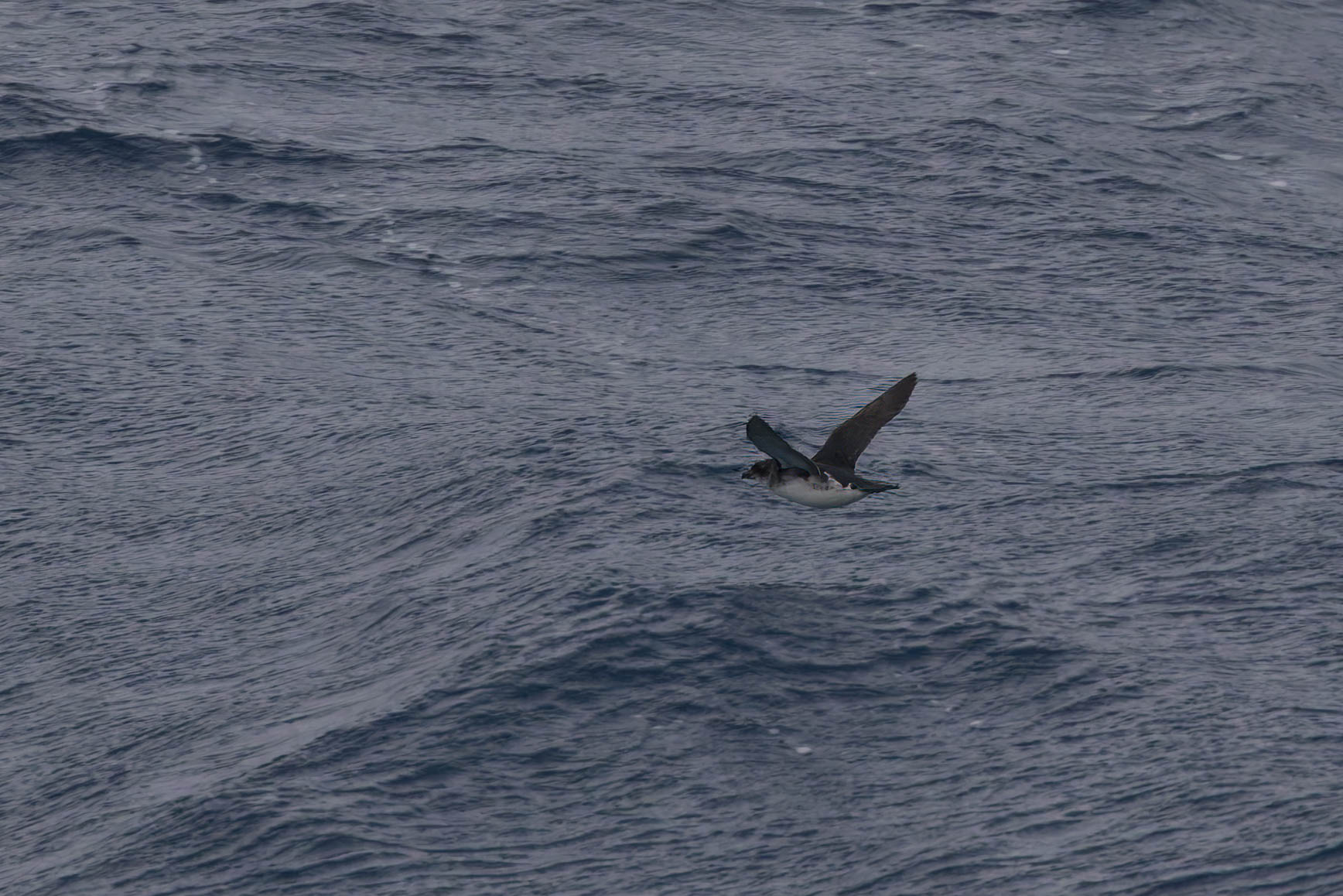
I tried various viewing spots on the ship, spending time up on deck 10 and 14 on the bow in the early morning. From here we picked out numerous “Little-type” shearwaters, almost all flying away from the ship having been flushed from the relatively calm surface. Most were called as Little, because of the white above the eye, but a few were clearly Subantarctic Shearwater (lifer). Later there was discussion amongst the experts about whether these were more likely to be a different morph of Subantarctic Shearwater, with the nearest definite Little breeding ground thousands of km away near Western Australia.


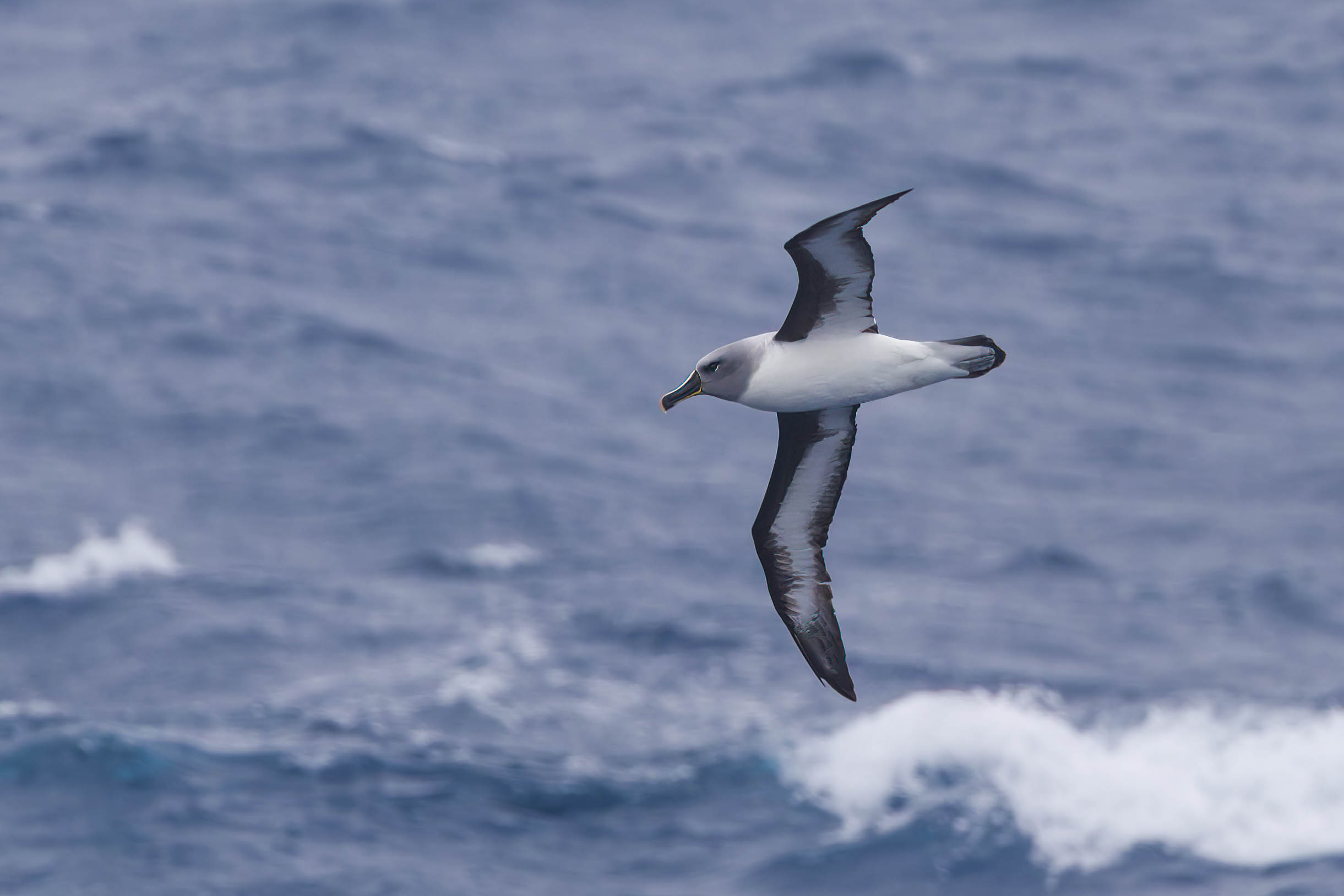
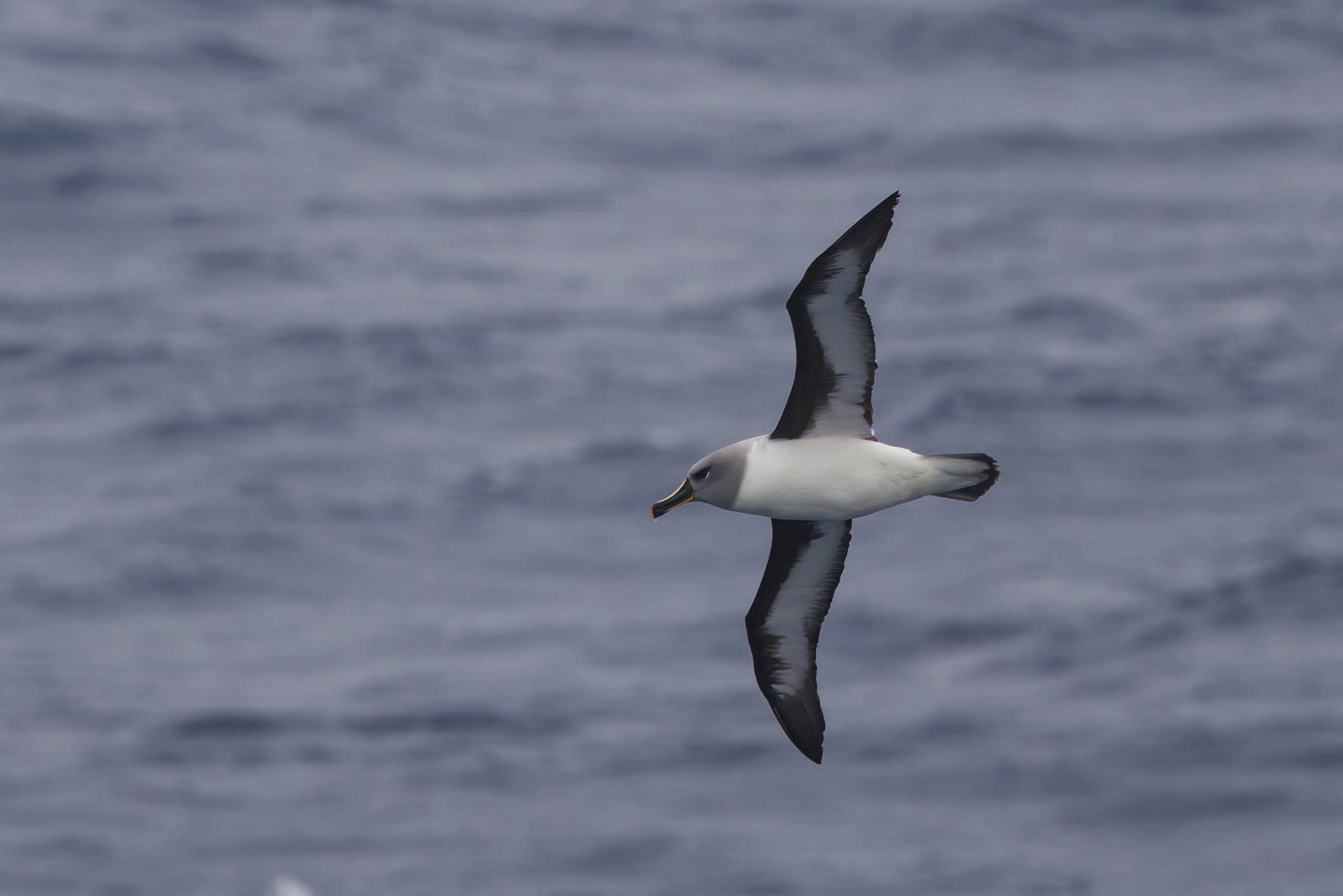
Over course of the day we had Indian Yellow-nosed Albatross, Shy Albatross, Sooty Albatross, Soft-plumaged Petrel (including my first dark morph), White-chinned Petrel, Sooty Shearwater, Wilson’s Storm-petrel, Black-bellied Storm-petrel (lifer), a single Salvin’s Prion (which would utimately become the commonest bird of the trip), and a Brown Skua. The highlight for me was our first Grey-headed Albatross, a beautiful mollymawk not unlike Buller’s (but much much rarer in Australian waters), and one of my top targets for the week.


Day 4
The next two days, 4 and 5, were the most important of the trip for the vast majority of the nearly 2000 punters on the ship — including me! We would be approaching the Prince Edward Islands, two small, uninhabited, volcanic islands (Marion and Prince Edward Island), officially under South African control, in the subantarctic, that are home to thousands of seabirds. We would not be able to land on the islands, but had permission to circumnavigate at low speed, some 12 nautical miles from the shore. No chance, sadly, for land-based birds like Back-faced Sheathbill, and probably low chances of the penguins that usually feed inshore, but opportunities for many seabirds, and a few penguin species.
The further south we had travelled, the more clothing was necessary. I had bought gloves, a beanie and a snood on Amazon Prime just two days before I travelled to Durban — these are not items in a typical wardrobe in the the UAE, but were essential for today and the next few days!


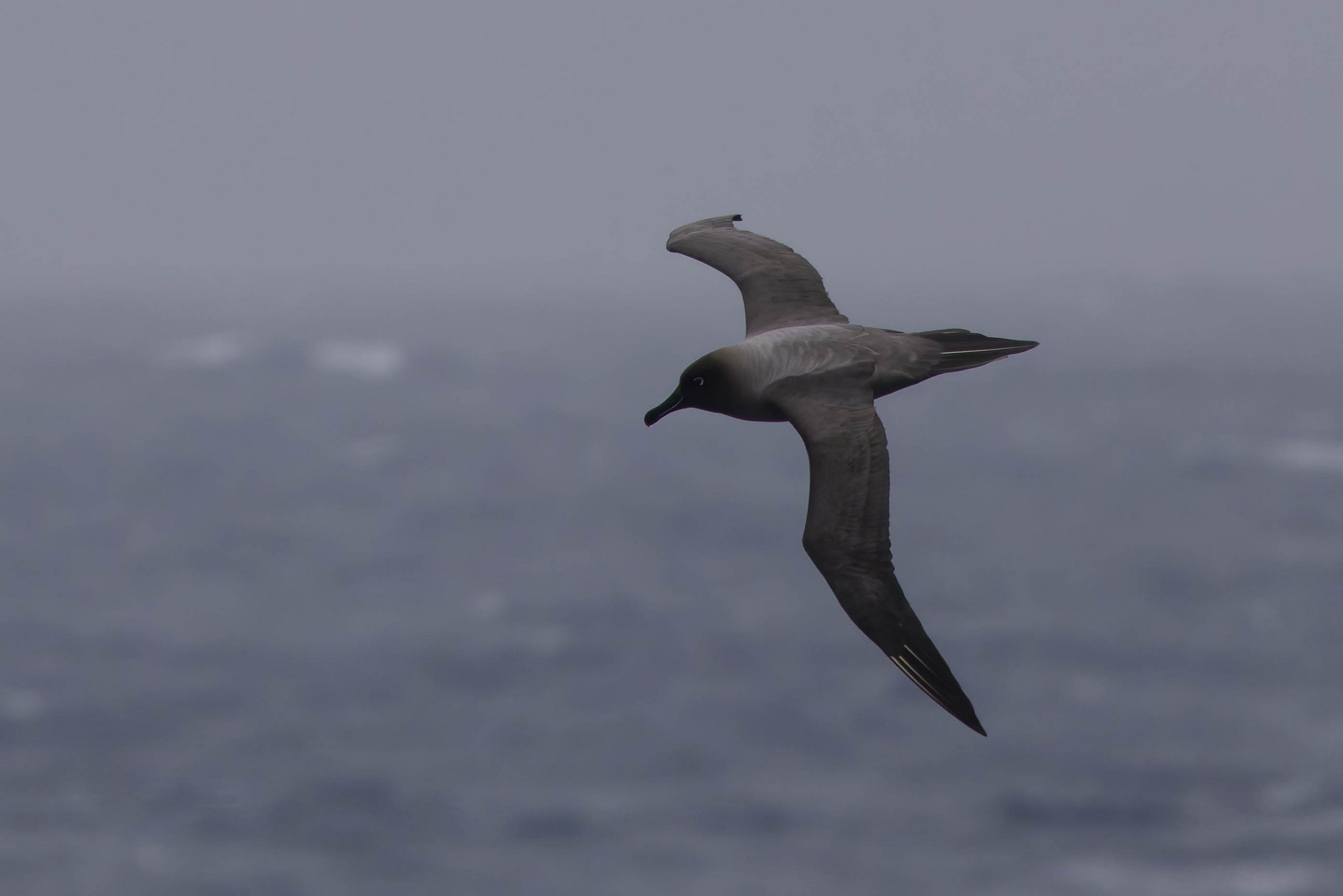
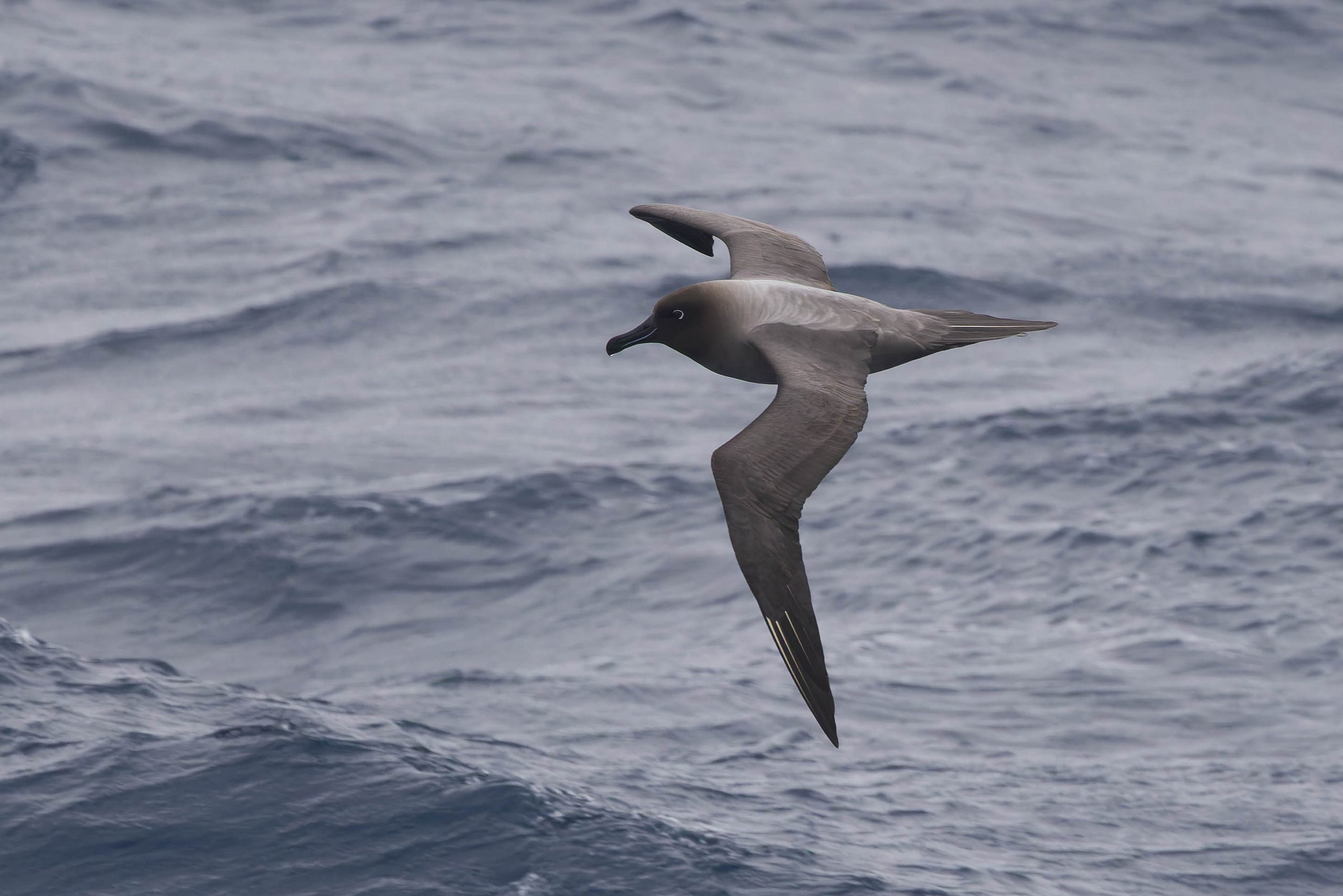
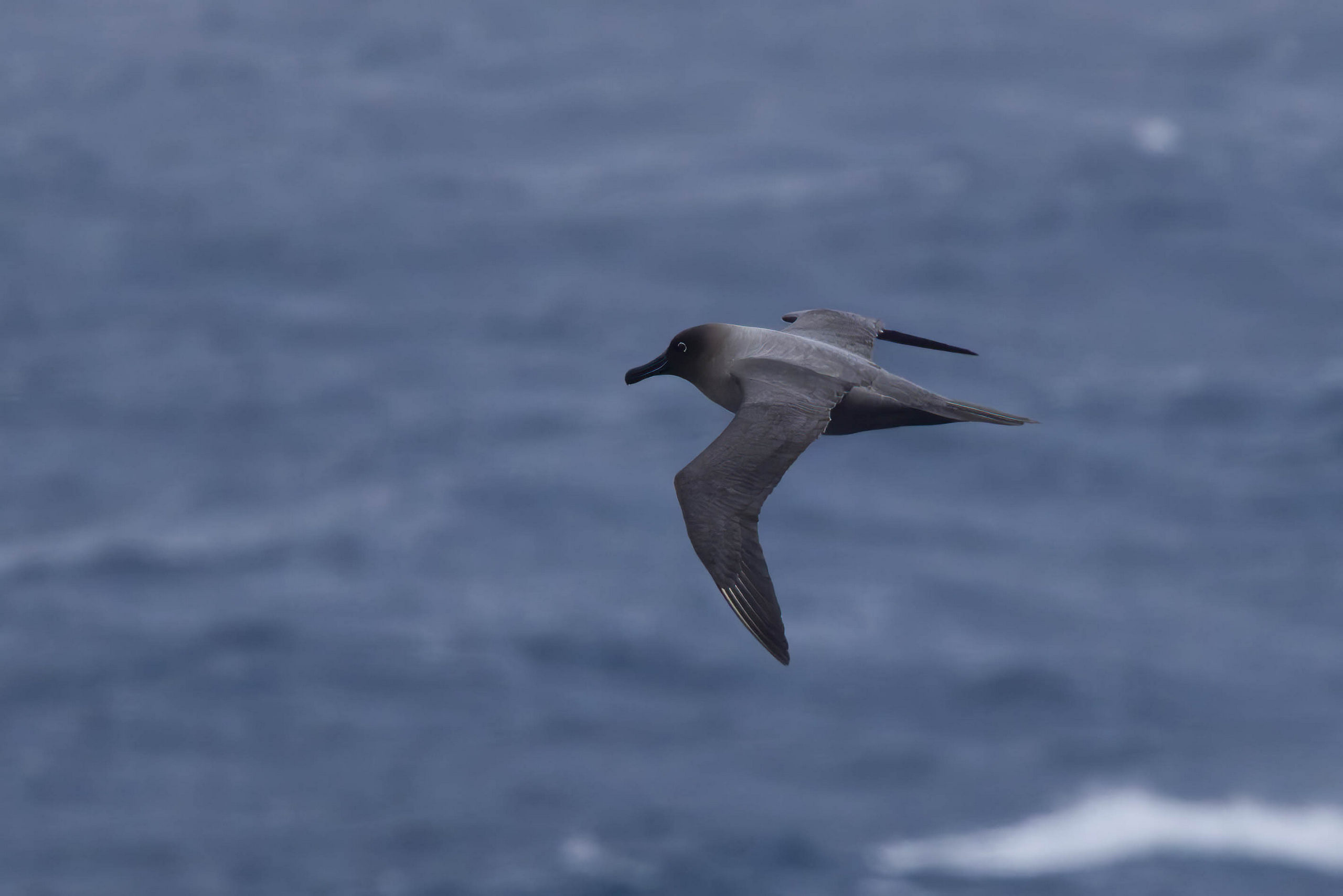
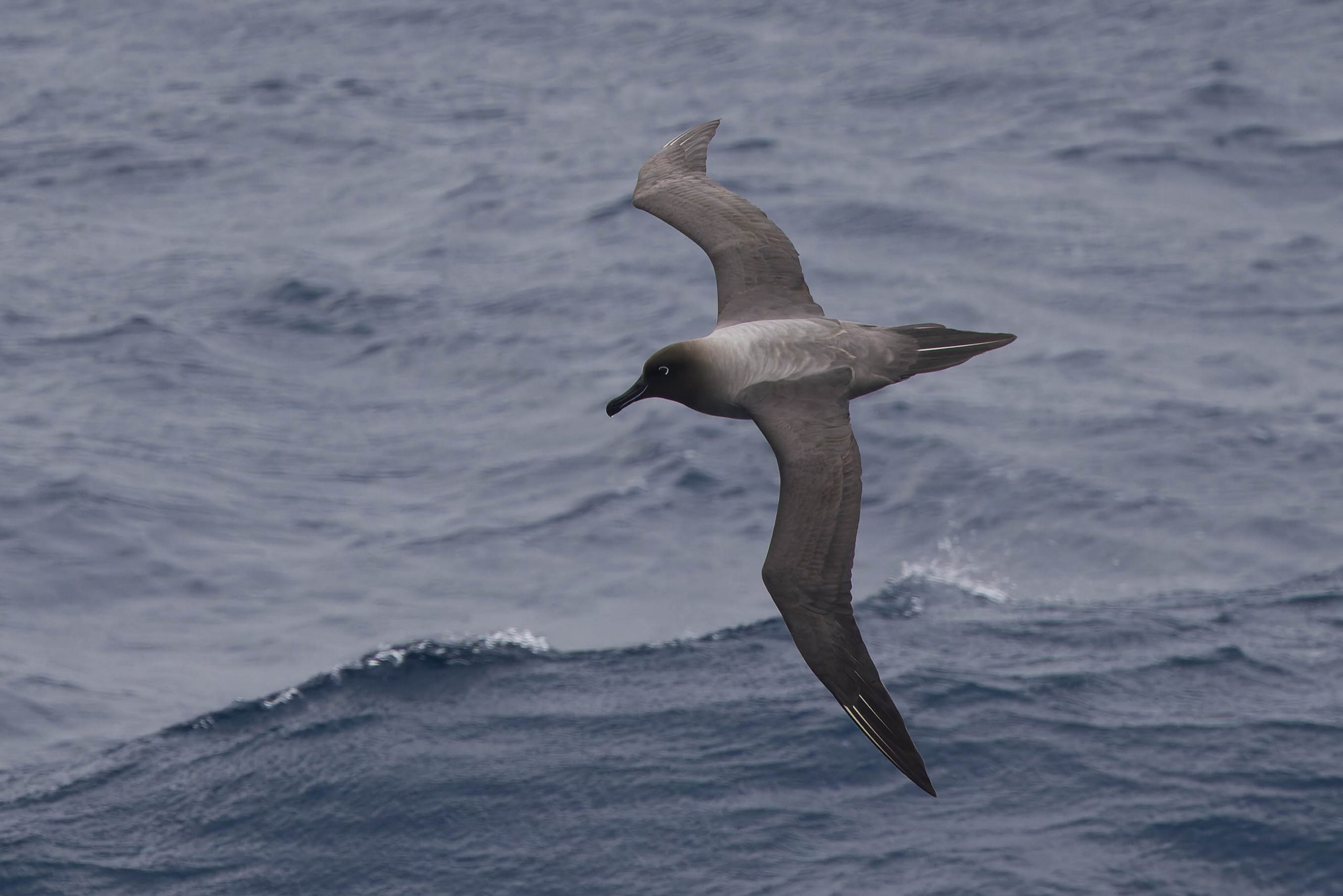
It was cold and gloomy when Andrew, Oscar, Chris and I arrived on the bow at Deck 10, Prince Edward Island dark and mysterious on the horizon. Immediately the air around the front of the ship was thick with albatrosses, criss-crossing our path, sweeping up and across the bow using the air currents generated by the ship. Within a minute or two Andrew called out “Light-mantled!”. Immediately I was battling conflicting emotions as I scanned where Andrew was pointing. This was my most-wanted so of course I wanted to see, it but I was also slightly disappointed that it had not been me to latch on first. LMSA is such a beautiful bird, an all-dark grey/brown albatross with a silvery mantle, white “eye-liner” and a thin blue line of “lip-stick” along the bill. Although similar sized to the mollymawks like Yellow-nosed and Shy (between these two in size in fact), in flight the two sooty albies, Sooty Albatross and Light-mantled Albatross have slimmer and more elegant jizz. The light was poor for photography, but I grabbed some record shots then just enjoyed the spectacle. The experience of being surrounded by these majestic creatures was why we had come on the trip.
Over the course of the day we would see around 5-6 Light-mantled Sooty Albatross, similar numbers of Grey-headed Albatross, 10 Sooty Albatross, and probably 40 Snowy Albatross, though shamefully I concentrated almost all my photographic efforts on the first three species.


After breakfast I wound up even higher on the bow, Deck 14, with Andy and Tom. I picked up a single penguin in the waves ahead of the ship — probably Macaroni — but missed the King Penguins seen by the other two because when the birds appeared below the bow and I was too far towards the centre of the ship to be able to see over.
A Pintado Petrel (formerly Cape Petrel) gave nice views, and we were joined by Giant Petrels, both Southern and Northern and several Salvin’s Prions.


Later I descended to Deck 7, narrowly missing some Gentoo Penguins that surfaced to much excitement just as I arrived on the deck. I could not latch onto these and found that in general seeing “someone else’s” penguins was nigh on impossible: even in a mild swell, trying to find someone else’s bird almost always ended in disappointment. They would pop up as dots in the waves, a cry would go up, but by the time directions had been shouted out or referred down the line of birders, the penguins would almost immediately have sunk back down never to be seen, or be “porpoising” off into the distance, unidentifiable small, black torpedoes.
I realised I would probably have to find some myself by scanning the endless ocean hoping one would pop into view. I did eventually get nice views and even some photos of the commonest, Macaroni Penguin. I perhaps also saw Southern Rock-hopper, but in the water these two species are surprisingly hard to separate, the key differences coming down to bill shape and size, and whether the yellow crests join like a mono-brow (Macaroni), or if they are well separated (Rockhopper). Andy’s sharper eyes — and being right place, right time — bagged him good views of King and Gentoo also. Although I spent much of Day 5 in this mode, with King Penguin my top target for the day, I ended the trip empty-handed. I consoled myself with a self-promise to visit Macquarie or South Georgia or both, where the views would be guaranteed and much, much better.


Other birds noted on the spectacular morning of Day 4 of the trip included Common Diving-petrel, White-chinned Petrel, Brown Skua, more Subantarctic Shearwaters, Black-bellied and Grey-backed Storm-petrels.


Around a hundred Salvin’s Prions (and a single Fairy Prion) were noted in the morning, but these numbers were dwarfed by the literally 1000s of birds in a constant stream, cruising up and down the sides of the vessel during the late afternoon as we rounded the south western side of Marion. The main afternoon excitement came when I locked onto the first White-headed Petrel of the trip. The small group I was with, including Oscar for whom this was one of the few potential lifers on the whole trip, was very excited and we had great views and decent photos. This became a point of status over dinner, because ours was the only group to have seen WHP so far. “Disappointingly” ;-), another bird was seen the next day and did laps up and down the ship, making sure that every punter had seen one and devaluing my self-find.
To avoid the lights on the ship being a distraction to the seabirds, our Captain took us away from the islands as dusk was falling, and we stooged until shortly before daybreak.
Day 5
By the time dawn broke our captain had returned the ship to the “safe” distance of 12 Nm from Marion. The birding remained excellent, with the same array of species as yesterday, especially the albatrosses which continued to wheel around the ship. Disappointingly, despite spending most of the hours available while we were close to the islands scanning back and forth, I again failed to find a King Penguin. Then, as pre-planned, mid-morning the ship did a U-turn and we headed north, commencing the long voyage back to Durban. Only once the islands had receded from view did I returned to the bow, knowing I had almost no further chances of penguins.
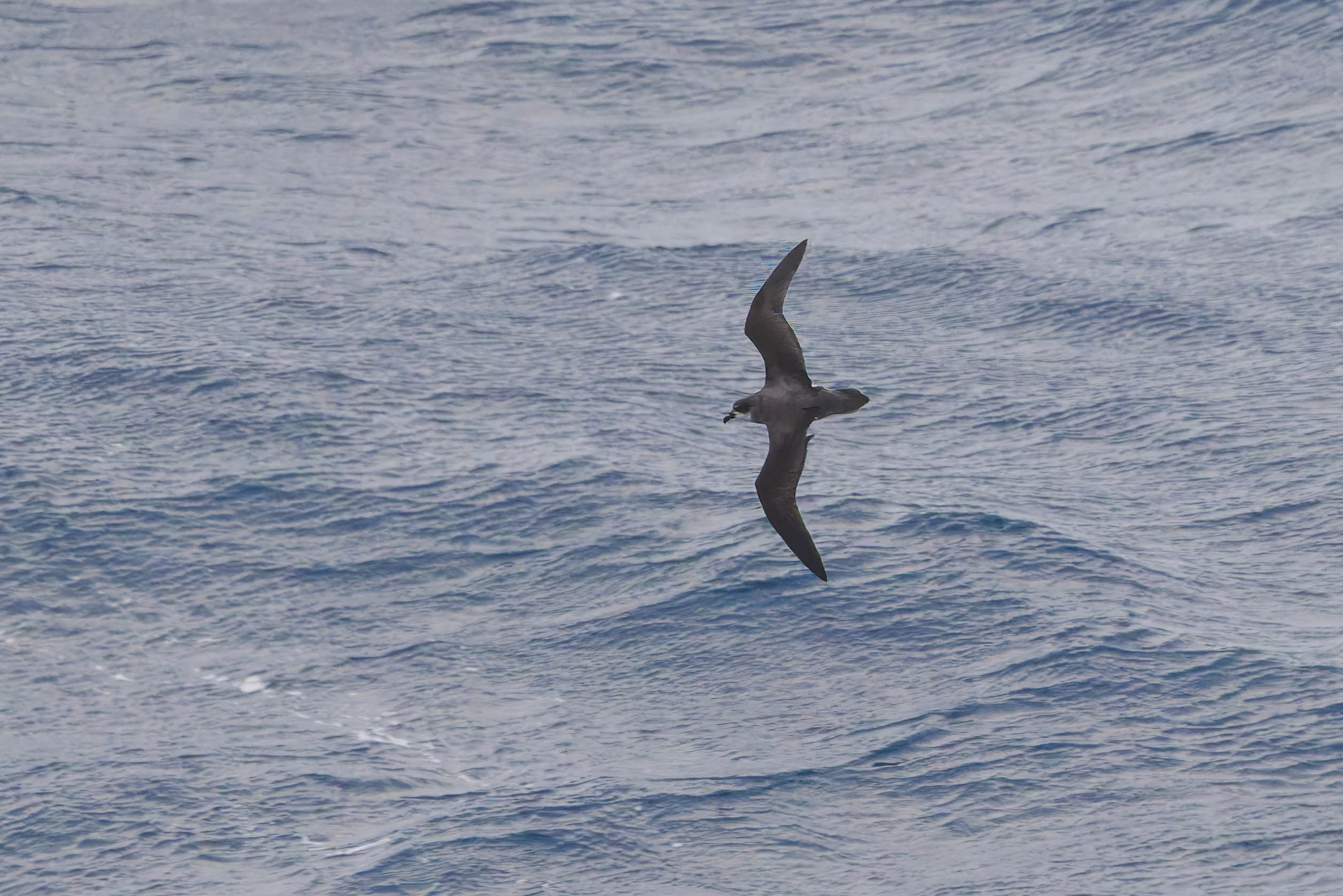
Despite my KP dip, there were still new birds to collect. During the afternoon I noted two new species, both key targets for me, Blue Petrel and Grey Petrel. I wanted to view these birds and dared not take my eye away to go for the camera, but later on with a few Euro-birders we found another Blue Petrel that behaved well enough for so decent record shots. Andy was the only one to get a shot of the Grey Petrel. It’s a 1-star ebird shot, certain never to win any photographic awards (though maybe it’s a hard positive that will help train Merlin’s deep learning), but at least he got it! Pterodromas were to the fore, with a White-headed Petrel and regular Soft-plumaged Petrels. A few Fairy Prions were noted amongst the dozens of Salvin’s


I joined the UAE-crew for beers and negronis in the lounge after dinner where I eavesdropped on birding tales from “the good old days” like I was in the audience during Monty Python’s “Four Yorkshiremen”. How much was true? About 5% was one estimate I heard 🤫😜🤣.
Day 6
The following morning, there were still some prions hanging around the ship and as Tom, Andy and I were photographing some very close Salvin’s Prions, one particular bird got us quite excited: compared with the 1000s we had already seen, the facial markings and shape seemed stronger (especially the wavy gape line connecting all the way back, the very steep forehead, square and bulging), and the bill broader. We got excellent photos, but the unanimous reaction of the experienced experts was: “very interesting bird, but the bill not broad or dark enough for Broad-billed Prion”. Maybe MacGillivray’s still in play, but seems unlikely on the basis of rarity.


As the avian diversity dropped through the “dead” zone, the main excitement reverted to cetaceans rather than birds. Some people had Long-tailed Skuas (I saw these birds but they were too distant for me to get anything on them other than to conclude they were skuas), and otherwise it was back to the three “staples” of the sub-tropical desert, Great-winged Petrel, Cory’s Shearwater and Tropical Shearwater. The cloud abruptly cleared, and late in the day we joined the other 1900 birders on the pool-deck for a group photo.


We arrived back into Durban the following morning. There was time for a final excellent breakfast, and even time for a lifer for me — just as we were called for our group’s disembarkation, Oscar (who had been birding every hour of every day when there was any light), picked up a Lanner Falcon perched on a crane in the port. I had time to sneak onto the back deck and peer though someone else’s scope before heading off, and collecting my bags. By this time I had already bidden farewell to Tom and Andy, since they had to go straight to the airport for their flight back to England. I regrouped with Oscar, Andrew and Chris, and we shared a taxi back to uMhlanga where we picked up a rental car and headed off inland for some more birding. Although I had missed the pre-cruise birding with Oscar and Andrew, I had the weekend at my disposal, and the the offer to join this group of excellent, experienced and sharp-eyed birders was too good to turn down. We had two days and one night, and in that short time I picked up more than 40 lifers, including a strong selection of A-listers. But that will have to be the subject of a separate blog post.
And just to round it out, here’s some more of the 5000 or so pictures I took on the trip 😉